


History Says This Will Happen to Palantir Stock by 2028
Key Points
Palantir faces rising competition from AI labs.
Its price-to-sales ratio of 81 is a steep premium to the valuations that the market affords most software companies.
- 10 stocks we like better than Palantir Technologies ›
Palantir (NASDAQ: PLTR) has been an incredible stock to own over the past few years. It has become one of the most prominent AI companies in the country, and a host of companies and government agencies make use of its services. It has grown its sales at an incredible pace over the past few years, and its stock has soared as a result.
However, there's one overarching question: Has Palantir's stock gotten ahead of itself? I think history offers a pretty strong indication about the answer, and it's not one that Palantir shareholders will be happy to hear.
Missed AI’s "Act 1"? Act 2 Could Be 15x Bigger. Most investors think they missed the AI boat because they didn't buy Nvidia in 2005. But according to our analysts, we’re only at the end of "Act 1"—the R&D phase. "Act 2" is the global rollout. Continue »
Image source: The Motley Fool.
Competition is rising
Palantir made a name for itself by offering its customers a fairly easy plug-and-play AI software. Essentially, clients can easily deploy Palantir's AI-powered analytics tool to mine their internal data for useful insights. The early iterations of its software were intended for government use, but eventually, the company found its way into the commercial marketplace. The combination of government and commercial AI has been a powerful one for Palantir, but it isn't the only game in town anymore.
Rising stars like Anthropic and OpenAI also have great AI products that companies can use, and these products could become more popular than Palantir's, which could result in its growth slowing.
Wall Street analysts are already projecting just that. The consensus view is that Palantir will report that it grew by 84% in Q3, and that it will further slow to 75% in Q4, compared to 93% in Q2. Next year, the projected growth rate declines to 50%.
If that happens, the stock could be in trouble, as there is a ton of hoped-for growth already baked into the stock. However, Wall Street has been consistently wrong on its Palantir projections, as its growth rate has continued to accelerate quarter after quarter, even though the company's own projections also indicated it would slow.
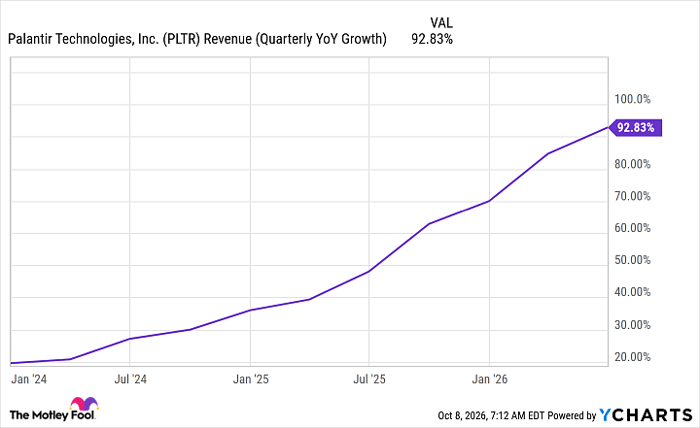
PLTR Revenue (Quarterly YoY Growth) data by YCharts.
Yet as more companies become comfortable deploying AI tools from giants like OpenAI and Anthropic, this may pose a sizable headwind for Palantir, since most of its platforms' capabilities can be recreated for far less than it charges for a subscription.
That wouldn't be great for the stock, and history has nearly countless examples of innovators that started as disruptors before being disrupted themselves. The main problem for Palantir's stock is that it's priced like the company has no competition.
Palantir's stock is pricey
From a price-to-sales ratio standpoint, Palantir is very expensive at 81.
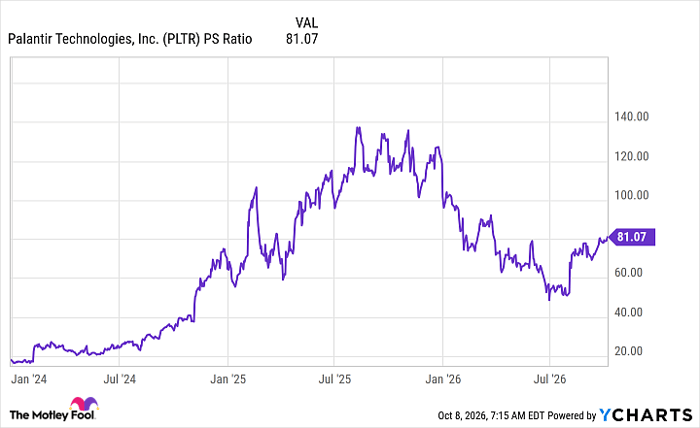
PLTR PS Ratio data by YCharts
Generally speaking, software stocks are considered expensive when they trade above 20 or 30 times sales, let alone triple or quadruple that level. For comparison, AI lab Anthropic is expected to go public with a market cap of about $2 trillion sometime in November. Back in July, Anthropic told investors that its annual run rate would be about $65 billion. If the market were willing to put a P/S valuation of 81 on Anthropic, that would give it an IPO market cap of $5.3 trillion.
As a group, companies that reach such high price-to-sales multiples have a terrible track record of long-term share price performance in the years that follow, as there is a lot of anticipated growth already priced into the stock. Even if Palantir can continue growing rapidly, its stock will spend a lot of time absorbing that growth while trading sideways to bring its valuation down to a more reasonable level. Or, it could be disrupted by one of the growing AI labs such as Anthropic or OpenAI, in which case the market could respond by selling it off. As a result, I think investors can expect lackluster returns from Palantir through 2028.
Should you buy stock in Palantir Technologies right now?
Before you buy stock in Palantir Technologies, consider this:
The Motley Fool Stock Advisor analyst team just identified what they believe are the 10 best stocks for investors to buy now… and Palantir Technologies wasn’t one of them. The 10 stocks that made the cut could produce monster returns in the coming years.
Consider when Netflix made this list on December 17, 2004... if you invested $1,000 at the time of our recommendation, you’d have $379,123!* Or when Nvidia made this list on April 15, 2005... if you invested $1,000 at the time of our recommendation, you’d have $1,408,822!*
Now, it’s worth noting Stock Advisor’s total average return is 950% — a market-crushing outperformance compared to 215% for the S&P 500. Don't miss the latest top 10 list, available with Stock Advisor, and join an investing community built by individual investors for individual investors.
See the 10 stocks »
*Stock Advisor returns as of October 11, 2026.
Keithen Drury has no position in any of the stocks mentioned. The Motley Fool has positions in and recommends Palantir Technologies. The Motley Fool has a disclosure policy.
Recommended Articles


