


Joby Just Flew an Aircraft Across the United States With No Pilot. Here's Why Wall Street Shrugged.
Key Points
Joby completed a 3,199-mile autonomous flight with zero pilot inputs.
Autonomous aviation could unlock major defense and logistics opportunities.
Joby still faces certification, manufacturing, and profitability hurdles.
- 10 stocks we like better than Joby Aviation ›
Joby Aviation (NYSE: JOBY) just accomplished something pretty spectacular. An aircraft equipped with Joby's autonomous flight technology traveled 3,199 miles across the United States without a human pilot touching the controls.
The converted Cessna Caravan taxied, took off, navigated across the country, avoided bad weather, and landed autonomously. To clarify, a safety pilot was onboard, but Joby says that the pilot made zero control inputs during the entire journey. That's a big deal.
Missed AI’s "Act 1"? Act 2 Could Be 15x Bigger. Most investors think they missed the AI boat because they didn't buy Nvidia in 2005. But according to our analysts, we’re only at the end of "Act 1"—the R&D phase. "Act 2" is the global rollout. Continue »
The aircraft wasn't just circling a controlled test facility, either. It traveled from California to North Carolina, operated at multiple airports, navigated real-world airspace, and was remotely supervised from locations as far as 2,323 miles away. Joby says it's the first autonomous flight across the United States.
Wall Street's response? Joby stock actually fell about 1% on Sept. 18, the day the company announced the achievement.
Why this flight actually matters
Most investors know Joby for its electric vertical take-off and landing (eVTOL) air taxi. But the company is actively building another business around autonomous aviation. Joby's technology can be integrated into different aircraft and used for cargo transport, medical deliveries, disaster response, and military logistics. In fact, Joby's autonomous system has already accumulated more than 800 automated flight hours across 400 flights and participated in major U.S. military exercises.
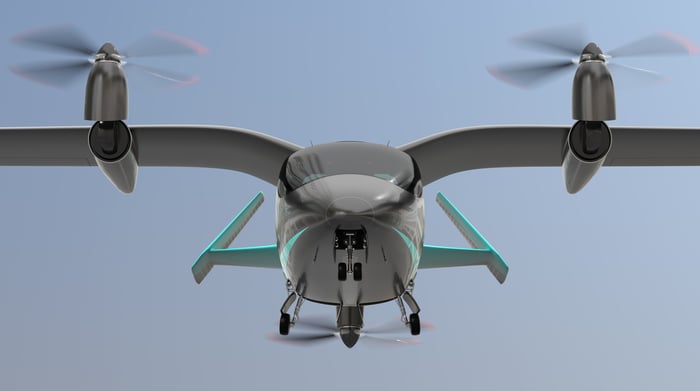
Image source: Getty Images.
In one Air Force exercise, Joby's autonomous aircraft delivered critical replacement parts that allowed other aircraft to return to service roughly 24 hours sooner than conventional logistics would have allowed. The company also acquired autonomy technology through its 2024 purchase of Xwing's autonomy division and has since expanded its defense ambitions.
So why didn't the stock take off?
Joby still has much bigger questions to answer. The company is spending heavily as it works toward Federal Aviation Administration (FAA) certification and commercial production of its electric air taxi. In the second quarter, Joby reported $38.6 million in revenue, but a $245.4 million net loss. It used $202 million of cash, cash equivalents, and short-term investments during the quarter.
The good news is that Joby ended June with about $2.3 billion in cash and short-term investments, giving it substantial financial firepower to keep developing its technology. But the market isn't valuing Joby based on whether an autonomous Cessna can fly across America. It's waiting to see whether Joby can turn its technology into a large commercial business.
That means FAA certification. It means manufacturing aircraft at scale. It means launching commercial air taxi operations. It also increasingly means proving there's a profitable business in autonomous aviation and defense.
The cross-country flight didn't answer those questions, but it did prove something significant: Joby's autonomous flight technology can operate thousands of miles across real-world airspace without a pilot taking control. Wall Street may have shrugged, but the technology didn't.
Should you buy stock in Joby Aviation right now?
Before you buy stock in Joby Aviation, consider this:
The Motley Fool Stock Advisor analyst team just identified what they believe are the 10 best stocks for investors to buy now… and Joby Aviation wasn’t one of them. The 10 stocks that made the cut could produce monster returns in the coming years.
Consider when Netflix made this list on December 17, 2004... if you invested $1,000 at the time of our recommendation, you’d have $379,123!* Or when Nvidia made this list on April 15, 2005... if you invested $1,000 at the time of our recommendation, you’d have $1,408,822!*
Now, it’s worth noting Stock Advisor’s total average return is 950% — a market-crushing outperformance compared to 215% for the S&P 500. Don't miss the latest top 10 list, available with Stock Advisor, and join an investing community built by individual investors for individual investors.
See the 10 stocks »
*Stock Advisor returns as of October 10, 2026.
Jeff Siegel has no position in any of the stocks mentioned. The Motley Fool has no position in any of the stocks mentioned. The Motley Fool has a disclosure policy.
Recommended Articles


