


As the Stock Market Eerily Repeats a Pattern Not Seen Since 2000, Warren Buffett Has a Blunt Message for Investors
Key Points
Stocks have climbed to lofty valuations recently, and Warren Buffett is concerned.
In 1999, Buffett warned against speculating in tech stocks, which he saw as overrunning fundamentals.
Buffett's words remind investors today to be selective and sharp-sighted.
- 10 stocks we like better than S&P 500 Index ›
When you look at the stock market today, you might get an eerie sense of déjú vu.
A radical new technology is capturing investors' imaginations, capital is pouring into companies Wall Street believes will dominate, and valuations are climbing to levels that seemed unthinkable only a few years before. If you thought I was describing today's artificial intelligence (AI) bull market, it might surprise you to learn that I actually have the dot-com era in mind.
Missed AI’s "Act 1"? Act 2 Could Be 15x Bigger. Most investors think they missed the AI boat because they didn't buy Nvidia in 2005. But according to our analysts, we’re only at the end of "Act 1"—the R&D phase. "Act 2" is the global rollout. Continue »
Indeed, there are several parallels between today's market and the dot-com era, one of which involves an investing legend who lived through both and stayed at the top of his game.
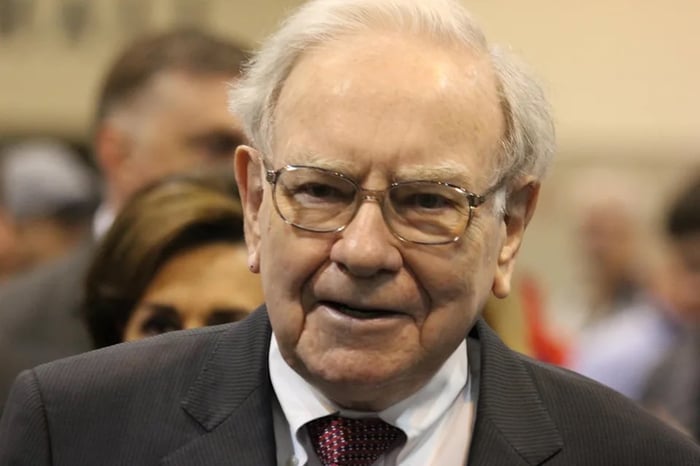
Warren Buffett. Image source: The Motley Fool.
Warren Buffett delivers a blunt warning to investors like it's 1999 again
Imagine it's September 1999, and the S&P 500 (SNPINDEX: ^GSPC) is roaring. Internet stocks are all the rage, with anything ".com" generating investor enthusiasm. The Nasdaq (NASDAQINDEX: ^IXIC) is racing toward its infamous peak, when, amid all that excitement, Warren Buffett delivers some sobering words.
As originally reported by Fortune, with editorial review by Buffett himself, the Oracle of Omaha told a group of friends that investors were expecting "far too much" from stocks. In essence, he was worried that investors were making a huge leap from "the internet is a revolutionary technology," which Buffett himself believed, to "internet companies will make me rich," which Buffett thought was far less certain.
As he put it:
Perhaps you are an optimist who believes that though investors as a whole may slog along, you yourself will be a winner. That thought might be particularly seductive in these early days of the information revolution (which I wholeheartedly believe in). Just pick the obvious winners, your broker will tell you, and ride the wave.
As it turned out, Buffett's words were wiser and more prescient than anyone would have expected, as many of that era's hottest internet stocks eventually collapsed when the dot-com bubble burst.
Fast forward nearly 27 years, and Buffett seems to recognize something similar in today's market. In May 2026, he likened the stock market to a "church with a casino attached," in which everyone prefers "gambling" to finding value. A few months later, he put the problem even more bluntly: "It's tough to find value when everybody is preferring gambling."
In both the dot-com era and today's market, Buffett makes a similar point: Excessive speculation makes it increasingly difficult to distinguish long-term winners from losers.
The market is flashing another dot-com era warning
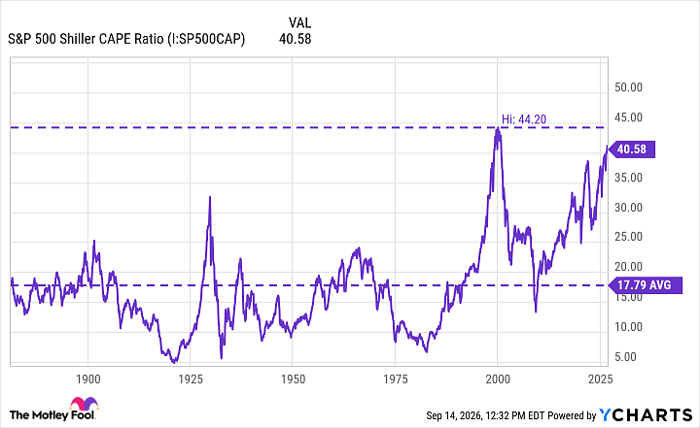
Buffett's words aren't the only thing connecting today's market with the dot-com era. Indeed, by one important valuation measure, the stock market has once again climbed into territory last seen around the turn of the millennium.
Data by YCharts
These are different readings of the Shiller CAPE Ratio, a popular valuation metric. The Shiller CAPE, in a nutshell, averages the last decade of inflation-adjusted earnings to smooth out unusually good or bad years, then compares that average with today's stock prices. The higher the Shiller CAPE, the more expensive the market is relative to its historical earnings.
For the first time since 1999, the CAPE has crossed the 40 mark, making this one of the most expensive markets ever. If history tells us anything, lofty valuations like this have often been followed by sharp declines.
That doesn't mean sell everything and wait for a market crash. The CAPE isn't particularly useful for predicting crashes, and expensive markets can stay expensive for many years. And timing the market usually doesn't end well for investors, who often sell too soon or too late and typically feel regretful either way.
What it means for investors today goes back to Buffett's words. An expensive market suggests that investors should lower expectations and become more selective about what they're willing to buy. It's true that a revolutionary technology can create enormous wealth. What's not true, however, is that every company attached to it is a good investment.
Rather than chasing whatever has connections to AI, investors would be better served looking for healthy businesses, reasonable valuations, and durable earnings. In today's lofty market, I think that is the wisest, most Buffett-like way to invest.
Should you buy stock in S&P 500 Index right now?
Before you buy stock in S&P 500 Index, consider this:
The Motley Fool Stock Advisor analyst team just identified what they believe are the 10 best stocks for investors to buy now… and S&P 500 Index wasn’t one of them. The 10 stocks that made the cut could produce monster returns in the coming years.
Consider when Netflix made this list on December 17, 2004... if you invested $1,000 at the time of our recommendation, you’d have $420,109!* Or when Nvidia made this list on April 15, 2005... if you invested $1,000 at the time of our recommendation, you’d have $1,303,689!*
Now, it’s worth noting Stock Advisor’s total average return is 938% — a market-crushing outperformance compared to 211% for the S&P 500. Don't miss the latest top 10 list, available with Stock Advisor, and join an investing community built by individual investors for individual investors.
See the 10 stocks »
*Stock Advisor returns as of September 17, 2026.
Steven Porrello has no position in any of the stocks mentioned. The Motley Fool has no position in any of the stocks mentioned. The Motley Fool has a disclosure policy.
Recommended Articles


