


Intel Stock Surges 9% as High-NA EUV Breakthrough Puts $106 in Focus
TradingKey - Intel closes September 8 at $104.47, which is only slightly higher than the referenced chart at $104.45. This looks even better from the viewpoint of Intel’s technical moves. The stock performance of 9.05% was supported by the disclosure from Intel and ASML. High-NA EUV is in use for high-volume manufacturing and has been used to process more than one million wafers in certification, R&D and some production layers. Intels newfound catalyst supports current foundry demand. In addition, higher demand for AI servers and the company’s improved pricing position supports the operating story.
High-NA EUV Is the Freshest Foundry Catalyst
Intel Foundry and ASML said High-NA EUV is already in use for high-volume manufacturing for selected production layers for a subset of Intel Core Ultra Series 3 processors, code-named Panther Lake. Intel said overlay, throughput and equipment availability are as expected and said that High-NA for selected layers in Intel 18A are as expected or better compared to layers processed with conventional EUV.
This is important because Intel’s roadmap for continued process leadership has taken much of the focus to support the company’s turnaround plan. High-NA deployment in production brings a segment of that plan to manufacturing, at a minimum.
Reuters noted that Intel is in a more advanced state of High-NA deployment than TSMC and Samsung. It is expected that competitors will begin to increase deployment in the future which reduces Intel’s relative advantage. However, it is still important to secure external foundry customers to provide a material difference in foundry revenue.
AI Server Demand Is Reviving the CPU Business
Intal’s Q2 report showed improved demand, and revenue for the quarter reached $16.1 billion, a 25% increase over the previous year. The Data Center and AI segment also benefited from stronger Xeon demand within AI infrastructure markets.
The most relevant information is that AI systems still rely on standard CPUs for systems integration (orchestration), storage, databases, networking, and other agentic workloads, even if the AI acceleration is performed by an NVIDIA or another vendor accelerator. Therefore, Intel’s business strategy does not require them to compete against the other companies in the stand-alone AI-GPU markets to benefit from the buildout of the data centers.
As for the guidance for Q3, it will stay as planned at $15.8 billion - $16.8 billion. There have not been any changes to the company’s financial guidance since the July 23 earnings release.
Pricing Power Is Becoming Part of the Story
MarketWatch reported on Intel shares also benefiting from an upgrade and reports that the company could increase prices for PC CPUs by approximately 10% in October, while decreasing the focus in less profitable areas.
The price increases have not been made official by Intel, and as stated before, I would not consider them to be official. However, considering the nature of the investor reactions, it is clear that restoring profits by using AI-linked demand and strengthened constraints on supply is convincing more and more investors that the gap in pricing can finally be restored.
Balance-Sheet Flexibility Has Improved, but Dilution Is Real
The financial landscape has also changed as a result of Intel’s equity raise in August. The company valued 210.5 million shares at $95 per share, and the underwriters exercised their option in full for an additional 31.6 million shares on August 11. Intel’s prospectus stated that exercising this call option in its entirety would bring net proceeds of around $22.62 billion.
This provides more financial flexibility for Intel to invest in foundry equipment, clean room capacity, and advanced manufacturing. Like most capital raises, there’s significant dilution. Capital raised only entitles Intel to long -term value if they can ultimately provide healthy returns on cash spent and attract external foundry customers.
14A Still Has to Win External Customers
The technology is moving in the right direction, but 14A is the bigger long -term risk. Intel has to attract a significant amount of external wafer demand to support the foundry business.
An excellent process will not solve the problem. Large customers that are willing to produce on Intel’s process, leading to a significant shift away from TSMC or Samsung, will be a very long execution risk.
Intel Technical Analysis: $106.10 Is the Next Breakout Test
On 8 September, Intel (INTC) closed at $104.47, equaling the chart’s $104.45 reference, having broken above a long-term descending trendline along with $101.31-$101.32 resistance. The strength of the breakout candle after the retrace from $85.82 confirms an aggressive shift in the short-term structure.
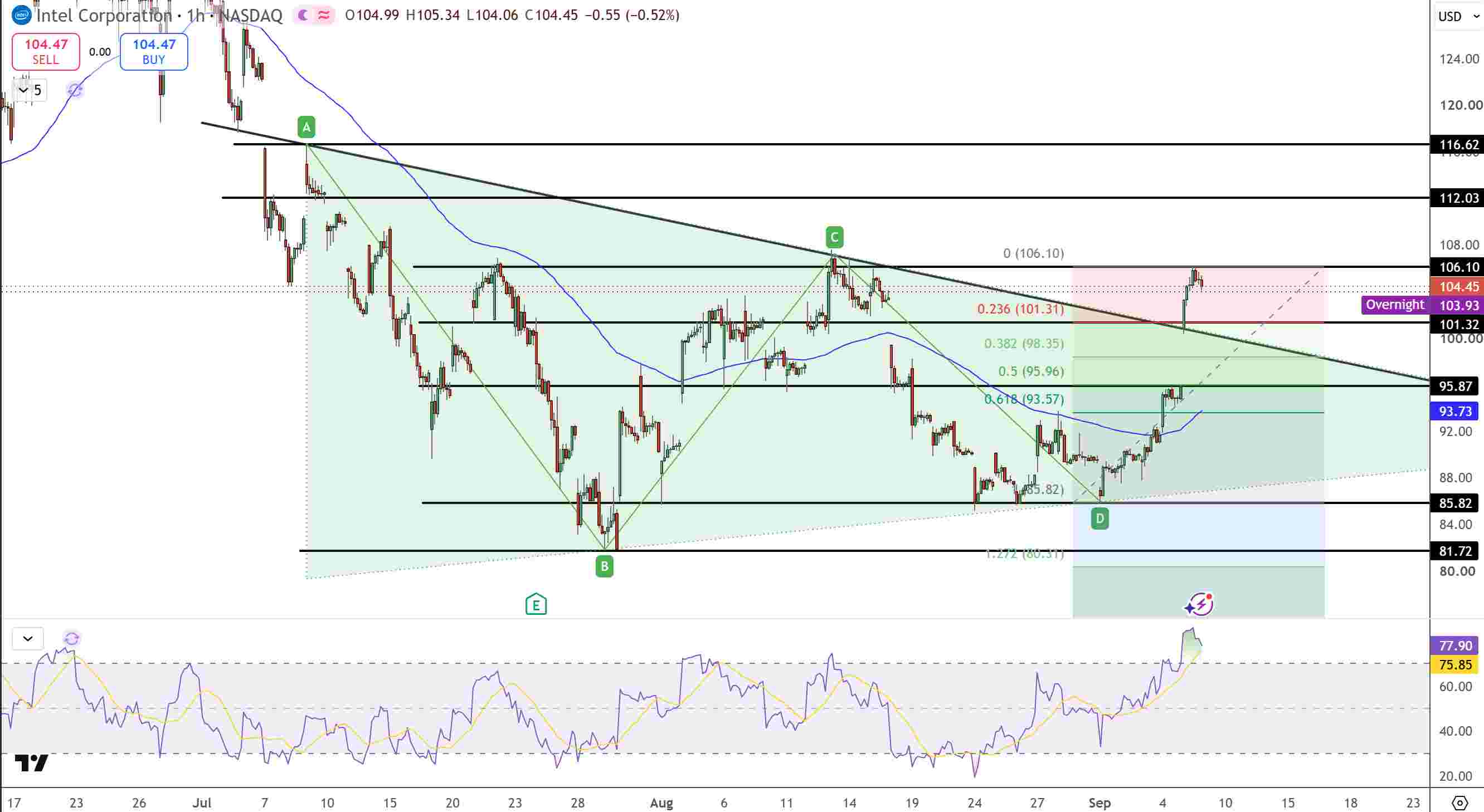
Intel Stock Price Chart - Source: Tradingview
The first significant hurdle is $106.10. A sustained hourly close above this level would strengthen the bullish reversal and would expose $112.03 and subsequently $116.62.
RSI at 78 is above the 70 overbought level and also above its lagging line, which is around 76. Hence, momentum clearly favors the buyer, but the Candlestick structure is stretched enough to expect some consolidation or a pullback. If it occurs, $101.31-$101.32 would be the key breakout support. A break below that would expose $98.35 and subsequently $95.87-$95.96 as the next support zones, with the moving average around $93.73 being deeper support.
What makes Intel Stock interesting?
Intel’s rally is attributed to strong demand for AI-Servers, higher pricing power, a High-NA EUV manufacturing milestone, and improvements in balance sheet flexibility.
What level indicates a further bullish move in INTC?
A confirmation for an aggressive bullish target above $106.10 would be a sustained hourly close above this level. This would then expose highs of $112.03 and $116.62.
Bottomline
Intel’s September 9 setup is more compelling than the old recovery story. The production process and milestones involved in the foundry thesis now provide the foundations for this new story. High NA EUV is already in manufacturing. Demand for servers remains strong. Intel’s balance-sheet flexibility has improved and more capital is available to execute on the foundry strategy. There are multiple risks, including competition, customer adoption of 14A and significant dilution. I am still Bullish above $101.31 and view $106.10 as the level of resistance. This is the price that must be breached to confirm the leg is extended to the range of $112-$117.
Recommended Articles


