


Warren Buffett Says This Move Is the Key to Surviving a Stock Market Crash. Here's What History Says Comes Next
Key Points
The generative AI boom has many characteristics of a speculative bubble.
Buffett successfully navigated a similar crisis in the early 2000s.
The Oracle of Omaha has important lessons for investors today.
- 10 stocks we like better than S&P 500 Index ›
Warren Buffett is considered one of the most successful investors in history. And his holding company, Berkshire Hathaway, has returned a jaw-dropping 5,502,284% from 1965 to 2024, trouncing the S&P 500's 39,054% gain over the same period. He pulled this off by focusing on value and lasting advantages instead of chasing the latest trends.
Let's explore how Buffett's investing philosophy can help investors navigate the near-term uncertainties like the generative artificial intelligence (AI) boom -- an investing megatrend that just might be the next financial bubble.
Missed Nvidia in 2009? This Rare Signal Is Flashing Again. In 2009, a "Double Down" signal flashed for a little-known chipmaker called Nvidia. For the first time in years, that same "Total Conviction" signal is flashing for a company 1/100th the size of Nvidia. Continue »
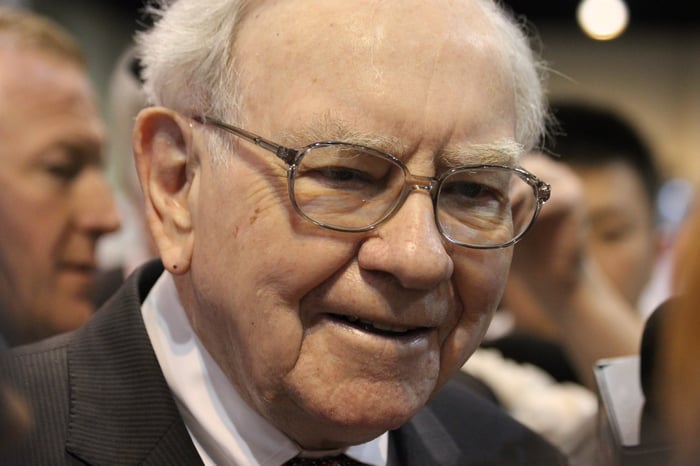
Former Berkshire Hathaway CEO Warren Buffett. Image source: The Motley Fool.
Stocks now trade near record highs
The early 2020s will go down in history as a fantastic time to be a stock market investor. The U.S. economy rebounded sharply after the devastation of the COVID-19 pandemic, and equity prices quickly followed suit, with the S&P 500 up 70% over the last five years. Much of this growth can be credited to tech companies, which provide the chips and infrastructure used to train and run large language models (LLMs).
The situation has been compared to the dot-com bubble, which occurred over 25 years ago. But while there are parallels, the situation is not exactly the same. The previous boom was driven by speculative, highly unprofitable internet stocks with extreme valuations, whereas this boom has so far been led by stable, established giants with strong fundamentals.
That said, bubbles almost always occur when investors assume "this time will be different." And it pays to pay close attention to how top investors navigated the previous tech bubble to avoid falling victim to the next one.
What can Warren Buffett teach us?
During a 1999 interview with Fortune, Buffett shared his opinions about the market at the height of the dot-com bubble, stating:
The key to investing is not assessing how much an industry is going to affect society, or how much it will grow, but rather determining the competitive advantage of any given company and, above all, the durability of that advantage. The products or services that have wide, sustainable moats around them are the ones that deliver rewards to investors.
These remarks are highly relevant to the current situation with AI stocks. On the surface, it can be difficult to see what similarities modern, profitable giants could have with the highly speculative internet stocks that crashed over two decades ago. But even seemingly unstoppable companies can eventually face challenges to their economic moats as the AI industry matures.
Micron Technology is perhaps the best example. The company has recently seen its revenue and margins soar amid soaring demand for its advanced memory products for data centers. And this mirrors a similar boom it enjoyed in the 1990s and 2000s, when there was elevated demand for its memory hardware for PCs. Eventually, demand cooled and supply caught up, leading to a sustained crash in Micron's profitability and stock price.
Buffett's investing philosophy suggests this boom-and-bust cycle could happen again due to weak economic moats in the memory industry. These products are commoditized, meaning Micron's chips can be easily replaced with those created by Samsung Electronics or SK Hynix. Furthermore, new Chinese entrants such as CMXT aim to mass-produce high bandwidth memory, raising the possibility of a supply glut in the future.
Investors should focus on sustainable moats
The AI industry is generating plenty of near-term winners. But not all of these companies will have what it takes to sustain their gains over the coming years and decades. With this in mind, it makes sense for investors to follow Warren Buffett's advice to evaluate stocks based on the strength of their economic moats instead of their explosive growth right now.
Should you buy stock in S&P 500 Index right now?
Before you buy stock in S&P 500 Index, consider this:
The Motley Fool Stock Advisor analyst team just identified what they believe are the 10 best stocks for investors to buy now… and S&P 500 Index wasn’t one of them. The 10 stocks that made the cut could produce monster returns in the coming years.
Consider when Netflix made this list on December 17, 2004... if you invested $1,000 at the time of our recommendation, you’d have $421,997!* Or when Nvidia made this list on April 15, 2005... if you invested $1,000 at the time of our recommendation, you’d have $1,413,876!*
Now, it’s worth noting Stock Advisor’s total average return is 978% — a market-crushing outperformance compared to 213% for the S&P 500. Don't miss the latest top 10 list, available with Stock Advisor, and join an investing community built by individual investors for individual investors.
See the 10 stocks »
*Stock Advisor returns as of September 8, 2026.
Will Ebiefung has no position in any of the stocks mentioned. The Motley Fool has positions in and recommends Berkshire Hathaway and Micron Technology. The Motley Fool has a disclosure policy.
Recommended Articles


