


Robinhood Stock Forecast: First Foray Into IPO Underwriting, Can HOOD Stock Surge to a Peak of $153?
TradingKey - Robinhood Enters IPO Underwriting for the First Time: Can Its Stock Price Surge to an All-Time High of $153?
According to a report by The Wall Street Journal on September 7, Robinhood (HOOD) serves as an underwriter for smart ring maker Oura, marking Robinhood's first participation in IPO underwriting and officially launching its lucrative investment banking business. It is reported that Robinhood was officially approved to become an IPO underwriter in June this year, signifying its transition from a retail brokerage into a comprehensive institutional-grade financial ecosystem. However, can this transition drive Robinhood's stock price to continue rising to challenge its all-time high?
In the past, Robinhood could only distribute a small amount of new shares to retail investors through traditional investment banks, resulting in limited profit margins and allocations controlled by others. Now, after gaining underwriting qualifications, Robinhood can directly collaborate with companies planning to go public, earning higher-margin underwriting service fees and securing more high-quality IPO allocations for retail investors on its platform.
Robinhood's IPO underwriting revenue is constrained not only by the overall IPO market but also by its own influence. Investment banking is highly dependent on the macroeconomic environment. If U.S. tech and unicorn IPOs experience a boom, the underwriting business will generate explosive non-trading revenue; if the market turns bearish, a freeze in IPO activity will drag down performance. Over the past two years, the U.S. IPO market was in a slump, but it is currently showing signs of recovery and rapidly heating up.
However, Robinhood's influence at the current stage remains very limited, and the revenue derived from it may be quite constrained. It is reported that 18 institutions, including Goldman Sachs, Morgan Stanley, and JPMorgan Chase, are participating in the Oura IPO, with Robinhood ranking last. In response, Georgetown University finance professor Reena Aggarwal stated, 'Robinhood's initial influence on the IPO underwriting market remains limited.'
IPO underwriting qualifications are a powerful tool to raise Robinhood's valuation ceiling, but its core revenue still relies on cryptocurrency trading volume, interest income, and the continuous expansion of user assets, making a significant short-term impact on its stock price unlikely. During overnight trading on September 8, Robinhood rose less than 1%, trading at $123.
Recently, Robinhood's DeFi TVL has continued to rise, briefly surpassing $900 million and driving a sustained rebound in its stock price. Having now broken through the strong Fibonacci 0.618 resistance level (corresponding to $120), the stock is expected to continue advancing toward around $135, the final key hurdle for a trend reversal. If it breaks through this level, a run toward its all-time high of $153 by year-end is highly probable.
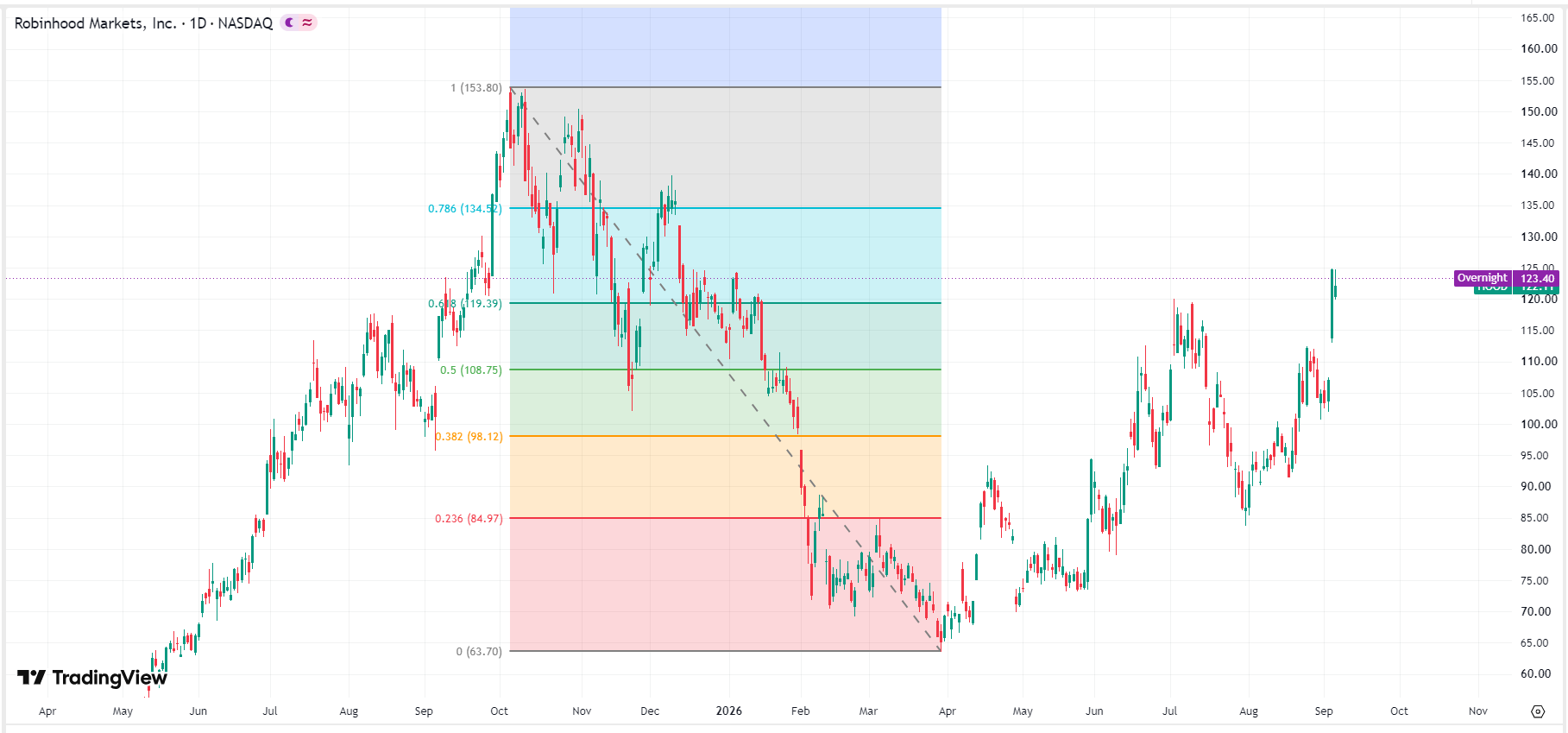 Robinhood stock price chart, Source: TradingView
Recommended Articles


