


US Stocks Closed All Day Today for Labor Day: What Investors Need to Know
TradingKey - Monday, September 7 (ET), is Labor Day in the US, and US stock markets will be closed for the full day. Both equity and options markets on the New York Stock Exchange and Nasdaq will be closed. US stock trading will resume as normal on Tuesday, September 8, with regular trading hours starting at 9:30 a.m. ET.
US Markets Closed: What Are the Other Market Holidays in 2026?
Labor Day is the eighth full-day closure for US stocks in 2026. According to the official NYSE and Nasdaq trading calendars, there are 10 full-day market holidays and 2 early close days for US stocks in 2026. Details are as follows:
Date | Holiday | US Stock Market Schedule |
January 1 (Thursday) | New Year's Day | Closed all day |
January 19 (Monday) | Martin Luther King Jr. Day | Closed all day |
February 16 (Monday) | Presidents' Day | Closed all day |
April 3 (Friday) | Good Friday | Closed all day |
May 25 (Monday) | Memorial Day | Closed all day |
June 19 (Friday) | Juneteenth | Closed all day |
July 3 (Friday) | Independence Day (Observed) | Closed all day |
September 7 (Monday) | Labor Day | Closed all day |
November 26 (Thursday) | Thanksgiving Day | Closed all day |
November 27 (Friday) | Day after Thanksgiving | Early close at 13:00 |
December 24 (Thursday) | Christmas Eve | Early close at 13:00 |
December 25 (Friday) | Christmas Day | Closed all day |
After Labor Day, the next full-day closure is Thanksgiving Day on November 26, followed by November 27, when US stocks will close early at 1:00 p.m. ET.
Not Just US Stocks, US Bond Market and Canadian Stocks Are Also Closed
U.S. fixed-income markets will also be affected on Labor Day. The Securities Industry and Financial Markets Association (SIFMA) recommends a full-day closure for U.S. dollar-denominated fixed-income securities markets, covering major products such as U.S. Treasuries, mortgage-backed securities, corporate bonds, and municipal bonds.
Major Canadian securities markets will also be closed for Labor Day, including the Toronto Stock Exchange (TSX), and all are scheduled to resume trading on Tuesday.
It should be noted that the closure of U.S. stock markets does not mean all financial products will cease trading for the entire day. Trading will continue for select equity index, energy, and precious metals futures, albeit under a shortened Labor Day schedule. Investors holding relevant positions should refer to the holiday trading hours for the corresponding contracts on exchanges such as the CME and ICE.
Market Closure May Reduce North American Session Liquidity
Due to the absence of U.S. stock and bond markets, overall market liquidity during the North American trading session over Labor Day is typically lower than on a normal trading day.
Gold, crude oil, forex, and certain stock index futures may still experience volatility, but reduced market participation could heighten the risk of price jumps and execution slippage. Therefore, short-term price movements occurring during the holiday should be interpreted with caution and should not be taken simply as the establishment of a new trend.
Meanwhile, certain U.S. economic data releases and institutional reports will also be impacted by the Labor Day holiday, so this week's key events will be largely concentrated from Wednesday to Friday.
Apple Event, PPI, CPI and Oracle Earnings Set to Arrive in Quick Succession
On Wednesday, September 9, Apple (AAPL) will hold a special event themed "Surprise and shine." This will also be the first fall product launch event since John Ternus officially assumed the role of Apple CEO on September 1. As of September 7, Apple has not officially announced the new product lineup for this event, and specific products will be confirmed at the launch.
On Thursday, September 10, the U.S. Bureau of Labor Statistics will release the August Producer Price Index (PPI) at 8:30 a.m. After the U.S. market close on the same day, Oracle (ORCL) and Adobe (ADBE) will report their fiscal 2027 first-quarter and fiscal 2026 third-quarter financial results, respectively.
On Friday, September 11, the U.S. Bureau of Labor Statistics will release the August Consumer Price Index (CPI) at 8:30 a.m. As key inflation data ahead of the Federal Reserve's next interest rate meeting, the results could influence market expectations regarding the future interest rate path.
Therefore, after U.S. stocks resume trading on Tuesday, market attention may quickly shift from the Labor Day holiday closure to inflation data, interest rate expectations, and tech company earnings.
US Stocks Historically Tend to Be Weak After Labor Day
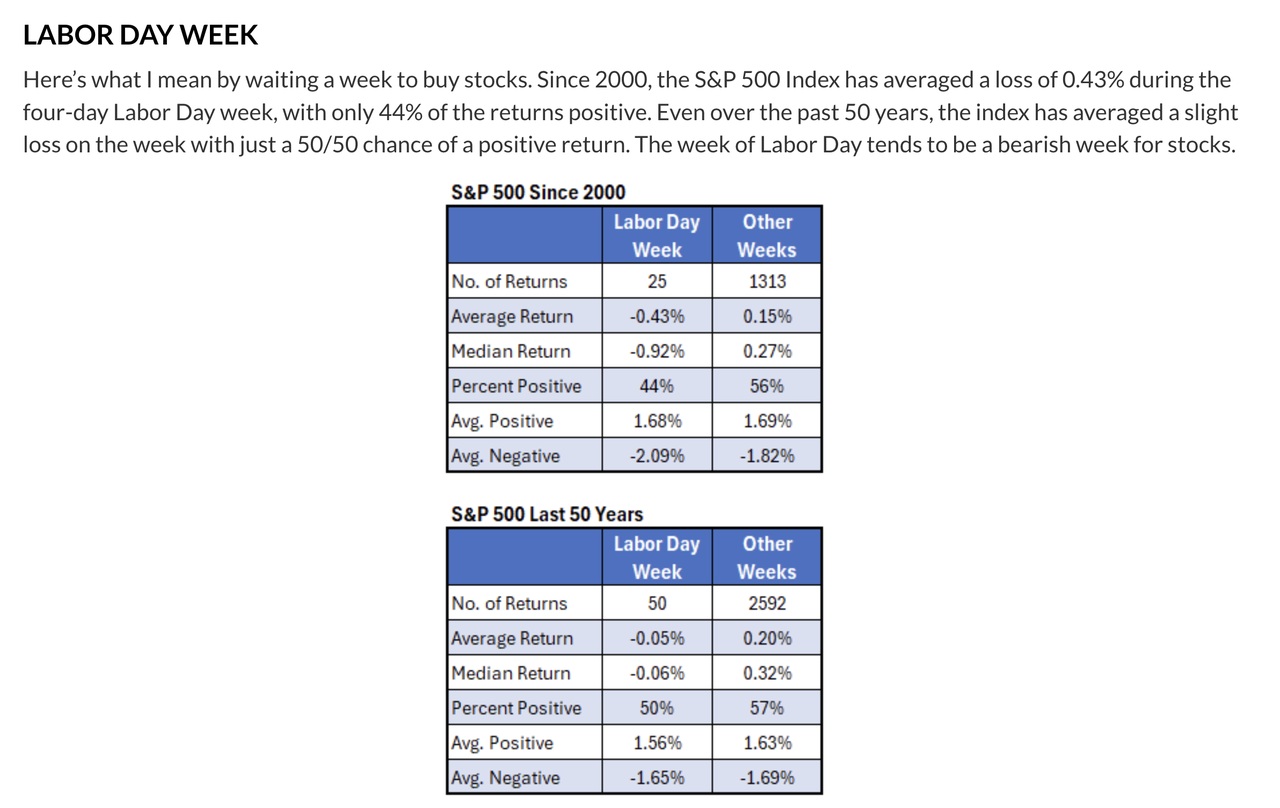
[Source: Schaeffer's Research]
Historical statistics show that the four trading days of Labor Day week are usually not particularly strong for U.S. stocks. According to previous data from Schaeffer's Research, since 2000, the S&P 500 Index has fallen by an average of about 0.43% during Labor Day week, posting positive returns in only about 44% of those years.
However, historical statistics cannot predict the market's direction this year. The post-Labor Day trend this year will still depend more on inflation data, Federal Reserve policy expectations, and changes in corporate fundamentals, meaning investors should not judge market movements based solely on seasonality.
Summary
U.S. stock markets will be closed all day on September 7 for Labor Day, with normal trading resuming on September 8. After Labor Day in 2026, U.S. markets will have two remaining full-day holidays—Thanksgiving and Christmas—while trading will close early on November 27 and December 24.
For investors, the market holiday itself is not the biggest risk factor this week. What truly deserves attention is the packed schedule of events once U.S. markets reopen: Thursday's PPI and Oracle earnings, followed by Friday's CPI. Among them, U.S. inflation data could prove to be a key variable influencing market interest rate expectations and short-term risk appetite.
Recommended Articles


