


I'm Confident This Stock Will Double by 2030. Here's the 1 Reason I'm So Sure.
Key Points
Uber has gone from huge losses to now posting sizable profits, proof that the business model works.
It's reasonable to expect the company's earnings per share will grow 19% annually through the rest of the decade.
The discounted valuation is likely due to the market's concern about autonomous vehicles.
- 10 stocks we like better than Uber Technologies ›
Uber (NYSE: UBER) just made headlines, announcing that it's going to trim 10% of its staff. The goal with this move is to reduce management layers and focus more on the core business.
Shares have still been on a very disappointing run. They're down 18% in the past 12 months (as of Sept. 3). And they currently trade 24% off their record from October last year. Investors have the chance to be opportunistic with an industry-leading enterprise.
Missed Nvidia in 2009? This Rare Signal Is Flashing Again. In 2009, a "Double Down" signal flashed for a little-known chipmaker called Nvidia. For the first time in years, that same "Total Conviction" signal is flashing for a company 1/100th the size of Nvidia. Continue »
I think better days are coming. I'm confident this growth stock will rise at a 19% compound annual rate to double by 2030. Here's the key reason I'm so sure.
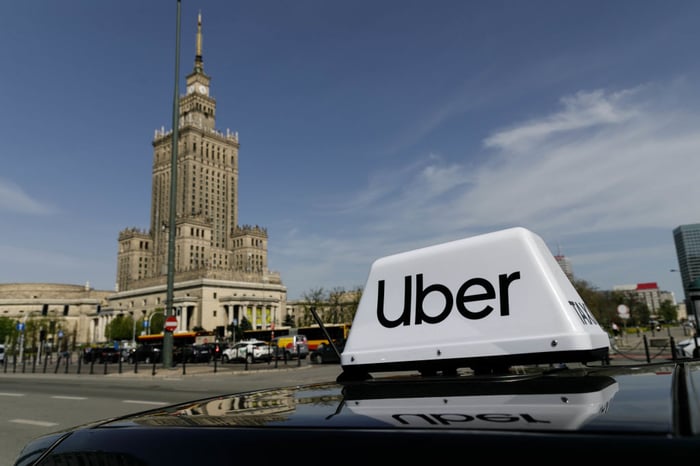
Image source: Getty Images.
Watch the bottom line
It wasn't that long ago that Uber was losing wild amounts of money. While this is undoubtedly an extremely innovative and disruptive company, critics questioned the sustainability of the business model.
Thanks to Dara Khosrowshahi's operational prowess, Uber evolved into a financial powerhouse. In 2025, it registered adjusted net income of $5.2 billion, up 32% year over year. This company runs a scalable platform that benefits from operating leverage, a situation in which earnings rise faster than sales.
Adding to that, I think profit growth will be the most important catalyst pushing the stock to a 100% gain in the coming four years. This implies that earnings per share will climb at a compound annual rate of 19%. This is a realistic outcome.
The bottom line's trajectory is obviously supported by revenue growth. Even though its mobility and delivery operations seem ubiquitous, notable gains continue. During the second quarter, sales were up 12%. This was driven by the monthly active user base expanding by 16% and gross bookings increasing 24%.
According to consensus analyst estimates, Uber's revenue is projected to grow at an annualized clip of 14% from 2025 to 2028. It's likely the double-digit gains will continue even after this forecast period. This trend should result in profits soaring.
"In the short run, the stock market is a voting machine," Ben Graham once wrote. "But in the long run, it is a weighing machine." Market sentiment rules the narrative in the near term. What matters over time, however, is a company's ability to grow its earnings power. Uber is well positioned to do just that.
Now is a good time to buy the dip
Uber shares have gone in reverse. As mentioned, they're trading 24% below their peak. This business looks like a prime buy-the-dip candidate right now.
The valuation further supports upside. Investors can currently buy the stock at a forward price-to-earnings ratio of 17.2. For the sake of comparison, the S&P 500 index carries a forward multiple of 21.1. Uber trades at almost a 20% discount to the overall market.
This gap, while attractive to prospective investors, isn't warranted. From a fundamental perspective, Uber is in a strong position. It has a powerful network effect that supports a durable competitive standing that's constantly improving. Revenue growth is healthy. And profitability has rapidly expanded.
But the market is focused intensely on the uncertainty that comes from autonomous vehicle (AV) technology. This poses a threat to Uber's entire business model, as the leading AV enterprises can quickly scale their user-facing platforms and find broad adoption. This is the most important tail risk that investors need to monitor.
There doesn't appear to be a reason to worry. Uber is making strategic investments and striking valuable partnerships to increase the probability that it is a key player in the AV wave, leaning on the fact that it controls demand with its massive user base.
Additionally, Khosrowshahi is convinced that human drivers will still be needed in a future that sees rising AV adoption. When demand for rides fluctuates wildly based on the time of day or week, a hybrid mobility ecosystem makes the most sense.
Should you buy stock in Uber Technologies right now?
Before you buy stock in Uber Technologies, consider this:
The Motley Fool Stock Advisor analyst team just identified what they believe are the 10 best stocks for investors to buy now… and Uber Technologies wasn’t one of them. The 10 stocks that made the cut could produce monster returns in the coming years.
Consider when Netflix made this list on December 17, 2004... if you invested $1,000 at the time of our recommendation, you’d have $445,833!* Or when Nvidia made this list on April 15, 2005... if you invested $1,000 at the time of our recommendation, you’d have $1,402,153!*
Now, it’s worth noting Stock Advisor’s total average return is 993% — a market-crushing outperformance compared to 214% for the S&P 500. Don't miss the latest top 10 list, available with Stock Advisor, and join an investing community built by individual investors for individual investors.
See the 10 stocks »
*Stock Advisor returns as of September 5, 2026.
Neil Patel has no position in any of the stocks mentioned. The Motley Fool recommends Uber Technologies. The Motley Fool has a disclosure policy.
Recommended Articles


