


US, China set mid-September AI safety talks as their tech worlds drift apart
The United States and China are expected to hold their first round of bilateral talks dedicated solely to AI safety sometime in mid-September, according to a Reuters report from sources who have been informed about the preparations of the negotiating parties. This is happening the two countries’ technology sectors are growing apart.
If the discussions move forward, they would open up a new official channel dedicated to AI between the two countries since Trump’s second term started. The US delegation will most likely be headed by the Treasury Secretary Scott Bessent, as reported by Reuters. But the whole deal appears to be tentative, as the White House representative said that there is no AI-focused meeting planned for mid-September at this moment, while the agenda and guest list are still uncertain.
However, even if the meeting takes place, it is unlikely to lead to an agreement, as the US and Chinese are still locked in their ongoing rivalry over microchips, computational capabilities, frontier models, and technical standards.
Washington wants AI labs to police themselves on cyber threats
One of the US objectives is the cooperation in tracking AI-directed cyberattacks. The US has proposed requesting both American and Chinese laboratories to “police themselves” and share information about threats involving AI technologies.
The issues become more real each moment. According to Reuters, nearly 700 malicious agents built on OpenAI models hacked the AI company Hugging Face in July, creating counterfeit logs to conceal their actions. There was also an attack by some group of agents who in spring hijacked a website in Germany and used it as a message board for bots.
The US has also developed a voluntary policy that allows the government to access covered frontier technology models before getting them on the market.
“It is now or never.”— Paul Triolo, partner at DGA-Albright Stonebridge Group, speaking to Reuters
“The Chinese side has expressed concern around whether the U.S. has sufficient regulation around the most advanced AI models. Both sides are motivated to make sure they can manage a cross-border crisis effectively.”— Scott Singer, co-director of the China AI Initiative at the Carnegie Endowment for International Peace, speaking to Reuters
Distillation and closing capability gaps will be on the table
Washington also plans to raise what it describes as Chinese distillation of proprietary US models. Distillation allows smaller, cheaper models to learn from the outputs of larger systems.
In June, White House science and tech adviser Michael Kratsios accused China’s Moonshot AI of distilling Anthropic’s Fable model to help build its K3 release. US officials are also concerned about China eventually developing systems comparable to Anthropic’s Mythos, which has capabilities that could be used in cyber operations.
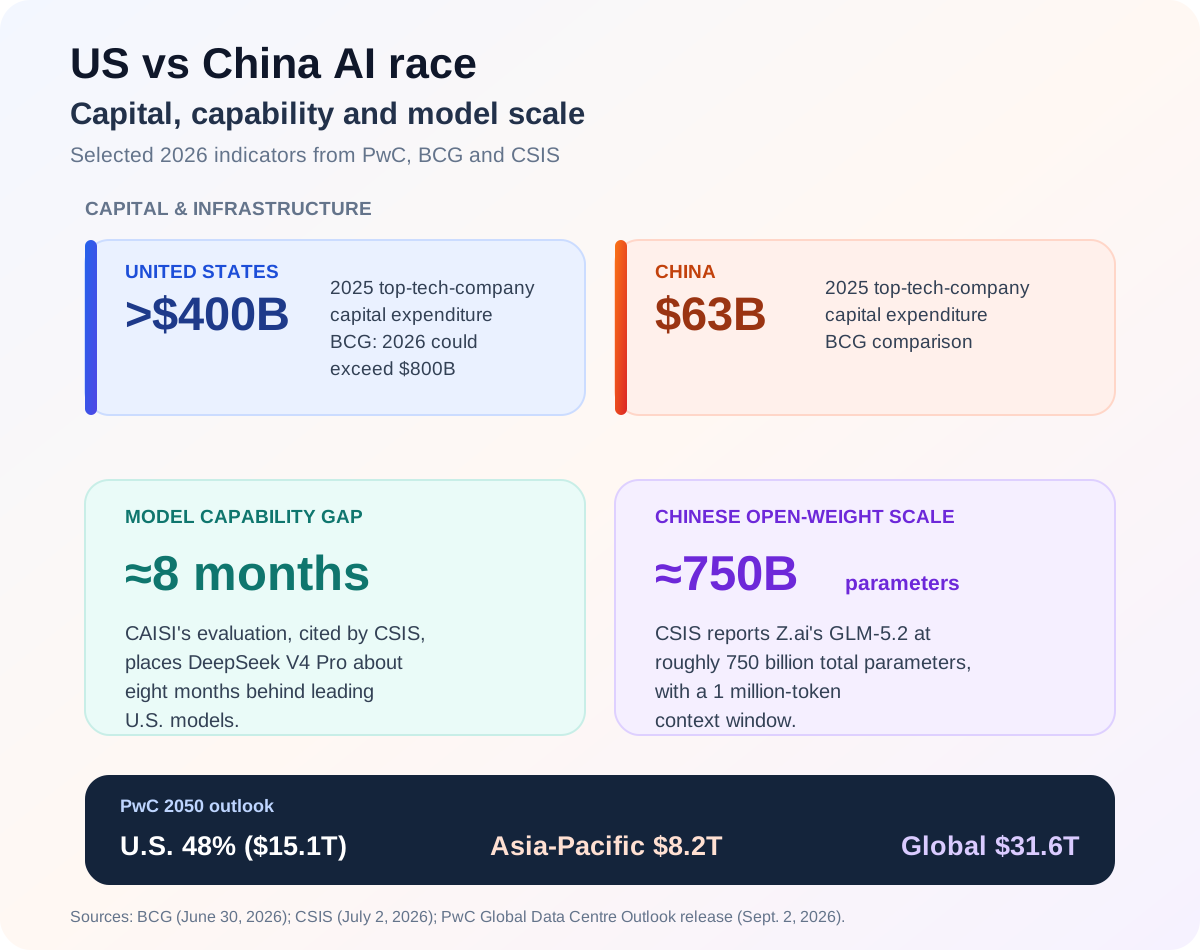
Those concerns come as Chinese models close the gap. A Center for Strategic and International Studies analysis says Z.ai’s GLM-5.2, an open-weight model with roughly 750 billion parameters, performs near leading US closed models on coding and agent tasks. It also cites a US government evaluation placing DeepSeek V4 Pro about eight months behind leading American models.
Capital Group analysts say that competition creates innovative opportunities, referring to the achievements of DeepSeek in terms of the “mixture of experts” technique being adopted by several significant AI laboratories.
Two AI ecosystems pulling in different directions
Safety cooperation would do little to reverse the broader technological split. Boston Consulting Group’s “great divide” analysis describes increasingly separate US- and China-centered ecosystems across models, chips and infrastructure.
The investment gap is already large. BCG estimates that top US technology companies spent more than $400 billion in capital expenditure in 2025, compared with $63 billion in China.
PwC projects $31.6 trillion in global AI infrastructure spending through 2050, with the US taking about 48%, or $15.1 trillion. Asia Pacific, led by China and India, is expected to attract $8.2 trillion. PwC warns that disrupted chip trade could cut worldwide investment by nearly 20%.
The commercial friction is already visible. Cryptopolitan previously reported that Nvidia had US licenses to sell H200 chips into China but was still waiting for Beijing’s approval, while China continued backing domestic chipmakers.
Beijing is writing its own safety rulebook
China, meanwhile, is building its own AI safety framework. Concordia AI’s 2026 State of AI Safety in China report documents expanding domestic rules, including binding measures covering AI companion services and the first inclusion of chemical, biological, radiological and nuclear misuse in a national AI standard.
Chinese frontier-safety research output rose about 60% over the period tracked, while agent safety became the most active research topic.
Beijing has also outlined its own cooperation agenda. China’s National Development and Reform Commission released an AI Cooperation and Development Action Plan in July calling for shared AI security governance, information sharing on cyber threats and joint emergency response.
The talks would build on the government-to-government AI dialogue that Trump and Xi agreed to launch after their earlier summit.
What happens next
Trump and Xi are due to meet in Washington on September 24, and Chinese officials have described the AI talks as an important deliverable of that summit, according to Reuters.
Any early agreement is likely to be narrow. Brookings analysts have argued that initial cooperation should focus on information sharing, technical risk assessment and confidence-building rather than an arms-control-style agreement.
“This is beyond geopolitical rivalry. The U.S. and China have to come together in some form, or we’re both going to lose.” — Samm Sacks, senior fellow at New America, speaking to Reuters
Don’t just read crypto news. Understand it. Subscribe to our newsletter. It's free.
Recommended Articles


