


Tim Cook, Elon Musk, Andy Jassy, and Jensen Huang All Just Warned Investors About the Same Thing. Spoiler Alert: It's Fantastic News for Micron and Sandisk.
Key Points
Hyperscalers are raising their capital expenditure budgets as prices for DRAM and high-bandwidth memory explode.
Rising memory and storage prices are cutting into free cash flows and eroding gross margins for big tech.
Memory makers Micron and Sandisk are benefiting enormously from the AI supercycle.
- 10 stocks we like better than Micron Technology ›
Earnings season is just about wrapped up, and for the artificial intelligence (AI) crowd, the script was unusually consistent. Four of the most powerful companies in the technology world spent meaningful airtime during their earnings calls talking about one input to the cost structure: memory.
Not models. Not load power. Not even graphics processing units (GPUs), at least not at first. High-bandwidth memory (HBM), DRAM, and NAND were in the spotlight during various earnings calls. In a way, this is ironic, as these products used to be viewed as common commodities. Now, CEOs are treating memory and storage like scarce precious metals.
Missed Nvidia in 2009? This Rare Signal Is Flashing Again. In 2009, a "Double Down" signal flashed for a little-known chipmaker called Nvidia. For the first time in years, that same "Total Conviction" signal is flashing for a company 1/100th the size of Nvidia. Continue »
The story is straightforward: The companies writing the biggest checks just told investors that memory prices are still going up, supply remains tight, and they are going to keep spending anyway. For investors who own shares of Micron Technology (NASDAQ: MU) or Sandisk (NASDAQ: SNDK), this should be music to your ears.
Image source: Getty Images.
Four CEOs, one common discussion
Tim Cook didn't hedge during his final earnings call as Apple's (NASDAQ: AAPL) CEO. He told investors that Apple paid more for memory during the March quarter than in the December quarter, and subsequently expected to pay "significantly more" in the June quarter. He went on to say that he expects to pay an even higher premium in the September quarter, describing the memory supercycle as "a 100-year flood." Apple raised Mac and iPad prices to partially offset rising memory costs. While that helped offset some of the toll rising memory costs took on its margins, Cook made it clear that pricing dynamics could hit Apple even harder in the current quarter.
Elon Musk was more blunt. During Tesla's (NASDAQ: TSLA) earnings call, he singled out Micron by name, thanking the chipmaker for giving Tesla a "very significant allocation on reasonable terms given the pretty insane pricing of memory these days." During the SpaceX earnings call, Musk did his best to quantify what the memory landscape currently looks like. He suggested that memory production is rising by around 20% a year, which would be a great accomplishment under normal circumstances. However, if that level of growth is occurring while demand is rising by, say, 200%, then Economics 101 makes it clear that prices must rise.
During Amazon's (NASDAQ: AMZN) second-quarter earnings call, investors learned the company had increased its capital expenditure budget for the year from about $200 billion to $220 billion. CEO Andy Jassy explained that "the higher cost of memory" had pushed its capex requirements higher, but even with that extra $20 billion, the hyperscaler still won't be able to build enough compute capacity this year to meet its existing demand. Jassy expects that compute shortage to persist into 2027.
Jensen Huang's version of the memory story was on display during Nvidia's (NASDAQ: NVDA) fiscal 2027 second-quarter earnings call last week. The giant chipmaker sees demand for its processors that would support far more than 70% revenue growth in its fiscal 2028. But current supply dynamics support the 70% forecast. To ensure Nvidia can keep up with demand, the company has locked in $279 billion of supply and capacity commitments through its fiscal 2032, "primarily related to the procurement of memory." Of that figure, $267 billion relates to supply contracts for the next two and a half years.
The theme here is that four different companies explicitly described the same bottleneck as it pertains to their artificial intelligence (AI) build-outs: constrained supplies of memory.
The AI capex cycle isn't drying up; it's just getting more expensive
Here's the part of the AI story some investors keep getting backward. Rising memory prices are not proof that the AI infrastructure build-out is about to slow down. Rather, it's evidence that even the largest buyers still can't procure enough silicon even after memory prices have already exploded. If this were a fading cycle, big tech players would be cutting their spending. Instead, they are doing the opposite.
Amazon raised its capex budget purely because memory costs more now and because the company still needs more racks. Nvidia is guiding for unprecedented growth, yet still says the real constraint in the chip value chain is memory supply, not GPU demand. Apple is paying a premium for HBM and DRAM, and simply passing some of its higher costs on to customers. Meanwhile, Tesla and SpaceX are grateful just to get invitations to the party.
To me, this is what a durable supercycle looks like: Capex remains elevated because the opportunity cost of frugality would be to leave demand on the table. Memory supply tightness is not a mere side effect sitting alongside the AI boom. Memory is the boom, and it's showing up in big tech's receipts.
Why is this good news for Micron and Sandisk?
For now, the pain that the tech sector is feeling over soaring memory prices is real, and it's showing up in two obvious places: gross margins and free cash flows.
Apple has already experienced a sequential drop in its gross margin due to soaring memory costs, while Nvidia is doing damage control ahead of time -- walking investors down from a gross margin profile in the mid-70s percentages toward the low-70s percentages as memory inflation works through its supply chain.
Meanwhile, Amazon and Tesla have experienced weaker cash conversion as they accelerate their capital expenditures and build more data centers or buy more chips. Many hyperscalers' free-cash-flow figures got ugly during the same quarter they were bragging about demand for their compute. That is the opportunity cost of building this infrastructure. Companies are laying out more cash up front, and the chips inside their servers cost more than their models assumed even just six months ago.
Someone is on the other side of this trade. Micron is selling into a market where only three DRAM suppliers have real pricing power, and HBM is sold out in advance going into next year. Sandisk specializes in NAND flash, prices of which are getting dragged higher as capacity budgets move downstream toward storage.
MU PE Ratio (Forward) data by YCharts.
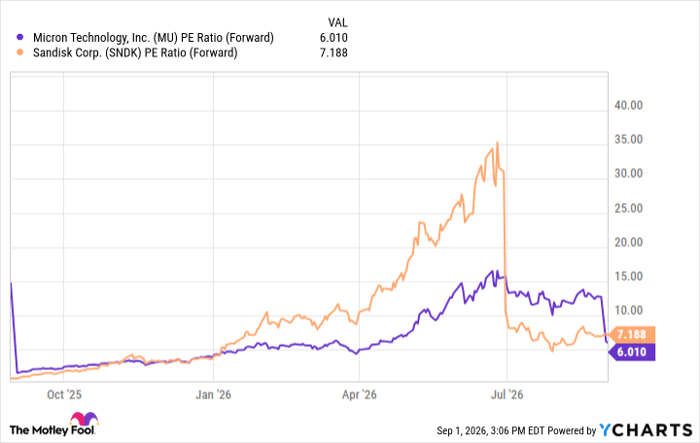
The takeaway here is that the AI capex cycle is very much intact and squeezing the memory buyers. Higher memory prices and bigger data center build-outs are two sides of the same invoice. The companies paying the invoice are already telegraphing a warning. The companies printing the invoice -- Micron and Sandisk -- are the ones the warning is for. With both of these memory stocks trading at modest forward price-to-earnings (P/E) multiples between 6 and 7, it could be that Micron and Sandisk remain grossly undervalued. In that context, they represent compelling opportunities to buy now and hold as the AI infrastructure era matures.
Should you buy stock in Micron Technology right now?
Before you buy stock in Micron Technology, consider this:
The Motley Fool Stock Advisor analyst team just identified what they believe are the 10 best stocks for investors to buy now… and Micron Technology wasn’t one of them. The 10 stocks that made the cut could produce monster returns in the coming years.
Consider when Netflix made this list on December 17, 2004... if you invested $1,000 at the time of our recommendation, you’d have $435,803!* Or when Nvidia made this list on April 15, 2005... if you invested $1,000 at the time of our recommendation, you’d have $1,334,577!*
Now, it’s worth noting Stock Advisor’s total average return is 966% — a market-crushing outperformance compared to 211% for the S&P 500. Don't miss the latest top 10 list, available with Stock Advisor, and join an investing community built by individual investors for individual investors.
See the 10 stocks »
*Stock Advisor returns as of September 3, 2026.
Adam Spatacco has positions in Amazon, Nvidia, and Tesla. The Motley Fool has positions in and recommends Amazon, Apple, Micron Technology, Nvidia, and Tesla. The Motley Fool has a disclosure policy.
Recommended Articles


