


SanDisk Stock Jumps 6% as $31B Japan AI Memory Expansion Fuels SNDK
TradingKey - SanDisk starts September with SNDK at $1,566.70 which is almost exactly at the $1,567.70 chart reference supplied, after a further hit due to the AI memory trade. The latest news is the USD$31 billion + plan with Kioxia to invest in Japan by 2032. Combined with record earnings, tight NAND pricing, and demand for data services, the news helps tell the growth story, but with the jump in bond yields, there is valuation risk.
$31 Billion Japan Expansion Extends the AI Storage Cycle
On August 27, SanDisk and Kioxia announced that they plan to invest roughly 5 trillion yen or USD$31 billion in Japan through 2032 assuming government support. This investment will fund their joint ventures in Japan and support their partnership in building flash memory and funding the supply and development of the technology of Japanese manufacturing over the long-term.
This is not USD$31 billion of SanDisk-only capex. It is a joint SanDisk-Kioxia investment plan. The partners have already made a USD$50 billion joint investment in Japan over the previous 25 years.
Q4 Results Show How Powerful NAND Pricing Has Become
SanDisk reported fiscal Q4 2026 revenue of $8.97 billion, a 51% increase from the prior quarter. Management attributed roughly one-third of this increase to an increase in the volume of shipments and two-thirds of this increase to an increase in pricing. GAAP net income was $6.90 billion, or $43.97 per diluted share, and non-GAAP EPS was $39.25.
For the full year 2026, revenue reached $20.25 billion, up 175% over the previous year. In addition, we saw $5.15 billion in Data Center revenue, representing a growth potential of 437%. The change in AI infrastructure has already started to switch SanDisks traditional flash sales to sales of higher value data center demand.
Q1 Guidance Points to Another Record Quarter
Analysts predict management will reach revenue between $10.30 and $10.80 billion with $44 to $46 non-GAAP EPS for fiscal Q1 of 2027. The consensus midpoint is $10.55 billion. With the $10.55 billion, sales for fiscal Q1 of 2027 are projected to have a record roughly 18% sequential sales growth compared to fiscal Q4 of 2026.
The risk here is concentrating on NAND pricing for the current period of earnings. Revenue volume alone would not likely impact profits as significantly as the normalization of price would.
Long-Term Customer Agreements Improve Visibility
On August 12, 2026, SanDisk and Kioxia announced a 9th generation QLC 2 terabit 3D flash design to support AI intensive workloads and data which improves the interface speed over the previous generation by 33% and uses a 6-plane architecture with a 4.8 Gb/s interface.
A separate August 4th announcement detailed 10th-generation QLC technology which has up to 60% greater bit density compared to the 8th generation and has a 4.8Gb/s interface. Separating these announcements is important because the 60% density does not relate to the August 12th 9th-generation product.
High Bandwidth Flash increases value and optionality over the longer term. SanDisk and SK hynix released the first Open Compute Project HBF specification on August 3, creating a common framework for high-capacity, high-bandwidth flash positioned near compute in AI inference systems. HBF still has more potential over the long term and is not currently a significant source of revenue.
At its August 13 Investor Day, SanDisk said it had signed New Business Model agreements with eight customers covering about 50% of fiscal 2027 bits and roughly two-thirds of fiscal 2028 bits.
QLC and HBF Expand the AI Memory Roadmap
On August 12, SanDisk/Kioxia revealed their latest 2Tb QLC NAND design with a 6-plane architecture and an interface speed of 4.8 Gbps, a 33% interface speed improvement over the previous generation. Kioxia announced 10th-gen QLC NAND technology with a bit density increase of up to 60% over the 8th generation, along with an interface speed of 4.8 Gbps, on August 4. Two separate announcements are important here; the 60% density figure does not apply to the 9th-generation QLC announced on August 12.
SanDisk/Kioxia and SK hynix also announced an HBF (High Bandwidth Flash) specification on August 3 in collaboration with the Open Compute Project, targeting high-capacity, high-bandwidth flash nearby compute for AI inference applications. HBF, for now, looks more like an opportunity with longer-term potential than a significant revenue generator.
China Competition Is the Main Structural Risk
With advanced NAND production and development, the parent of YMTC is targeting an IPO on the Shanghai Stock Exchange to raise about $4.9 billion. More Chinese capacity can certainly impact global pricing, especially in conventional flash markets.
Pricing sponsors current SanDisk profits. The bull case here is if AI storage demand can absorb new capacity at a faster rate than competitors can add capacity.
SanDisk Technical Analysis: $1,608 Is the Breakout Test
As of September 1, SNDK is currently trading at $1,566.70, almost exactly at our projected $1,567.70 zone. With the price reclaiming the $1,501 moving average and trading above the rising trend line, the short term structure is still bullish.
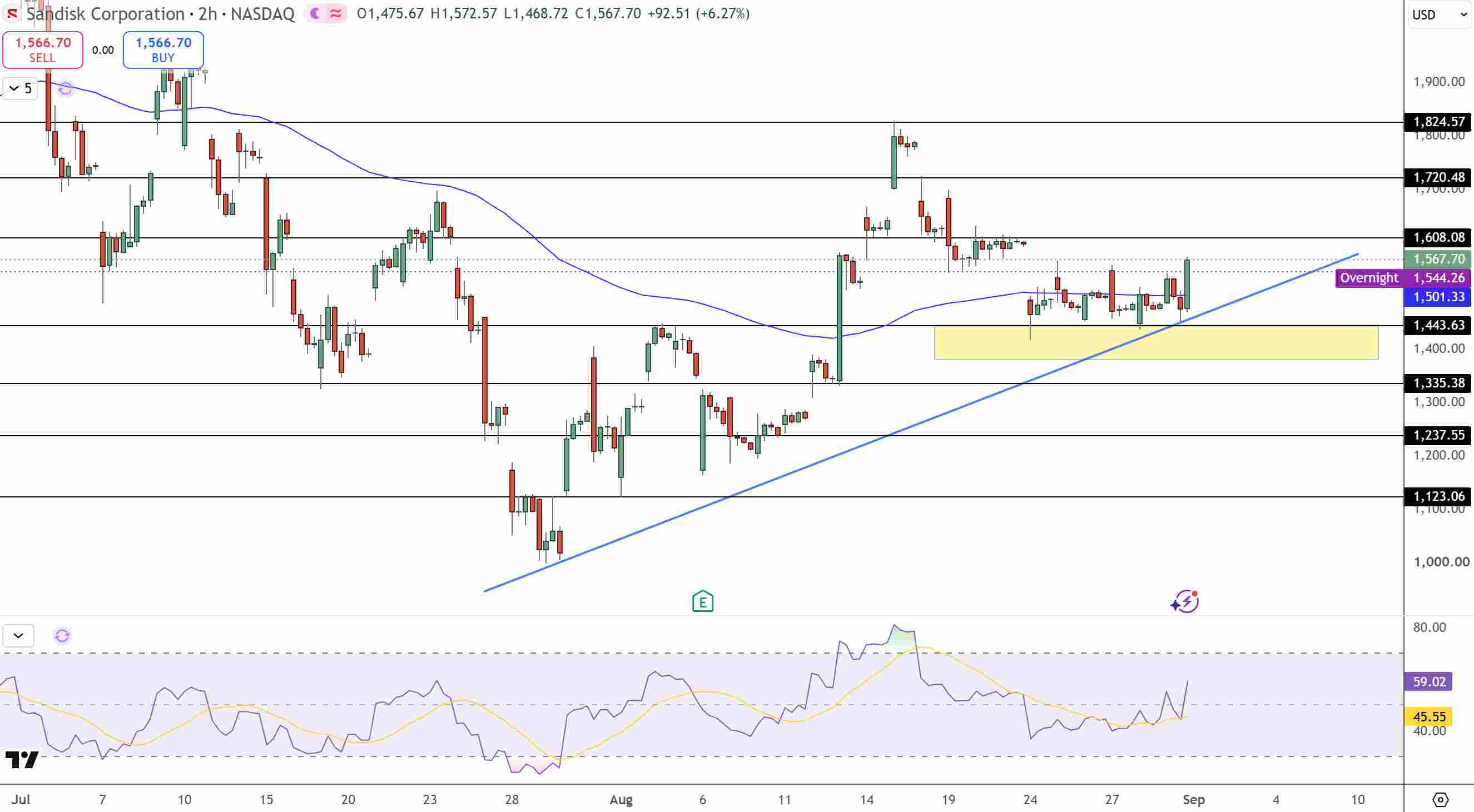
SanDisk Stock Price Chart - Source: Tradingview
The first visible resistance is $1,608.08. We could expect a range breakout and a target of $1,720.48 then $1,824.57 with a sustained 2-hour close well above $1,608. Our RSI is at $59 and is above the 46 level and the signal line, and is still very much under the 70 level.
The initial support is in the zone $1,544-$1,501. A breakdown of this structure will expose the zone $1,443.63 and the broader zone $1,390-$1,440.
Key Levels
· Current price: Around $1,566.70
· Immediate support: $1,544 - $1,501
· Breakout resistance: $1,608.08
· First upside target: $1,720.48
· Higher target: $1,824.57
· Major downside support: $1,443.63
· RSI: Around 59, bullish but not overbought
Why is SanDisk stock rising?
Positive factors include strong Q4 and full-year 2026 results, new joint investment partnership with Kioxia in Japan, and the Data Center growth at 437% and NAND by record pricing, all within the context of strong AI-storage demand.
What is the biggest risk to SNDK?
The biggest downside risk is a reversal of NAND pricing. Adverse effect from pricing coupled with an ongoing capacity increase from SanDisk, Kioxia, YMTC, and other suppliers, will tend to dampen the margins in the future in case the demand for AI is stifled.
Bottom Line
SanDisk has very good earnings for this year and long-term customer agreements with strong AI-storage customers, and a $31 billion plan with Kioxia in Japan, strengthens the expectations for longer demand for flash. However, the longer the demand is expected to be, the more difficult supply has to be restrained, and during this time SNDK has a bullish trend above $1,500 (Resistance at $1,608), and a break above that would support $1,720, with the possibility of even $1,825.
Recommended Articles


