


If a Stock Market Crash Is on the Way, History Says This Is the Smartest Thing Investors Can Do
Key Points
As difficult as it may be, refrain from making any rash, panic-based decisions.
Those who say they can consistently time the market are not telling the truth.
Learn to see market downturns and even crashes as an opportunity to build your wealth.
- These 10 stocks could mint the next wave of millionaires ›
The mental images that come to mind when you hear the words "stock market crash" may resemble the black-and-white photos from 1929, when anxious crowds stood outside the New York Stock Exchange and, eventually, bread lines formed. However, not all crashes are the same. For example, while the worst of the Great Depression lasted for years, other crashes have been much shorter.
Whether there's widespread financial fallout or the Federal Reserve quickly steps in to inject liquidity, crashes do happen -- as do recoveries. In between, history illustrates the smartest thing investors can do to get through as unscathed as possible.
Missed Nvidia in 2009? This Rare Signal Is Flashing Again. In 2009, a "Double Down" signal flashed for a little-known chipmaker called Nvidia. For the first time in years, that same "Total Conviction" signal is flashing for a company 1/100th the size of Nvidia. Continue »
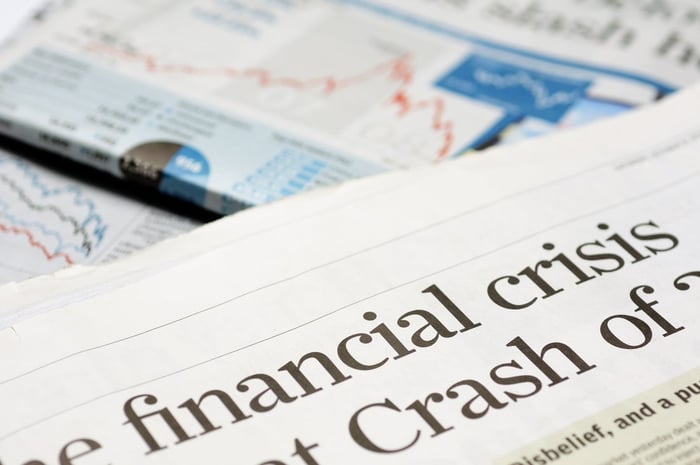
Image source: Getty Images.
It's important for investors to fight their instincts
Like a wild elephant charging in your direction, word of a market crash is likely to electrify your nerves, and every instinct you possess may tell you to flee. If possible, do the opposite. Rather than selling off your holdings, remain invested and keep buying high-quality, diversified stocks -- particularly index funds.
Some will tell you they can consistently time exits and reentries. It's simply not true. While you know crashes can occur and you understand that the market will eventually right itself, you can't know when either will happen. In fact, those who have tried to time exits and reentries have consistently lost out over the long term.
To succeed in timing the market, you must be right twice. You must exit and reenter the market at just the right times, typically under uncertain and emotional conditions.
Once you accept the reality that timing the market is a fool's errand, you realize the value of coming up with a better plan -- and that better plan is making the most of the time you have to buy high-quality assets at bargain prices. As Warren Buffett has advised, "Be fearful when others are greedy, and be greedy when others are fearful."
The investing story history tells
Given the number of crashes the U.S. stock market has experienced -- both large and small -- it's fascinating to realize that it's still managed to deliver an average annual return of roughly 10% over the last century. What that illustrates is that the market may tumble, but when it picks back up, it does so with a fury. And those who stuck with it, buying assets at bargain prices, are in a prime position to prosper. Even severe crashes -- like the 2008 crash, when the S&P 500 index fell by 57% -- saw recoveries that carried the index to new heights.
More recent crashes tell the same story. In only 22 trading days during the COVID-19 crash, the S&P 500 dropped 30%, making it the fastest drop of that magnitude in history. But those who stayed invested saw the market rebound and push to record levels.
Why sticking with it works
Behind the scenes, there are several ways you can benefit from staying the course. For example:
- Lower prices: You can buy more shares of high-quality assets on sale, potentially balancing or further diversifying your portfolio.
- Compound growth: Compounding doesn't stop just because the market hits a rough patch. Leaving your money invested lets your gains compound over time.
- No locked losses: While selling off may "feel" like the right thing to do, doing so during a crash turns a temporary situation into a real, permanent loss.
- The best days: Historically, the biggest gains tend to happen following a crash. Selling out also means missing out on those gains.
When you're concerned that a crash is imminent, it's natural to want to cut and run. However, standing firm may be one of the best things you can do to build wealth.
Where to invest $1,000 right now
When our analyst team has a stock tip, it can pay to listen. After all, Stock Advisor’s total average return is 978%* — a market-crushing outperformance compared to 213% for the S&P 500.
They just revealed what they believe are the 10 best stocks for investors to buy right now, available when you join Stock Advisor.
See the stocks »
*Stock Advisor returns as of August 29, 2026.
Dana George has no position in any of the stocks mentioned. The Motley Fool has no position in any of the stocks mentioned. The Motley Fool has a disclosure policy.
Recommended Articles


