


Optimus Just Entered Production at Fremont. Here's What Changes for Tesla Investors.
Key Points
Optimus production has started at Fremont, marking a significant milestone.
Scaling Optimus manufacturing will be a lengthy, challenging process for Tesla.
Initial production will focus on internal use and iterative improvement, not immediate commercial sales.
- These 10 stocks could mint the next wave of millionaires ›
Tesla (NASDAQ: TSLA) has stated that 80% of the company's value will come from its Optimus robot in the future. That's a pretty impressive claim when you consider the profit potential in recurring revenue from Tesla's robotaxis (something Musk undoubtedly believes in). It's also something investors should consider when assessing the importance of initial Optimus production to the stock's long-term case.
Optimus begins production
That Optimus is now in production at Fremont, California (using production space previously used for Model X and Model S electric vehicles), is a landmark development. Still, it's not a pivotal moment for the company. As Musk has made abundantly clear, initial production is only the start of a lengthy and challenging process of scaling production in preparation for commercialization.
Missed Nvidia in 2009? This Rare Signal Is Flashing Again. In 2009, a "Double Down" signal flashed for a little-known chipmaker called Nvidia. For the first time in years, that same "Total Conviction" signal is flashing for a company 1/100th the size of Nvidia. Continue »
Speaking on the recent earnings call, Musk said Optimus "will be the biggest product ever" and that "the production scaling challenge is very substantial. This is going to be the hardest product to scale manufacturing that we've ever made at Tesla."
Why Optimus production is challenging
It's not hard to see why that might be the case: As Musk notes, "Everything on the robot is new," and there isn't a supply chain in place to build Optimus or any other robots of its type. Therefore, Tesla has had to "build up a supply chain in its entirety" or take production in-house, according to Musk.
The challenges are many. For example, Tesla is ultimately aiming to use Fremont production to create a manufacturing template for scaling at its Giga Texas factory in Austin, Texas, which will be its mass production plant dedicated to Optimus. However, generating the production momentum needed to standardize processes and reduce unit production costs could be difficult if Tesla continues to face supply chain constraints.
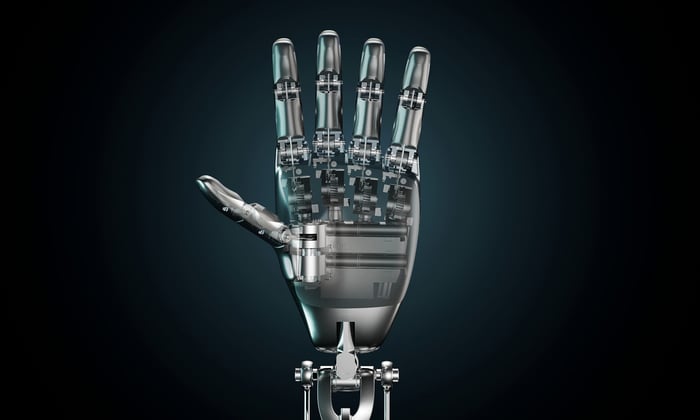
Image source: Tesla.
Optics might remain challenging
Difficulties seem likely, given that Musk expects the "initial portion" of the "S-curve" production ramp will be "flat and long." By "S-curve," Tesla simply means that slow initial production will be followed by an aggressive ramping up and then a tailing off of growth. Of course, the problem with the S-curve is that it starts out somewhat flat.
That scenario will undoubtedly raise concerns, not least because the Giga Texas factory is part of Tesla's aggressive capital spending of more than $25 billion in 2026, with that figure set to rise in 2027 and 2028.
Image source: The Motley Fool.
What changes for Tesla investors
It's important to remember that the initial production ramp-up isn't just about perfecting the manufacturing process; it will also kick-start a closed-loop learning cycle in which Optimus robots produced at Fremont will be used in Tesla's "Optimus Academy" , performing routine tasks on Tesla's own factory floors. It's a process that will enable incremental improvements in Optimus, potentially leading to long-term margin benefits. But here's the thing: The improvements are unlikely to be evident from the shape of the S-curve.
So don't be surprised if Tesla starts reporting on other performance indicators related to Optimus's performance (e.g., length of function, capability, asset use) in its own factories.
Don’t miss this second chance at a potentially lucrative opportunity
Ever feel like you missed the boat in buying the most successful stocks? Then you’ll want to hear this.
On rare occasions, our expert team of analysts issues a “Double Down” stock recommendation for companies that they think are about to pop. If you’re worried you’ve already missed your chance to invest, now is the best time to buy before it’s too late. And the numbers speak for themselves:
- Nvidia: if you invested $1,000 when we doubled down in 2009, you’d have $544,464!*
- Apple: if you invested $1,000 when we doubled down in 2008, you’d have $59,793!*
- Netflix: if you invested $1,000 when we doubled down in 2004, you’d have $439,308!*
Right now, we’re issuing “Double Down” alerts for three incredible companies, available when you join Stock Advisor, and there may not be another chance like this anytime soon.
See the 3 stocks »
*Stock Advisor returns as of August 27, 2026.
Lee Samaha has no position in any of the stocks mentioned. The Motley Fool has positions in and recommends Tesla. The Motley Fool has a disclosure policy.
Recommended Articles


