


Up Nearly 30% in August, Is SpaceX Stock Still a Buy?
Key Points
SpaceX delivered strong second-quarter results.
Right now, SpaceX is more of an AI and telecom business than it is a space exploration company.
- 10 stocks we like better than Space Exploration Technologies ›
Space Exploration Technologies (NASDAQ: SPCX) stock has had a great run in August. After starting out strong following its June IPO, then pulling back sharply in July, it's on the rise again. If you had the foresight to pick up shares on Aug. 1, you're up by nearly 30%. That's an incredible run in a short time frame, and pushed it to around $138 per share -- just above its $135 IPO price, though still well below its first-day opening price of $150.
But is the rally essentially over for now?
Missed Nvidia in 2009? This Rare Signal Is Flashing Again. In 2009, a "Double Down" signal flashed for a little-known chipmaker called Nvidia. For the first time in years, that same "Total Conviction" signal is flashing for a company 1/100th the size of Nvidia. Continue »
Let's take a look at what caused SpaceX to rebound, and consider if it's still worth buying here.
Image source: The Motley Fool.
SpaceX's Q2 results created some buzz
Heading into August, there were two primary concerns surrounding SpaceX's stock: what its Q2 results would look like, and how the end of its first insider lockup period would impact the share price.
Two days after that quarterly report was delivered, most insiders who owned shares prior to the IPO were free to start selling up to 20% of their shares. That about doubled the float for SpaceX.
The concern was that the market would be flooded with heavy selling pressure from insiders cashing out, which would crater the stock price.
However, while there was a spike in trading volume coinciding with the ending of that lockup period, it really hasn't had much sustained effect on trading volumes.
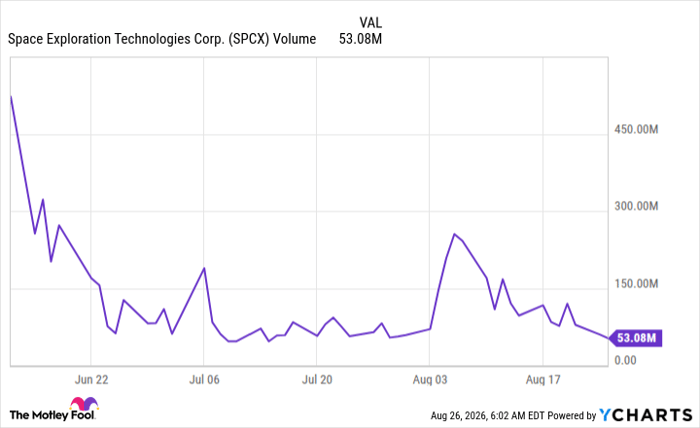
SPCX Volume data by YCharts.
Another smaller tranche of shares was unlocked on Aug. 20, and more lockup periods will end over the next year. Those upcoming events could still prove this thesis right, but the first increase in the float proved not to be a big deal in terms of its impact on the share price.
SpaceX also crushed its Q2 results. Revenue grew at an impressive 92% pace, and its net loss was only $541 million, which looks puny compared to the $100 billion in cash it has on hand after its IPO funding raise and the $25 billion bond sale it conducted a few weeks later. SpaceX's artificial intelligence business saw incredible growth, with revenue rising from $818 million in the prior-year period to $2.56 billion in Q2. Revenues from the connectivity segment (which primarily consists of its Starlink satellite internet service) increased from $3.25 billion to $4.29 billion, and its space business remained the smallest segment, increasing from $619 million to $962 million.
This shows once again that SpaceX currently isn't primarily a space stock; its business is more AI- and connectivity-focused right now. That's the lens I'm viewing the stock through, and if it maintains these growth rates for a while, it may become a strong business.
However, I'm still a bit skeptical about SpaceX's current valuation. If we value the stock based on full-year revenue estimates, it trades at 41 times sales -- an expensive valuation for any company. While some investors may be willing to pay that kind of premium, I'm not. I'll be waiting until SpaceX's business grows into its valuation or the stock declines to better reflect that underlying business. (Of course, those things may never happen, and I could miss out.)
Ultimately, because there is so much hoped-for growth already priced into the stock, there's just too much risk relative to the reward potential that remains. I think most investors would be better off staying patient at least until SpaceX has its initial year of trading under its belt.
Should you buy stock in Space Exploration Technologies right now?
Before you buy stock in Space Exploration Technologies, consider this:
The Motley Fool Stock Advisor analyst team just identified what they believe are the 10 best stocks for investors to buy now… and Space Exploration Technologies wasn’t one of them. The 10 stocks that made the cut could produce monster returns in the coming years.
Consider when Netflix made this list on December 17, 2004... if you invested $1,000 at the time of our recommendation, you’d have $439,308!* Or when Nvidia made this list on April 15, 2005... if you invested $1,000 at the time of our recommendation, you’d have $1,286,826!*
Now, it’s worth noting Stock Advisor’s total average return is 964% — a market-crushing outperformance compared to 212% for the S&P 500. Don't miss the latest top 10 list, available with Stock Advisor, and join an investing community built by individual investors for individual investors.
See the 10 stocks »
*Stock Advisor returns as of August 27, 2026.
Keithen Drury has no position in any of the stocks mentioned. The Motley Fool has no position in any of the stocks mentioned. The Motley Fool has a disclosure policy.
Recommended Articles


