


Warren Buffett Says This 1 Move Is the Key to Surviving a Stock Market Crash. 100 Years of History Says He's Right.
Key Points
With tech valuations surging, some experts are raising the alarm over an AI bubble.
Warren Buffett's timeless advice can set investors up for long-term success.
The stocks you choose right now will make or break your portfolio during a recession.
- 10 stocks we like better than S&P 500 Index ›
The stock market is in an interesting place right now. While major indexes like the S&P 500 (SNPINDEX: ^GSPC), Nasdaq Composite (NASDAQINDEX: ^IXIC), and Dow Jones Industrial Average (DJINDICES: ^DJI) have reached record highs in recent months, volatility in the tech sector has renewed concerns about an AI bubble.
While it's impossible to predict the market's short-term moves, around 45% of fund managers believe an AI bubble is the biggest tail risk facing the market right now, Bank of America's latest Global Fund Manager Survey found.
Missed Nvidia in 2009? This Rare Signal Is Flashing Again. In 2009, a "Double Down" signal flashed for a little-known chipmaker called Nvidia. For the first time in years, that same "Total Conviction" signal is flashing for a company 1/100th the size of Nvidia. Continue »
If there's one investor who has no shortage of experience surviving bear markets, it's Warren Buffett. Here's the move he says is key to surviving market volatility.
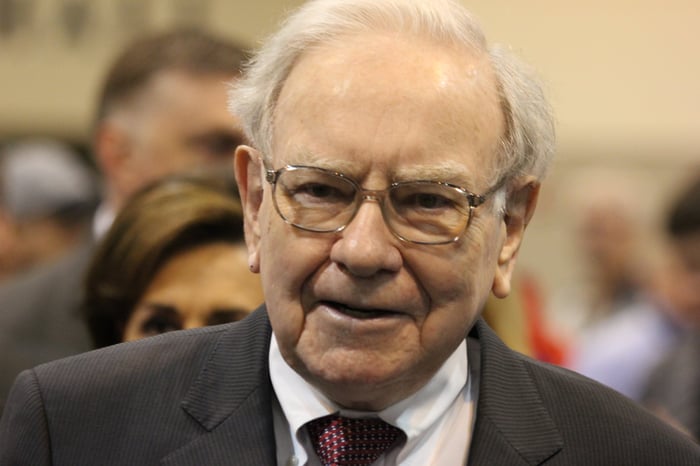
Image source: The Motley Fool.
This is "the key to investing," according to Warren Buffett
In the late 1990s, as excitement around the internet surged and many tech stocks exploded in value, Buffett issued a warning to investors that stock prices would likely fall in the coming years.
He emphasized that although some industries have the potential to transform society, that doesn't automatically make those stocks strong investments.
"The key to investing," Buffett explained in a 1999 essay for Fortune, "is not assessing how much an industry is going to affect society, or how much it will grow, but rather determining the competitive advantage of any given company and, above all, the durability of that advantage."
The dot-com bubble immediately proved his point. Although the internet revolutionized the world, many tech companies went bankrupt in the early 2000s despite their record-breaking initial public offerings (IPOs) just a few years earlier.
History says the future is bright -- but with a caveat
Every recession in history shares one trait: They separate the winners from the losers. From the Great Depression to the dot-com bubble burst to the financial crisis in 2008, thousands of companies have gone bankrupt during tough economic times.
Even the strong companies faced brutal setbacks. Microsoft, for example, fell by more than 60% throughout the dot-com bear market. Amazon fared even worse, losing nearly 95% of its value between 1999 and 2001. And Apple plummeted by more than 50% in a single trading day in 2000.
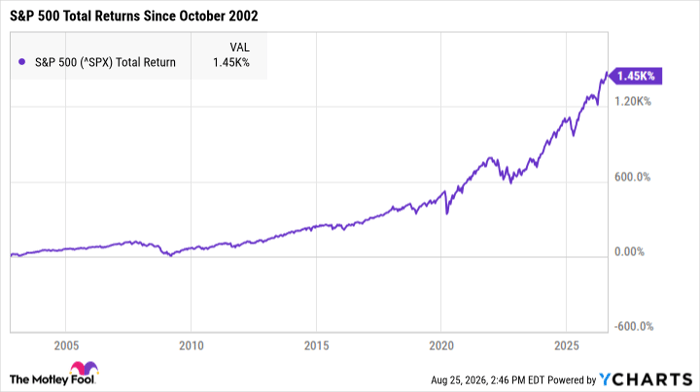
Today, though, those three companies are industry-leading juggernauts. The broader market has also thrived despite severe short-term volatility, with the S&P 500 surging by nearly 1,500% since it bottomed out in October 2002.
^SPX data by YCharts
If investors take away one lesson from the last century of crashes, bear markets, and recessions, it's that many stocks will not survive an economic downturn. But those that do often earn extraordinary returns over time, so choosing your investments wisely is key.
Right now, it's anyone's guess as to whether an AI bubble will rival the dot-com bubble. But even if a bear market is coming, companies with strong competitive advantages and robust business fundamentals will be the best positioned for substantial long-term growth.
Should you buy stock in S&P 500 Index right now?
Before you buy stock in S&P 500 Index, consider this:
The Motley Fool Stock Advisor analyst team just identified what they believe are the 10 best stocks for investors to buy now… and S&P 500 Index wasn’t one of them. The 10 stocks that made the cut could produce monster returns in the coming years.
Consider when Netflix made this list on December 17, 2004... if you invested $1,000 at the time of our recommendation, you’d have $443,461!* Or when Nvidia made this list on April 15, 2005... if you invested $1,000 at the time of our recommendation, you’d have $1,307,633!*
Now, it’s worth noting Stock Advisor’s total average return is 973% — a market-crushing outperformance compared to 213% for the S&P 500. Don't miss the latest top 10 list, available with Stock Advisor, and join an investing community built by individual investors for individual investors.
See the 10 stocks »
*Stock Advisor returns as of August 27, 2026.
Bank of America is an advertising partner of Motley Fool Money. Katie Brockman has no position in any of the stocks mentioned. The Motley Fool has positions in and recommends Amazon, Apple, and Microsoft. The Motley Fool has a disclosure policy.
Recommended Articles


