


SoftBank Plans Up to $20 Billion Bond Sale to Refinance OpenAI as Masayoshi Son Boosts AI Investments
TradingKey - On August 26, Asia-Pacific time, Bloomberg reported that SoftBank Group Corp. is in talks with investment banks regarding a bond issuance plan of $10 billion to $20 billion to refinance loans obtained for its investment in OpenAI.
The bonds may be denominated in US dollars and euros and could launch as early as September. The plan remains in the discussion phase, with the specific size and terms not yet finalized. A SoftBank spokesperson stated that the company is considering various options to refinance the bridge loan, but no decision has been made.
As of the close that day, SoftBank shares rose 1.49% to 5,163 yen (approximately $32.45).
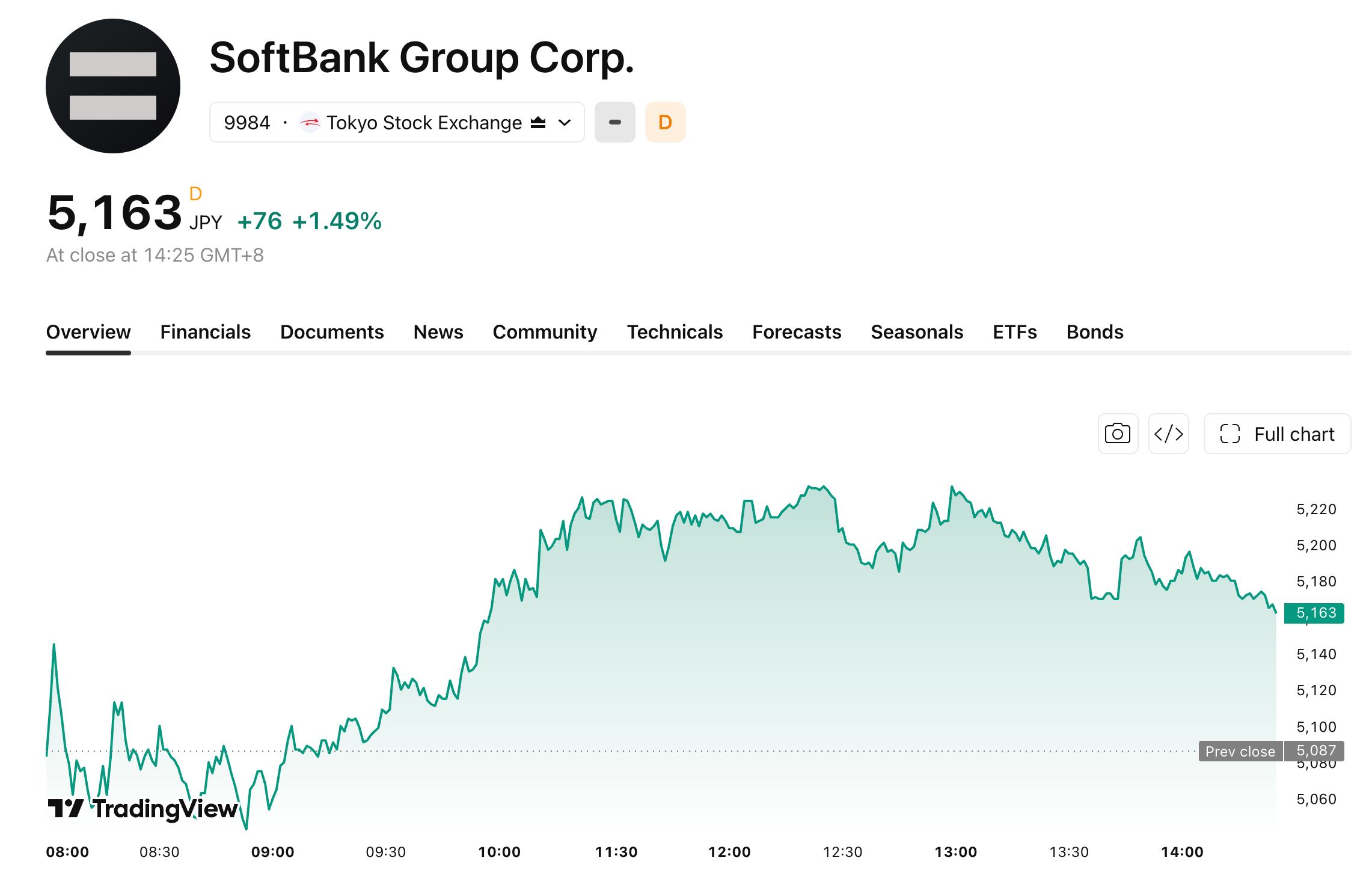
[Source: TradingView]
According to Bloomberg, SoftBank is considering issuing under Rule 144A for the first time in over a decade to attract US institutional investors. If the issuance size reaches the upper limit of $20 billion, the deal would become one of the largest such bond issuances by an Asian company this year.
In April this year, SoftBank issued approximately $3.6 billion in overseas bonds, including a 10-year US dollar bond with a coupon rate of 8.5%. The yield to maturity on this bond has recently hovered around 8.4%.
In March this year, SoftBank secured $40 billion in total bridge financing, of which $30 billion was used by a financing subsidiary for an additional investment in OpenAI, and $10 billion was allocated for general corporate purposes of SoftBank Group.
To date, $20 billion has been invested in OpenAI. SoftBank plans to make a third $10 billion investment in OpenAI in October and will borrow another $10 billion to support the transaction. The bridge loan ultimately matures in March 2027.
In addition to the overseas bond plan, on August 6, SoftBank officially finalized and obtained a margin loan totaling $10 billion, backed by OpenAI-related assets. Furthermore, SoftBank plans to issue 1 trillion yen (approximately $6.3 billion) in 7-year retail bonds in Japan, with a coupon rate guidance of 4.3% to 4.9%, expected to be priced in September.
In July, S&P adjusted SoftBank's rating outlook from "negative" to "stable," maintaining its BB+ long-term issuer credit rating, which remains below investment grade. Meanwhile, SoftBank's financial report released in May showed that as of the end of March, its cumulative gain on the OpenAI investment was approximately $45 billion, primarily driven by increases in the fair value of equity, which is not entirely realized.
SoftBank Group is essentially an investment holding company. Official company statements indicate that it will use a combination of asset-backed financing and asset sales to repay and refinance the bridge loan. OpenAI's IPO plan could serve as an important avenue for asset monetization, though not the only one.
Recommended Articles


