


The Best Dividend Stock for 2027 and Beyond: Procter & Gamble
Key Points
Procter & Gamble's annual dividend growth between 4% and 6% has outpaced inflation and preserved purchasing power.
Rising bond yields globally have put pressure on stock valuations.
The uncertain environment has little impact on P&G’s underlying business or its ability to grow -- and, in turn, increase its dividend.
- 10 stocks we like better than Procter & Gamble ›
Procter & Gamble Co.'s (NYSE: PG) annual dividend growth rate of 4% to 6% over the last two decades, coupled with its 3% dividend yield, gives income-seeking investors an unusually solid combination of current income and long-term growth, in my view, for 2027 and beyond. Home to globally well-known household brands, the consumer-defensive giant has increased dividends for 70 consecutive years, backed by its ever-growing recurring cash flows.
A growing dividend supported by a business that generates billions of dollars in cash every year is extremely important to income-seeking investors. For context, in fiscal 2026, which ended June 30, P&G paid out $10.2 billion in dividends on operating cash flow of $19.6 billion and net income of $16 billion.
Missed Nvidia in 2009? This Rare Signal Is Flashing Again. In 2009, a "Double Down" signal flashed for a little-known chipmaker called Nvidia. For the first time in years, that same "Total Conviction" signal is flashing for a company 1/100th the size of Nvidia. Continue »
P&G's in-built inflation-fighting mechanism
What I see in P&G, one of the best income-generating stocks to own today, is its built-in inflation-defense mechanism. In a more volatile stock market, expected absolute stock returns decline. And as global bond yields rise, markets will be choppier in the foreseeable future.
Over the past decade, Procter & Gamble's annual dividend growth has consistently kept up (and sometimes even outpaced) the U.S. inflation rate, which has risen considerably since COVID-19. For income-seeking investors, this means there is no erosion of purchasing power, and, I think, that makes P&G the best dividend stock to own over the next few years.
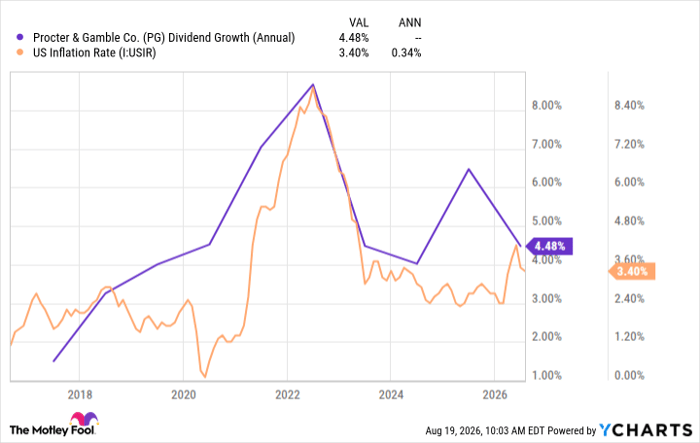
PG Dividend Growth (Annual) data by YCharts.
Rising yields pressure valuations
The U.S economy remains strong, but that's not necessarily great for future stock returns. As the above chart shows, inflation has been sticky. Additionally, tech stocks -- the best performers over the last few years -- saw a broader sell-off in July, led by semiconductor stocks. The bigger problem may be that stocks that have generated above-average returns in the recent past may be running too hot and could be overvalued. Investors may not get higher returns without a valuation pullback, and rising bond yields are evidence of that.
The mathematics behind this is simple: As bond yields go up, investors usually demand higher earnings yields from stocks as well. Breaking it down further, the earnings yield of a stock is just the inverse of its price-to-earnings (P/E) ratio. So as the earnings yield goes up, the P/E ratio falls, pushing down the share price.
The uncertain environment does not make P&G's business less attractive
P&G may not have been the stock market's darling over the past few years, but its globally recognized brands give it scale and pricing power -- the most important qualities of a business with growing recurring cash flows. It sells necessities and household products, things that people need irrespective of an economic downturn or a stock market drawdown. Brands such as Tide, Dawn, Pampers, Gillette, Crest, and Oral-B, among others, don't simply lose pricing power or see demand fall.
Management still expects fiscal 2027 organic sales growth to clock between 1% to 3%, and net earnings per share (EPS) growth in the range of 1% to 5%. This growth is despite expectations of an additional $1 billion in cost pressures due to higher raw material, transportation, and energy prices.
Additionally, the company expects adjusted free cash flow (FCF) productivity (calculated as the ratio of adjusted FCF to core net earnings) to remain above 85%. In layperson's terms, this means management expects at least 85% of its core net income to be converted to free cash flow. In short, P&G's revenue and cash flow growth are persistent, leading to a persistent increase in capital returned to shareholders.
Shouldn't buying Treasury bonds suffice then?
Investors looking for safety could, in theory, buy Treasury bonds as their yields rise. But holding bonds has a disadvantage: there's no income growth. That's where I'd argue that P&G stock is better suited to tackle an inflationary environment and ensure income growth through rising dividends.
What about owning higher-yielding stocks? Again, a great idea, but future income growth is usually unreliable when dividend yields are high.
Image source: Getty Images.
A 3% dividend yield may not seem much. However, it is the starting point for a dividend that has historically outpaced inflation, thus preserving purchasing power over a five- or 10-year period. If P&G's dividend grows annually by 5% on average over a 10-year period, the dividend would have grown by nearly 63%. If you bought the stock today, your yield on the original investment would be substantially higher a decade later, at nearly 4.9%.
The stock isn't overvalued
Defensive stocks, such as Procter & Gamble, don't get much credit in a bull market. But slow growers shine in volatile markets, or simply when investors don't want to take on too much risk. At 21.6 times trailing earnings and four times trailing sales, the stock isn't overvalued. At the same time, these numbers don't suggest the market has been ignoring the stock. I think that's the sweet spot -- a stock that is poised to perform well in the future without any fears of overvaluation.
If you are worried about uncertainty in the U.S. stock market as valuations stretch to historic highs and long-term interest rates remain elevated, P&G's dividend appeal lies in stable income generation and the ability to grow your purchasing power over longer time horizons.
Should you buy stock in Procter & Gamble right now?
Before you buy stock in Procter & Gamble, consider this:
The Motley Fool Stock Advisor analyst team just identified what they believe are the 10 best stocks for investors to buy now… and Procter & Gamble wasn’t one of them. The 10 stocks that made the cut could produce monster returns in the coming years.
Consider when Netflix made this list on December 17, 2004... if you invested $1,000 at the time of our recommendation, you’d have $432,621!* Or when Nvidia made this list on April 15, 2005... if you invested $1,000 at the time of our recommendation, you’d have $1,335,314!*
Now, it’s worth noting Stock Advisor’s total average return is 973% — a market-crushing outperformance compared to 213% for the S&P 500. Don't miss the latest top 10 list, available with Stock Advisor, and join an investing community built by individual investors for individual investors.
See the 10 stocks »
*Stock Advisor returns as of August 21, 2026.
Isac Simon has no position in any of the stocks mentioned. The Motley Fool has no position in any of the stocks mentioned. The Motley Fool has a disclosure policy.
Recommended Articles


