


Billionaire Stanley Druckenmiller Sold Broadcom and Bought the Same Artificial Intelligence (AI) Stock Berkshire Piled $17 Billion Into
Key Points
Druckenmiller's Duquesne Family Office just dumped 195,955 shares of Broadcom stock.
Filings reveal that Druckenmiller's investment firm initiated a position in another chipmaker during the second quarter.
Interestingly, Berkshire Hathaway has also steadily built a core position in the same AI stock as Druckenmiller.
- 10 stocks we like better than Alphabet ›
Over the past week, a flurry of 13F filings have revealed the portfolio moves institutional investors made during the second quarter. The shifts from one such billionaire investor, Stanley Druckenmiller, captured my attention.
Druckenmiller's Duquesne Family Office fully exited Broadcom (NASDAQ: AVGO) while initiating a new position in Alphabet (NASDAQ: GOOGL). I find this move particularly interesting because Alphabet relies on Broadcom to help design its custom Tensor Processing Units (TPUs), the specialized chips that power a portion of Google's artificial intelligence (AI) infrastructure.
Missed Nvidia in 2009? This Rare Signal Is Flashing Again. In 2009, a "Double Down" signal flashed for a little-known chipmaker called Nvidia. For the first time in years, that same "Total Conviction" signal is flashing for a company 1/100th the size of Nvidia. Continue »
By favoring the company that is aggressively spending rather than the supplier receiving those dollars, Druckenmiller is signaling a nuanced view of the AI infrastructure trade. Rather than quietly riding the wave of ongoing chip demand, he may be looking further downstream toward the platforms tightly integrating these accelerators with the end-user experience.
Image source: The Motley Fool.
The case for selling Broadcom stock
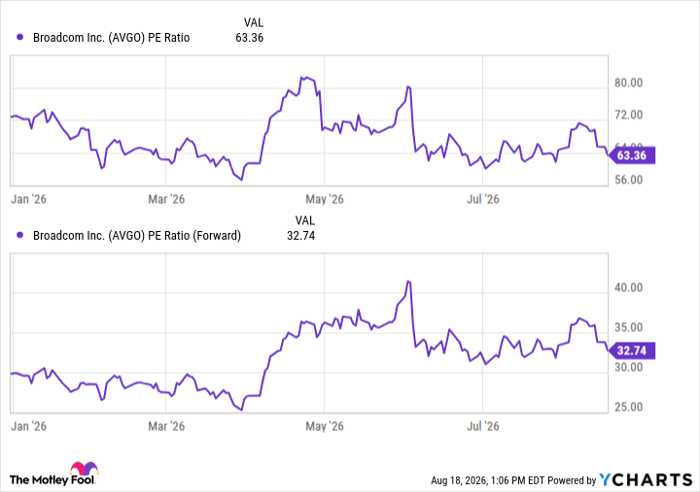
One reason for selling Broadcom stock hinges on valuation and the evolving nature of the AI semiconductor cycle. Despite some valuation compression in recent months, Broadcom's price-to-earnings (P/E) and forward P/E are still frothy. The broader semiconductor industry trades at a 43 P/E and about 26 times forward earnings. Against this backdrop, it could be argued that Broadcom is still pricing in much of the near-term upside from hyperscaler contracts.
AVGO PE Ratio data by YCharts
While Broadcom remains a critical partner for large buyers, its AI segment leaves the company exposed to external spending decisions from big tech. Druckenmiller has a history of moving early when the risk-reward equation changes. By taking profits in Broadcom now, he may have concluded that easy gains from the pure AI infrastructure layer have been captured and that incremental returns will be harder to achieve.
There is also the simple discipline of portfolio concentration. What I mean by that is holding both the buyer and the seller of the same chips creates unnecessary correlation risk if the broader AI spending narrative decelerates.
What makes Alphabet an attractive investment?
Alphabet possesses massive data assets through Google search and YouTube, world-class research talent (DeepMind), and a proprietary hardware stack. Its TPUs are not merely cost-saving tools; rather, they are tightly integrated with the software and services that generate a portion of Alphabet's AI-driven revenue.
Owning the company that both designs these chips and deploys them across an AI ecosystem spanning search, cloud computing, and consumer products gives investors deep exposure to Alphabet's entire value chain rather than a single link.
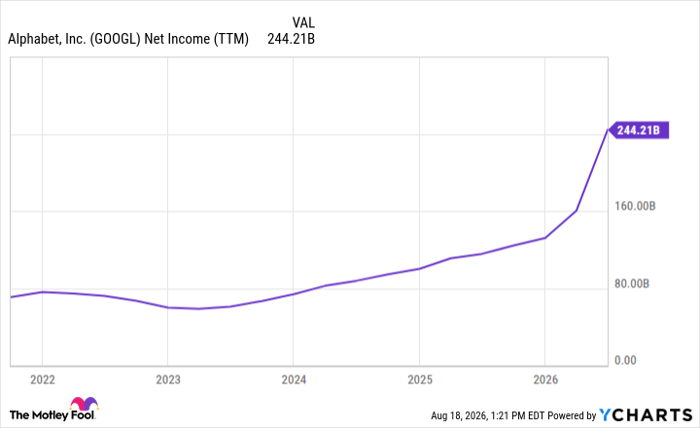
Recent acceleration in Google Cloud growth has proven that the company's capital expenditures are translating into higher-margin recurring revenue and widening operating profits. All told, Alphabet quietly offers a leveraged play on AI without the volatility of pure play chipmakers themselves.
Druckenmiller isn't the only billionaire who likes Alphabet
The most compelling aspect of investing in Alphabet is the degree of the company's vertical integration. By controlling the design of its custom accelerators, the software that runs on them, and the global distribution platforms that monetize the resulting intelligence, Google has built an extremely profitable self-reinforcing system that is difficult for competitors to replicate at scale.
GOOGL Net Income (TTM) data by YCharts
This advantage helps explain why Alphabet has swiftly emerged as a core holding at Berkshire Hathaway. Berkshire appears to be treating Alphabet less like a speculative technology name and more like a durable franchise. During the second quarter, the investment conglomerate plowed $17 billion into Alphabet alone.
This enthusiasm is unique because it persists even though Alphabet's accelerated spending has pressured free cash flow in recent periods. This paradox resolves when investors consider the long-term economics: Heavy capital outlays today lay the foundation for proprietary AI services that should generate superior returns once the infrastructure is fully deployed.
Billionaires like Druckenmiller appear willing to tolerate near-term compression in cash flow because they see the alternative -- ceding technological leadership -- as more costly in the long-run. With this in mind, Druckenmiller's rotation away from Broadcom and recent investment in Alphabet looks less like a simple swap and more like a bet on ownership of a complete AI stack.
Should you buy stock in Alphabet right now?
Before you buy stock in Alphabet, consider this:
The Motley Fool Stock Advisor analyst team just identified what they believe are the 10 best stocks for investors to buy now… and Alphabet wasn’t one of them. The 10 stocks that made the cut could produce monster returns in the coming years.
Consider when Netflix made this list on December 17, 2004... if you invested $1,000 at the time of our recommendation, you’d have $432,621!* Or when Nvidia made this list on April 15, 2005... if you invested $1,000 at the time of our recommendation, you’d have $1,335,314!*
Now, it’s worth noting Stock Advisor’s total average return is 973% — a market-crushing outperformance compared to 213% for the S&P 500. Don't miss the latest top 10 list, available with Stock Advisor, and join an investing community built by individual investors for individual investors.
See the 10 stocks »
*Stock Advisor returns as of August 20, 2026.
Adam Spatacco has positions in Alphabet. The Motley Fool has positions in and recommends Alphabet, Berkshire Hathaway, and Broadcom. The Motley Fool has a disclosure policy.
Recommended Articles


