


TradingKey Daily Market Briefing: Gold Tops $4,600, Bitcoin Surges as Market Focuses on Nvidia Earnings and Jackson Hole Meeting

Tracking Market Trends
TradingKey - On August 21 Eastern Time, the three major U.S. stock indices closed higher across the board, but still recorded losses for the week. After experiencing volatility in Treasury yields, Middle East uncertainty, and a cooling of the AI trade, the market saw a phased recovery on Friday. Strong U.S. services sector data, coupled with news that the U.S. Treasury expanded long-term Treasury buybacks, temporarily alleviated market concerns about long-end interest rates continuing to rise, driving a rebound in risk appetite.
At the close, the Dow Jones Industrial Average rose 0.98% to 53,282.32 points; the S&P 500 Index gained 0.43% to 7,674.37 points; and the Nasdaq Composite Index gained 0.43% to 26,180.45 points.
In terms of sectors and individual stocks, the materials, healthcare, and financial sectors performed relatively well. Ross Stores (ROST) rose 4.39%, mainly boosted by an upward revision in its annual profit forecast and better-than-expected quarterly performance. Crypto-related stocks were the day's biggest highlight, with Robinhood (HOOD) surging 13.7%, Coinbase (COIN) gaining 8.2%, and Strategy (MSTR) climbing 6.1%. Bitcoin rose approximately 6.4% on the day, reaching its highest level since May and driving crypto asset-related stocks higher in tandem.
As for tech stocks, the main AI theme remains in a cautious phase ahead of earnings verification. Nvidia (NVDA) is scheduled to release its financial results, which the market regards as a crucial window to gauge AI chip demand, data center capital expenditures, and the AI infrastructure investment cycle. Previously, rising long-end Treasury yields weighed on the semiconductor sector, with the Philadelphia Semiconductor Index falling about 5% last week, indicating that investors remain cautious regarding AI trade valuations and financing costs.
In commodities, crude oil remains oscillating at high levels. Last Friday, oil prices rose for the sixth consecutive trading day, primarily because Trump threatened economic sanctions against Iran's trading partners, raising market fears of further supply tightening. Entering early Asian trading on August 24, investors chose to take profits before the U.S. announced further sanctions on Iran, with Brent crude falling over 2% to $91.50 and WTI crude (USOIL) dropping about 0.8% to $86/barrel. Although oil prices retreated in the short term, supply risks in the Middle East have not been eliminated.
In precious metals, gold (XAUUSD) continued its strong momentum. Spot gold rose 1.9% last Friday to $4,604.80, touching an intraday high of $4,632.13, a new high since mid-May. The rise in gold was mainly driven by a weakening U.S. dollar, the U.S. Treasury's long-term Treasury buyback plan, and market concerns about U.S. debt and policy stability.
In the crypto market, Bitcoin (BTC) continued to be a highlight among risk assets. Bitcoin surged last week, reclaiming $70,000 and briefly rising above $79,000, prompting a simultaneous rebound in crypto stocks. The market attributed this rally to changes in liquidity expectations from the U.S. Treasury's buybacks of long-term Treasuries, a weaker U.S. dollar, and improved expectations for crypto regulation. However, after substantial short-term gains, whether Bitcoin can continue to achieve breakthroughs will depend on ETF fund inflows, dollar trends, and sentiment in U.S. tech stocks.
Market News
US-Canada trade tensions escalate as markets focus on North American supply chain risks. Canada announced that it will impose retaliatory tariffs on select US goods starting September 8 in response to the US levying 50% tariffs on approximately $20 billion worth of Canadian goods. The dispute spans multiple industries, including steel, dairy, electronics, agricultural equipment, pulp, and paper, further exacerbating trade friction between the US and Canada. As both nations are core members of the North American supply chain, a continued escalation of the trade conflict could impact costs across automotive, manufacturing, consumer goods, and industrial raw materials.
Nvidia earnings and the Jackson Hole symposium become this week's market focus. Nvidia will report its quarterly results this week, with the market closely focused on AI chip demand, data center revenue, progress on the Rubin platform, and whether AI infrastructure orders can support high valuations. Meanwhile, Federal Reserve Chair Warsh will deliver a speech at the Jackson Hole economic symposium. Given recent sharp fluctuations in long-dated Treasury yields, investors hope to gain clues from the speech regarding the Fed's future rate path and policy communication framework.
Impact of US Treasury long-term buybacks continues to unfold. The US Treasury previously announced an expansion of its long-term Treasury buybacks, which temporarily pushed down long-end yields and weighed on the US dollar, driving assets like gold and Bitcoin higher. Markets believe that while this operation helps ease bond market pressure in the short term, it also sparks discussion among investors regarding US debt sustainability, fiscal policy independence, and the credibility of the US dollar. The synchronized rally in gold and Bitcoin reflects a shift by some capital toward assets hedging against inflation and currency debasement.
Oil prices remain high as Iranian sanction expectations continue to dominate energy markets. US Treasury Secretary Bessent is expected to announce further sanctions against Iran, calling them potentially the "strictest in history." Although crude oil pulled back in early Monday Asian trading due to profit-taking, Brent and WTI remain at high levels. As long as risks surrounding Iranian supply, passage through the Strait of Hormuz, and Middle East shipping show no clear signs of easing, energy prices may continue to exert pressure on inflation expectations and Federal Reserve policy.
US services data shows strength, but manufacturing remains weighed down by supply chains. Latest economic data shows that US services activity accelerated its expansion, helping ease market concerns over an economic slowdown. However, manufacturing growth remains dragged down by inventory adjustments and supply chain disruptions related to the Iran war. For US equities, resilience in the services sector helps support corporate earnings expectations, but if oil prices and long-end rates continue to rise, corporate borrowing costs and consumer pressure could once again weigh on market sentiment.
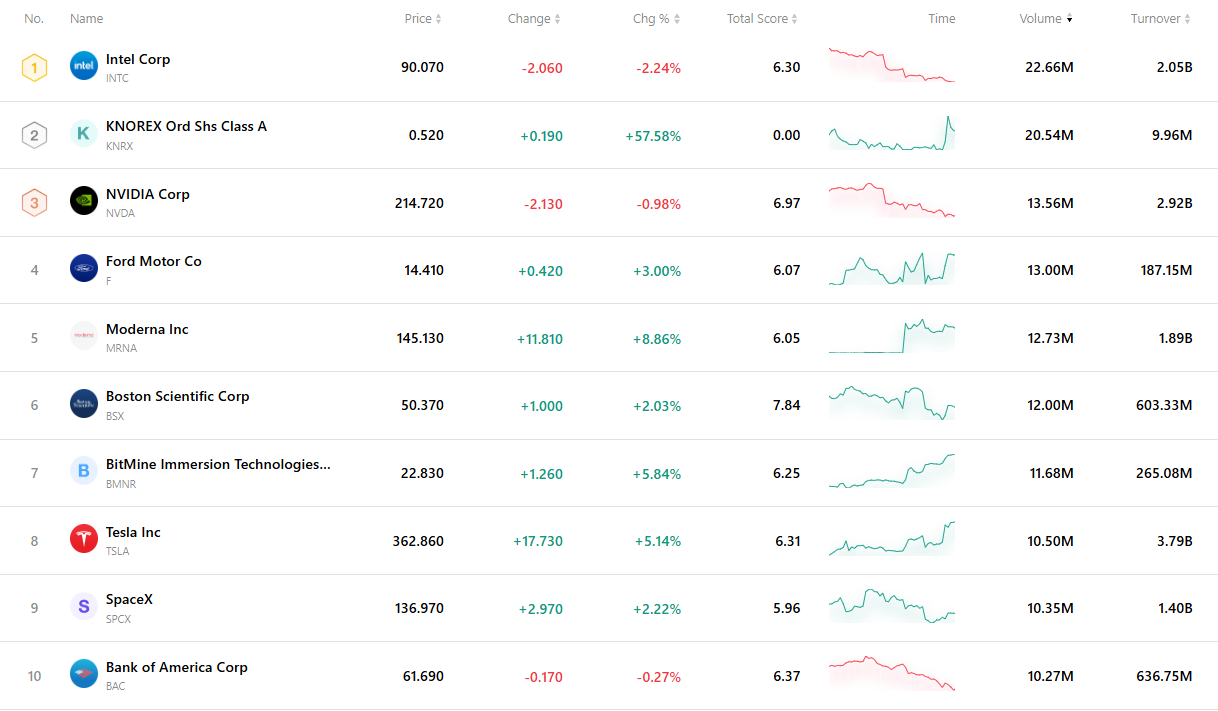
Top 10 Most Active Stocks
The table below lists the ten most actively traded stocks in the current market. Supported by massive trading volumes and excellent liquidity, these assets have become key benchmarks for tracking global market dynamics.
Read more
* The content presented above, whether from a third party or not, is considered as general advice only. This article should not be construed as containing investment advice, investment recommendations, an offer of or solicitation for any transactions in financial instruments.


