


Micron Just Delivered a Monster Quarter, but the Stock Is Plummeting. The Reason Is Obvious.
Key Points
Micron generated record revenue, profit, and gross margin during its fourth quarter earnings report.
Questions around the sustainability and cost of hyperscaler capex is taking a toll on the semiconductor industry.
Micron's sell-off appears overblown, making now an attractive entry point to buy the dip.
- Motley Fool Issues Rare "Total Conviction" Buy Alert ›
On Sept. 30, Micron Technology (NASDAQ: MU) reported a monster fiscal fourth-quarter earnings report. The company set records across revenue, profitability, and cash generation. Ordinarily, blowout earnings results give investors plenty of reasons to celebrate.
However, Micron stock has been moving in the opposite direction over the last month. As of market close on Oct. 22, shares declined roughly 20% since Micron reported earnings and were trading nearly 29% below their all-time high.
Missed AI’s "Act 1"? Act 2 Could Be 15x Bigger. Most investors think they missed the AI boat because they didn't buy Nvidia in 2005. But according to our analysts, we’re only at the end of "Act 1"—the R&D phase. "Act 2" is the global rollout. Continue »
What's important to understand is that Micron's sell-off isn't a reflection of a deteriorating business. Rather, investors are concerned about the sustainability of artificial intelligence (AI) spending, elevated valuations, and the likelihood that the memory industry's unusually high profitability won't last forever. Here's what smart investors need to know.
Micron's earnings report was a blowout
For the fiscal fourth quarter (period ended Sept. 3), Micron generated $54.2 billion in revenue, representing nearly 380% growth year over year and a 31% increase sequentially. Profitability was even more impressive. The company's gross margin reached 87%, compared with 45% in the prior-year period. Meanwhile, earnings per share (EPS) surged to $32.87, compared with just $2.83 a year earlier.
The company's Core Data Center unit generated $18 billion in revenue, up from $1.6 billion last year. Moreover, the Cloud Memory segment contributed another $16.3 billion, nearly 4x bigger than the fourth quarter of 2025.
Micron also produced nearly $44 billion in operating cash flow and $33 billion in adjusted free cash flow, underscoring that earnings growth is translating into robust cash generation. Management expects the momentum to continue. For fiscal Q1 2027, Micron guided for $61.5 billion in revenue and EPS of $37.84. So, why are investors selling the stock like there's no tomorrow?

Image source: Getty Images.
3 reasons Micron stock is cratering
The first explanation behind Micron's sell-off is that the company is not alone. Over the last month, there has been a broader sell-off among semiconductor stocks. The iShares Semiconductor ETF (NASDAQ: SOXX) has declined 15% since Micron reported earnings. This demonstrates that weakness in the chip market extends beyond Micron itself.
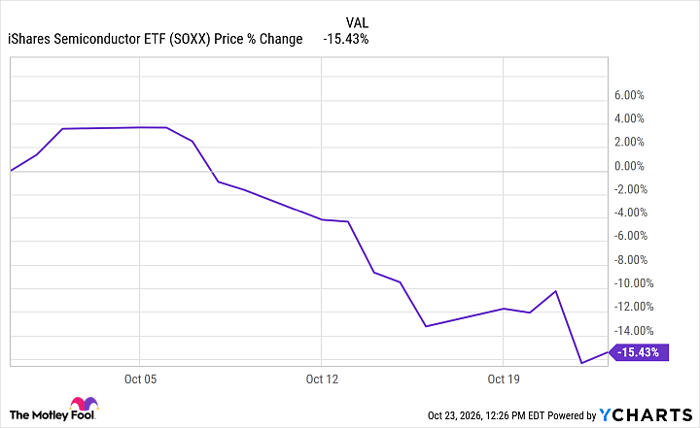
SOXX data by YCharts
Second, investors are increasingly concerned about the cost and sustainability of AI capital expenditures (capex). Hyperscalers such as Amazon, Microsoft, Alphabet, and Meta Platforms are budgeting hundreds of billions of dollars annually to data centers and advanced processors.
These investments require substantial financing beyond organic cash flow generation. Bond yields are elevated as companies increasingly tap the debt markets, making investors question how long AI infrastructure spending can realistically continue to accelerate.
Recent developments have reinforced some of these concerns. For instance, Tesla recently reduced its projected 2026 capex by 20%, from more than $25 billion to roughly $20 billion. Although this decision doesn't establish a broader framework for hyperscaler spending trends, it illustrates how some of the most ambitious AI developers are forced to balance infrastructure investments with financial discipline.
The third concern is the most obvious: investors remain wary of the durability of the memory supercycle given the industry's cyclical nature. If demand eventually exceeds today's scarce supply of high-bandwidth memory (HBM), average selling prices will normalize and profit margins will erode.
Micron stock: Buy the dip or value trap?
At approximately $887 per share, Micron trades at a forward price-to-earnings (P/E) ratio of 7. That's a modest valuation for a company experiencing Micron's level of revenue and profit growth supported by secular demand for its infrastructure.
Against this backdrop, I think Micron is a compelling opportunity to buy the dip rather than a value trap. At 7 times forward earnings, I think investors have already priced in considerable downside risk into Micron stock. For this reason, I see Micron as a compelling AI stock to buy and hold.
Should you buy stock in Micron Technology right now?
Before you buy stock in Micron Technology, consider this:
The Motley Fool Stock Advisor analyst team just identified what they believe are the 10 best stocks for investors to buy now… and Micron Technology wasn’t one of them. The 10 stocks that made the cut could produce monster returns in the coming years.
Consider when Netflix made this list on December 17, 2004... if you invested $1,000 at the time of our recommendation, you’d have $355,124!* Or when Nvidia made this list on April 15, 2005... if you invested $1,000 at the time of our recommendation, you’d have $1,296,254!*
Now, it’s worth noting Stock Advisor’s total average return is 901% — a market-crushing outperformance compared to 210% for the S&P 500. Don't miss the latest top 10 list, available with Stock Advisor, and join an investing community built by individual investors for individual investors.
See the 10 stocks »
*Stock Advisor returns as of October 26, 2026.
Adam Spatacco has positions in Alphabet, Amazon, Microsoft, and Tesla. The Motley Fool has positions in and recommends Alphabet, Amazon, Meta Platforms, Micron Technology, Microsoft, Tesla, and iShares Trust-iShares Semiconductor ETF. The Motley Fool has a disclosure policy.
Recommended Articles


