


I'm Not Worried About a Stock Market Crash, and It's Because I'm Making This 1 Investing Move
Key Points
The S&P 500 is on track for a 100% gain over three years.
Concerns about the general economic environment and AI spending have weighed on investors’ minds in recent months.
- 10 stocks we like better than S&P 500 Index ›
The S&P 500 has soared for the past three years and continues to roar higher this year -- it's heading for a 100% gain over this entire period. Artificial intelligence (AI) stocks, as well as other growth players, led much of this bull market's momentum, and the long-term AI story looks exciting. AI has the potential to improve the way many things are done, in our lives and in the corporate world, and all of this may significantly boost earnings.
This is fantastic, yet some investors have started to worry about a potential stock market crash. That's amid general economic and geopolitical uncertainty and concerns about the massive tech investment in AI infrastructure. The questions certain investors have are whether the economy will support growth stocks in the coming quarters and whether AI revenue will surpass companies' investments in the technology.
Missed AI’s "Act 1"? Act 2 Could Be 15x Bigger. Most investors think they missed the AI boat because they didn't buy Nvidia in 2005. But according to our analysts, we’re only at the end of "Act 1"—the R&D phase. "Act 2" is the global rollout. Continue »
Though a market crash is bound to happen at a certain point, I'm not worried about it. That's because I'm making this one investing move.

Image source: Getty Images.
Will a market crash happen?
So, first you might wonder why I'm so sure that a market crash will happen. This is because crashes are part of the general investing cycle, and they do occur from time to time. Throughout history, there have been many, from the crash of 1929 to the coronavirus crash in 2020. All of this suggests that such an event will happen again.
Why are some investors convinced that the market is on the brink of such an event? For a few reasons. First, the stock market never climbs steadily forever, so after more than three years of gains, it's reasonable to consider when the next big decline might come. At the same time, these years of positive performance have resulted in a tremendous increase in valuations, as seen in the S&P 500 Shiller CAPE ratio. The measure is extremely reliable, as it considers stock price and earnings over a 10-year period to account for the changing economic environment.
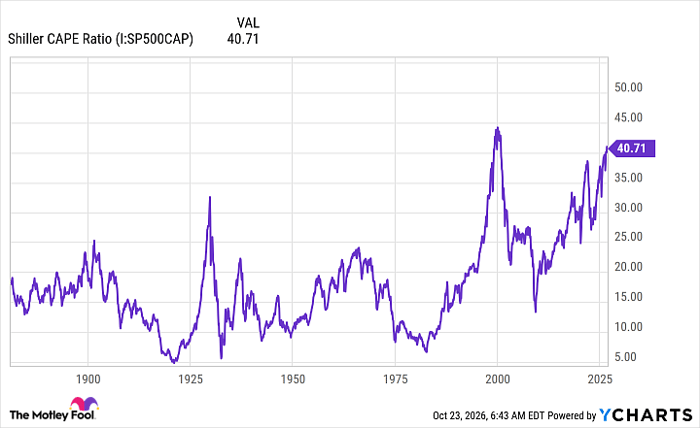
Shiller CAPE Ratio data by YCharts
As you can see in the chart above, this ratio has reached a high, showing that stocks are very expensive right now. And such peaks have always resulted in a decline in the S&P 500. Meanwhile, any earnings disappointment or slowdown in AI demand could prompt some investors to sell stocks -- and the index could drop.
Of course, a potential decline could be small, or it could be a crash -- and the length of the downturn may vary too.
The power of quality stocks
Now here's why I'm not worried: I'm feeling calm about any potential crash because I'm holding onto quality stocks for the long term. For example, I've owned e-commerce and cloud giant Amazon and biotech innovator Vertex Pharmaceuticals for a number of years, and I don't plan on selling any time soon. So, if the market crashes and these and other players tumble, that's OK. I know they have the financial strength and competitive advantages to help them recover and grow after the storm has passed.
Data supports this. If you invested in U.S. stocks at the peak right before the global financial crisis in 2007, you would have seen a 40% decline after a year -- but you would have seen a 109% increase after 10 years, according to iShares by BlackRock.
A look at the S&P 500's performance shows us that it has always delivered a win over the long run.
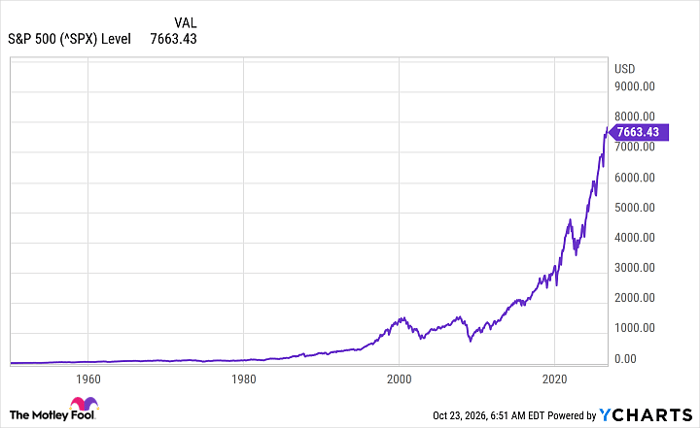
^SPX data by YCharts
And the same is true for companies that have well-established market positions, a track record of earnings growth, and solid long-term prospects.
So, right now, if you want to push aside worries about a potential market crash, you can do two things. First, as I'm doing right now, hold onto stocks that you believe in. Even if they decline during difficult times, they are likely to recover if you hold onto them for several years. Second, use any declines to get in on quality stocks at a good price. These two techniques will help you beat any market crash, and that means, like me, you don't have to worry about the next one.
Should you buy stock in S&P 500 Index right now?
Before you buy stock in S&P 500 Index, consider this:
The Motley Fool Stock Advisor analyst team just identified what they believe are the 10 best stocks for investors to buy now… and S&P 500 Index wasn’t one of them. The 10 stocks that made the cut could produce monster returns in the coming years.
Consider when Netflix made this list on December 17, 2004... if you invested $1,000 at the time of our recommendation, you’d have $355,124!* Or when Nvidia made this list on April 15, 2005... if you invested $1,000 at the time of our recommendation, you’d have $1,296,254!*
Now, it’s worth noting Stock Advisor’s total average return is 901% — a market-crushing outperformance compared to 210% for the S&P 500. Don't miss the latest top 10 list, available with Stock Advisor, and join an investing community built by individual investors for individual investors.
See the 10 stocks »
*Stock Advisor returns as of October 26, 2026.
Adria Cimino has positions in Amazon and Vertex Pharmaceuticals. The Motley Fool has positions in and recommends Amazon, BlackRock, and Vertex Pharmaceuticals. The Motley Fool has a disclosure policy.
Recommended Articles


