


Where Will Bloom Energy Stock Be in 5 Years?
Key Points
Bloom Energy's solid-oxide fuel cells help data centers meet their electricity needs in months.
Years-long grid interconnection queues are fueling strong demand for Bloom's fuel cells.
Over the next few years, Bloom must scale manufacturing and continue to deliver on its major hyperscaler deals.
- 10 stocks we like better than Bloom Energy ›
The AI boom has created an urgent problem: Data centers need enormous amounts of power, and the electric grid can take years to catch up. That bottleneck has opened the door for power equipment providers like Bloom Energy (NYSE: BE) to become a critical bridge power provider for hyperscalers.
Data center demand has been an incredible tailwind, sending Bloom's stock soaring 2,085% since November 2024. The narrative around Bloom Energy has changed in recent years, as the company transforms from a speculative renewable hydrogen play into a data center power story.
Missed Nvidia in 2009? This Rare Signal Is Flashing Again. In 2009, a "Double Down" signal flashed for a little-known chipmaker called Nvidia. For the first time in years, that same "Total Conviction" signal is flashing for a company 1/100th the size of Nvidia. Continue »
The next five years will determine whether Bloom's incredible growth is durable or simply a temporary surge. Here's what Bloom needs to do to keep winning in the coming years.
Bloom Energy secured several major deals in recent years
Over the past several years, Bloom Energy has secured numerous large deals to power utilities and data centers. In November 2024, Bloom signed a landmark deal with American Electric Power for up to 1 gigawatt (GW) of power from its solid-oxide fuel cells (SOFCs). The deal started with a 100 MW order, and earlier this year, American Electric exercised its option for the remainder.
Bloom Energy also has deals with Oracle and Brookfield Asset Management. In April, Bloom expanded on its deal with Oracle to deploy 2.8 GW of fuel cell capacity. Oracle was an early customer that validated Bloom's time-to-power advantage when Bloom delivered its fuel cells well ahead of its 90-day target.

Image source: The Motley Fool.
Meanwhile, Brookfield Asset Management expanded its partnership with Bloom to $25 billion in June, up from their original $5 billion agreement last year.
Bloom Energy will scale manufacturing in the coming years
Next up for Bloom Energy is scaling up manufacturing capacity and delivering on these massive agreements. The company is taking steps to double its near-term run-rate capacity to 2 GW annually, while expanding its industrial footprint. As part of this, Bloom acquired a 158,000-square-foot facility in Fremont, California, to go with its existing 164,000-square-foot plant.
Long-term, Bloom thinks it can scale up to 5 GW in annual capacity. Bloom is scaling its manufacturing using "copy exact" modular increments. One benefit for Bloom is that its return on investment for capacity expansion comes in a few months, not years, as it often does for traditional industrial manufacturers.
With cash on its balance sheet and external financing, Bloom is well capitalized to fund this expansion. At the end of the second quarter, Bloom had nearly $2.7 billion in cash on its balance sheet. The company is generating $175 million in free cash flow. Finally, Bloom's agreements with Brookfield and Industrial Development Funding help absorb funding risk, allowing it to scale without fears of dilution through equity or debt offerings.
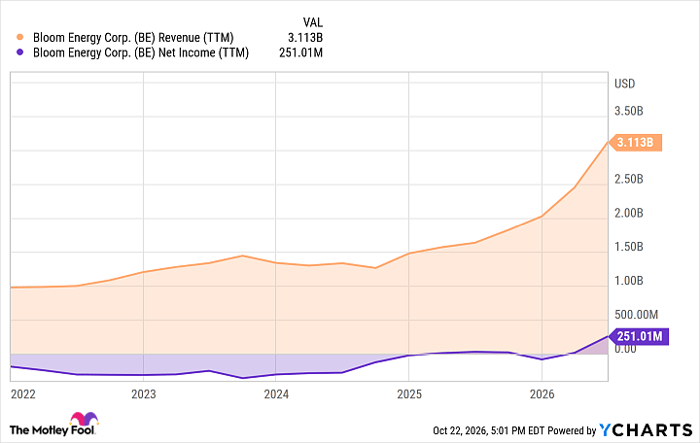
BE Revenue (TTM) data by YCharts
What's next for Bloom Energy
Over the next couple of years, investors will want to see Bloom deliver on its massive hyperscaler deals and prove it can manufacture and deliver solid-oxide fuel cells on time and at scale. Bloom has passed its first test with its initial customers and has proven it can deliver power quickly. Now it's time to scale up and potentially secure even more major deals.
To support this, Bloom is developing and marketing its 800V DC-native energy server platform. This platform will connect DC-native power to DC-native compute, cutting out the middleman and reducing energy waste for hyperscalers. Bloom estimates that this can cut non-computer capital expenditures for a 1 GW data center by $3.6 billion, or 27%.
Bloom will begin deploying early versions of its DC-native platform next year and will expand and retool manufacturing to produce them at scale for data center customers. The Open Compute Project and major semiconductor developers aim to have 800V DC as the default standard by 2028. By 2030, Bloom hopes its energy servers will become the standard for behind-the-meter campuses.
Execution will determine Bloom Energy's future
Bloom Energy has benefited from rising data center power demand, and its backlog stands at $442 million, with management noting that backlog growth is outpacing revenue growth.
However, even after a recent drop, Bloom stock is not cheap, at roughly 40 times forward earnings. This high valuation reflects robust growth, leaving Bloom's stock vulnerable to price volatility. But if it can continue expanding manufacturing capacity, deliver on its massive deals, and generate strong free cash flow, Bloom could deliver strong returns over the next five years.
Should you buy stock in Bloom Energy right now?
Before you buy stock in Bloom Energy, consider this:
The Motley Fool Stock Advisor analyst team just identified what they believe are the 10 best stocks for investors to buy now… and Bloom Energy wasn’t one of them. The 10 stocks that made the cut could produce monster returns in the coming years.
Consider when Netflix made this list on December 17, 2004... if you invested $1,000 at the time of our recommendation, you’d have $355,124!* Or when Nvidia made this list on April 15, 2005... if you invested $1,000 at the time of our recommendation, you’d have $1,296,254!*
Now, it’s worth noting Stock Advisor’s total average return is 901% — a market-crushing outperformance compared to 210% for the S&P 500. Don't miss the latest top 10 list, available with Stock Advisor, and join an investing community built by individual investors for individual investors.
See the 10 stocks »
*Stock Advisor returns as of October 25, 2026.
Courtney Carlsen has positions in Bloom Energy and Oracle. The Motley Fool has positions in and recommends Bloom Energy, Brookfield Asset Management, and Oracle. The Motley Fool has a disclosure policy.
Recommended Articles


