


Micron and Sandisk Hit Record Memory Margins. There's One Clear Winner.
Key Points
Micron is exposed to all facets of the memory chip industry.
Sandisk has locked half of its revenue base into contracts.
- Motley Fool Issues Rare "Total Conviction" Buy Alert ›
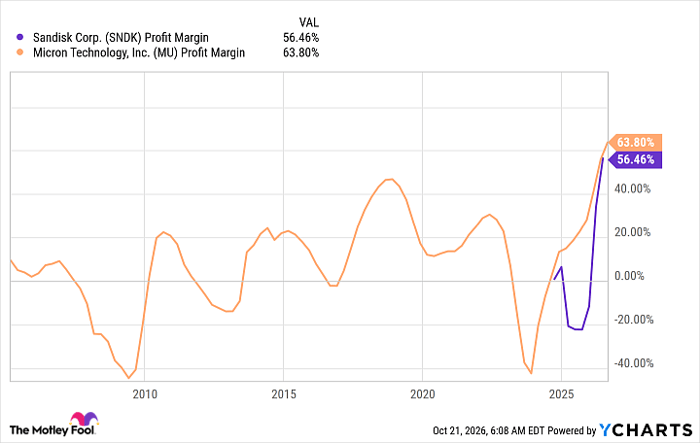
Being a memory chip stock investor during 2026 has been incredibly rewarding. Two of the best performers are Sandisk (NASDAQ: SNDK) and Micron Technology (NASDAQ: MU), and each has delivered impressive returns over the past year. The reason is simple: Memory chip demand is at an all-time high, and supply has run out. Therefore, prices on memory chips have skyrocketed. This has been massively beneficial to Sandisk's and Micron's profit pictures, and each has achieved record margins.
While both stocks are doing quite well, I think there's one clear winner here, and it has far more upside moving forward.
Missed AI’s "Act 1"? Act 2 Could Be 15x Bigger. Most investors think they missed the AI boat because they didn't buy Nvidia in 2005. But according to our analysts, we’re only at the end of "Act 1"—the R&D phase. "Act 2" is the global rollout. Continue »

Image source: Getty Images.
Micron and Sandisk are thriving in today's environment
Micron and Sandisk both make memory chips, but the areas they focus on are different. Both Sandisk and Micron make NAND memory, which is used for long-term data storage, often in devices like solid-state drives. Micron also makes DRAM memory, which is used for quick information access in computing devices. Both of these are important, but one segment of Micron's business stands out.
A subsegment of DRAM memory is HBM -- high bandwidth memory. HBM is what is used inside computing units like graphics processing units (GPUs), and Micron points out that industry HBM shipments will grow at a faster pace than conventional DRAM. For 2027 and 2028, Micron expects industry NAND and DRAM shipments to grow in the low to mid-20% range both years. So, there isn't going to be a lot of growth in these two industries, but with HBM growing faster than DRAM, it will give Micron an edge over Sandisk.
Micron also announced an industry-first partnership: a custom HBM chip for Nvidia (NASDAQ: NVDA). This is a big deal, as Nvidia and its peers were just using off-the-shelf memory chips. But with Micron entering into a partnership with Nvidia, this could lead to a more contractual situation, stabilizing Micron's revenue.
This is an issue for both Sandisk and Micron, as unstable revenue and cash flows are common in the industry. Memory chips are cyclical, and prices can rise and fall with demand. You can see this come to life in Micron's and Sandisk's profit margins, as they are highest when demand is great -- like it is right now.
Data by YCharts.
Both companies are taking steps to mitigate the effects of a downturn by entering into long-term supply agreements with their clients. Basically, Micron and Sandisk are trading the upside of higher memory chip prices for guaranteed revenue. This reduces the ceiling, but also raises the floor of business performance. Since this industry has been plagued by prolonged underperformance due to low demand, this is a smart move. Micron estimates it has now secured about 35% of its revenue through 2030. Sandisk has signed about 50% of its clients to these kinds of contracts.
This is a major evolution for both companies, and it could lead the market to value their stocks higher.
Micron and Sandisk are both cheap
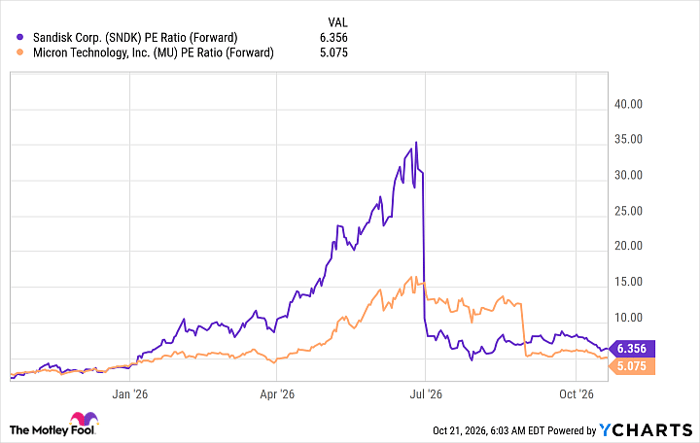
Because the market is expecting a cyclical downturn from both companies at any moment, their stocks don't trade at very high premiums.
Data by YCharts. PE = price-to-earnings.
However, with both companies taking steps to close their cyclical potential, I think they should trade at a nearly average premium for big tech stocks. If they can rally to something like 20 times earnings by the end of their respective fiscal years, that could lead to the stocks tripling or quadrupling in value by this time next year.
That's a huge performance, but that will only occur if the market understands that these two have fundamentally shifted their business to be less exposed to cyclical downturns.
So, which is the winner? I think it's clearly Micron. Micron has exposure to HBM, which will be the highest growth area within the memory chip industry. It's also trading at a far cheaper price tag than Sandisk, giving it more upside. While Sandisk is still a solid pick, Micron offers greater return potential.
Should you buy stock in Micron Technology right now?
Before you buy stock in Micron Technology, consider this:
The Motley Fool Stock Advisor analyst team just identified what they believe are the 10 best stocks for investors to buy now… and Micron Technology wasn’t one of them. The 10 stocks that made the cut could produce monster returns in the coming years.
Consider when Netflix made this list on December 17, 2004... if you invested $1,000 at the time of our recommendation, you’d have $361,596!* Or when Nvidia made this list on April 15, 2005... if you invested $1,000 at the time of our recommendation, you’d have $1,303,935!*
Now, it’s worth noting Stock Advisor’s total average return is 910% — a market-crushing outperformance compared to 211% for the S&P 500. Don't miss the latest top 10 list, available with Stock Advisor, and join an investing community built by individual investors for individual investors.
See the 10 stocks »
*Stock Advisor returns as of October 24, 2026.
Keithen Drury has positions in Micron Technology and Nvidia. The Motley Fool has positions in and recommends Micron Technology and Nvidia. The Motley Fool has a disclosure policy.
Recommended Articles


