


If I Could Tell Every Investor 1 Thing About Stock Market Crashes, It Would Be This
Key Points
Market crashes can be stressful.
But at the end of the day, they are typically part of what makes the market healthy.
Calm and patient investors can even take advantage of market crashes.
- 10 stocks we like better than S&P 500 Index ›
With the bull market now nearly four years in, investors are bracing for some kind of reset.
The worst-case scenario would likely be a repeat of the dot-com bubble, in which the tech-heavy Nasdaq Composite lost roughly 80% of its value between 2000 and 2002.
Missed Nvidia in 2009? This Rare Signal Is Flashing Again. In 2009, a "Double Down" signal flashed for a little-known chipmaker called Nvidia. For the first time in years, that same "Total Conviction" signal is flashing for a company 1/100th the size of Nvidia. Continue »
Many investors have cited similarities between what's going on now with artificial intelligence and the rise of the internet in the late 1990s.
In recent years, the market has gone through several major sell-offs, including the tariff storm in 2025, the market's reaction to rising interest rates in 2022, and the outbreak of the COVID-19 pandemic in 2020.
There's no sugarcoating it: Those were not fun experiences and definitely felt stressful at the time. But if I could tell investors one thing about market crashes, it would be this.

Image source: Getty Images.
Corrections and bear markets are part of investing
Any long-term investors who think the past three or four years are the norm, where the market gains at least 15%, and often over 20%, would be sorely mistaken.
If you are a long-term investor with a five- to 10-year time horizon, expect a pullback. It may not necessarily be an event like the dot-com bubble. It could be a correction, in which the market falls by at least 10% from a recent peak, or a bear market, in which the market declines by at least 20%.
According to a Charles Schwab study published in 2025, there were 27 market corrections between November 1974 and February 2025, meaning there was a market correction roughly every other year during this period.
On six of those occasions -- 1980, 1987, 2000, 2007, 2020, and 2022 -- the broader benchmark S&P 500 (SNPINDEX: ^GSPC) tipped into a bear market.
While it would certainly be nice for the market to grow like a weed every year, corrections and resets are actually what make a healthy market. Often, stocks or sectors soar unjustifiably due to investor enthusiasm and greed, ultimately becoming overvalued.
Those stocks need to reset to maintain market fundamentals and root out bad actors (not that poor performance necessarily means bad actors are involved).
Dips are also good for long-term investors because they allow them to buy stocks of very strong companies at a much better entry point, helping them accumulate more wealth over time. It's tougher to make money in a market where most companies always trade at premium valuations.
The one thing to know about market crashes
As I mentioned, a correction or bear market is never fun, especially if your portfolio is struggling. But the important thing to understand is that these crashes don't often last long.
For instance, according to Schwab, past bear markets tend to be much shorter than past bull markets. Dating back to 1961, past bear markets have averaged a 36% loss and lasted 409 days, or about 13 months.
Meanwhile, past bull markets have, on average, lasted 1,894 days, or slightly over five years, giving investors an average return of 182.5%.
What does this tell us? Those who grind through a bear market often eventually enter a bull market that more than makes up for losses incurred in the bear market.
If you don't believe me, just look back at the period since the 2020 pandemic. There have been two bear markets, and the S&P 500 has still generated fantastic gains.
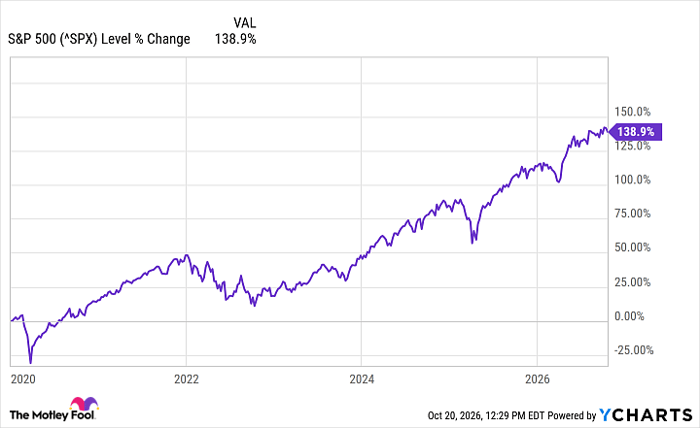
^SPX data by YCharts.
As things stand, four years into a bull market, are we due for some kind of pullback? History suggests the answer is yes. But timing the market is next to impossible, so never try to.
The best thing you can do as an investor is to stay invested in the broader market and battle-test all your individual holdings. Make sure, to the best of your ability, that your investment thesis in a stock looks at what might happen to the company under tougher market or economic conditions.
It may not be a bad idea to have some cash ready to buy stocks if the market crashes.
Should you buy stock in S&P 500 Index right now?
Before you buy stock in S&P 500 Index, consider this:
The Motley Fool Stock Advisor analyst team just identified what they believe are the 10 best stocks for investors to buy now… and S&P 500 Index wasn’t one of them. The 10 stocks that made the cut could produce monster returns in the coming years.
Consider when Netflix made this list on December 17, 2004... if you invested $1,000 at the time of our recommendation, you’d have $361,596!* Or when Nvidia made this list on April 15, 2005... if you invested $1,000 at the time of our recommendation, you’d have $1,303,935!*
Now, it’s worth noting Stock Advisor’s total average return is 910% — a market-crushing outperformance compared to 211% for the S&P 500. Don't miss the latest top 10 list, available with Stock Advisor, and join an investing community built by individual investors for individual investors.
See the 10 stocks »
*Stock Advisor returns as of October 24, 2026.
Charles Schwab is an advertising partner of Motley Fool Money. Bram Berkowitz has no position in any of the stocks mentioned. The Motley Fool recommends Charles Schwab and recommends the following options: short September 2026 $95 calls on Charles Schwab. The Motley Fool has a disclosure policy.
Recommended Articles


