


SpaceX Q3 Sales Rose 161% in Q3. Here's What Starlink, Starship, and AI Results Reveal About the Stock.
Key Points
SpaceX reported $14.58 billion in quarterly revenue and $0.35 in diluted earnings per share.
Starlink’s average revenue per user improved, while AI revenue nearly tripled from the previous quarter.
- 10 stocks we like better than Space Exploration Technologies ›
Space Exploration Technologies (NASDAQ: SPCX) reported its third-quarter earnings after the market closed on Tuesday, Oct. 20.
Ahead of the report, I laid out what I'd be looking for. And, frankly, the latest report was better than I expected in several key ways. Here's a look at what the company's Q3 earnings showed.
Missed AI’s "Act 1"? Act 2 Could Be 15x Bigger. Most investors think they missed the AI boat because they didn't buy Nvidia in 2005. But according to our analysts, we’re only at the end of "Act 1"—the R&D phase. "Act 2" is the global rollout. Continue »
SpaceX's third-quarter results beat expectations
The headline numbers beat Wall Street's targets on the top and bottom lines. SpaceX reported sales of $14.58 billion, well above the $12.72 billion consensus estimate. Diluted earnings were $0.35 per share, beating the $0.13 per share consensus estimate from analysts.
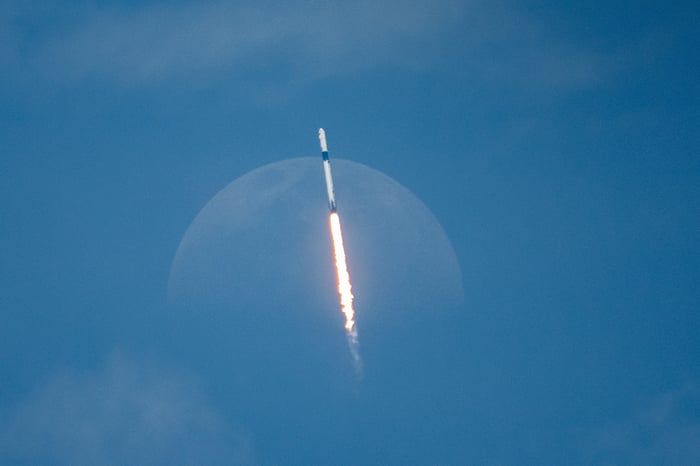
Image source: Getty Images.
Going into the report, I wanted to see whether stronger sales were translating into better profit. It did.
Starlink grows while revenue per user improves
For Starlink, I was especially interested in how much each customer was paying. That figure moved in the right direction.
Average revenue per user, or ARPU, a key figure, rose to $69 a month from $66 last quarter. That's a modest bump, but the trend is what is important. At least for now, it doesn't appear that the company's move into developed markets is affecting the global average.
Still, I wouldn't declare the pricing question settled. It's still pretty early innings, and as time goes on, I still think a higher mix of growth coming from developing nations will lower ARPU and the segment's margins.
Overall, though, the results were strong for the segment, with sales up 69% and operating profit nearly doubling year over year.
Starship's next test is full recovery
For the space business, growth didn't look great. But that was expected as the company has turned its focus on delivering as many Starlink satellites into orbit as it can. The launch business doesn't book any revenue from those. Of course, this dynamic is a big reason why the connectivity segment looks as good as it does.
I was especially interested in what management had to say about Starship, the company's next-generation rocket, designed to be reusable and carry much larger payloads into orbit than the Falcon 9, SpaceX's current workhorse.
The question was whether Starship is getting closer to becoming a reliable, reusable part of the company. What, if any, material updates did the top brass have for the rocket's development timeline?
On the earnings call, Musk said SpaceX expects its next Starship flight in November, when it will attempt to catch both the booster and upper stage as they return to Earth. Management also plans to refly the upper stage and attempt in-orbit refueling early next year.
Those would be meaningful steps toward making Starship a reliable, reusable rocket, and the update gives investors concrete milestones to watch.
AI revenue surges, but spending will accelerate
Right now, the AI business -- or what SpaceX now calls "Super Intelligence" -- is the segment to watch. Revenue reached $7.6 billion, up from $2.6 billion last quarter. Operating profit hit $431 million.
Cursor, the AI coding company SpaceX acquired in August, contributed just $608 million in sales, so most of the growth was organic. It was also a drag on operating profit, which would have come in at about $1.6 billion for the quarter if not for stock compensation expenses related to Cursor.
AI capital expenditures, or capex, while still extremely high, increased modestly, from $15.8 billion to $16.4 billion. However, the company expects that to increase in the fourth quarter. CFO Bret Johnsen told investors to expect total company capex of $35 billion to $40 billion next quarter, with the lion's share going to AI.
A lot went right for SpaceX this quarter. Starlink grew without another decline in ARPU, AI sales are really taking off, and some meaningful progress was made for Starship. Still, capex is accelerating, and the company's financials look considerably worse on a cash basis. Whether that spending will ultimately yield sufficient returns to reward shareholders remains the question that matters most.
Should you buy stock in Space Exploration Technologies right now?
Before you buy stock in Space Exploration Technologies, consider this:
The Motley Fool Stock Advisor analyst team just identified what they believe are the 10 best stocks for investors to buy now… and Space Exploration Technologies wasn’t one of them. The 10 stocks that made the cut could produce monster returns in the coming years.
Consider when Netflix made this list on December 17, 2004... if you invested $1,000 at the time of our recommendation, you’d have $361,596!* Or when Nvidia made this list on April 15, 2005... if you invested $1,000 at the time of our recommendation, you’d have $1,303,935!*
Now, it’s worth noting Stock Advisor’s total average return is 910% — a market-crushing outperformance compared to 211% for the S&P 500. Don't miss the latest top 10 list, available with Stock Advisor, and join an investing community built by individual investors for individual investors.
See the 10 stocks »
*Stock Advisor returns as of October 23, 2026.
Johnny Rice has no position in any of the stocks mentioned. The Motley Fool has no position in any of the stocks mentioned. The Motley Fool has a disclosure policy.
Recommended Articles


