


Prediction: Intel Stock Will Take Off After Oct. 29
Key Points
Intel stock has lost momentum after a stunning performance in the first half of 2026.
The strong demand for server processors and the price hikes that Intel has implemented lately could help the company beat Wall Street's expectations once again.
An improvement in the build-out of AI data centers next year should help Intel stock step on the gas once again.
- Motley Fool Issues Rare "Total Conviction" Buy Alert ›
After rising incredibly in the first half of 2026, Intel (NASDAQ:INTC) stock has run into rough weather in recent months. Shares of the semiconductor specialist are down by 31% since the beginning of July.
However, Intel stock could get a nice shot in the arm following the release of its third-quarter results on Oct. 29. Let's look at the reasons why Intel's upcoming report could give the stock a much-needed boost.
Missed AI’s "Act 1"? Act 2 Could Be 15x Bigger. Most investors think they missed the AI boat because they didn't buy Nvidia in 2005. But according to our analysts, we’re only at the end of "Act 1"—the R&D phase. "Act 2" is the global rollout. Continue »

Image source: Getty Images.
Strong server processor demand will be a tailwind for Intel
The demand for server central processing units (CPUs) has taken off this year. Artificial intelligence (AI) data centers that handle inference and agentic AI workloads are driving increased demand for server CPUs. What's more, the strong demand means server CPUs are now in short supply, which has led to higher prices.
It is reported that Intel has already implemented cumulative CPU price hikes of 30% in 2026, with the latest increase occurring on Oct. 5. I won't be surprised to see further price hikes as the shift toward agentic AI and inference is going to supercharge the server CPU market. That's because the ratio of CPUs to GPUs (graphics processing units) in an inference-oriented AI data center is moving to 1:1. That's a major shift compared to the CPU-to-GPU ratio of 1:4 or 1:8 in a standard AI data center.
McKinsey estimates that inference workloads will account for 60% of AI compute demand by 2030, compared to 40% this year. As a result, the demand for server CPUs should continue to remain robust over the long run. Meanwhile, Intel noted in its July earnings call that "server CPU demand continues to far outpace available supply." This indicates that the favorable pricing environment that has helped Intel beat Wall Street's earnings per share (EPS) expectations handsomely in each of the last four quarters is sustainable.
Analysts are expecting a 21% jump in Intel's Q3 revenue to $16.5 billion. The company's earnings per share could jump by 74% year over year to $0.40, according to consensus estimates on Yahoo! Finance. The estimates sit slightly higher than the midpoint of Intel's revenue guidance of $16.3 billion and EPS guidance of $0.38.
However, the company could easily meet elevated Wall Street expectations given recent CPU price hikes and the shift toward CPU-centric AI workloads. This explains why analysts expect Intel's earnings to triple on a year-over-year basis in the current quarter to $0.44 per share. Its revenue growth is also expected to accelerate to 25% in Q4.
Importantly, analysts anticipate Intel's EPS growth rate to accelerate in 2028.
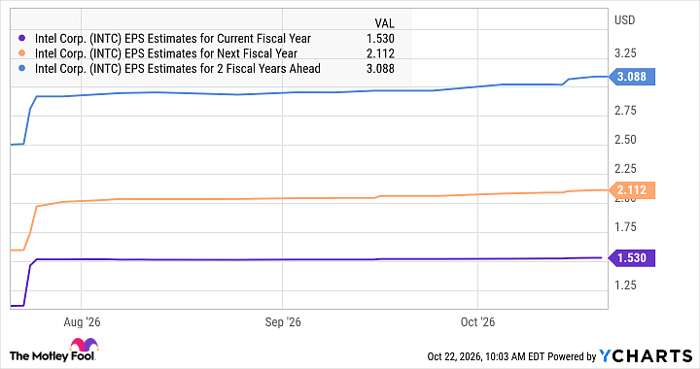
INTC EPS Estimates for Current Fiscal Year data by YCharts
The stock is expensive, but it can justify the valuation
Intel trades at just under 50 times forward earnings. While that's expensive when compared to the tech-focused Nasdaq-100 index's forward earnings multiple of 21, the big earnings beats that Intel has delivered in recent quarters explain the premium valuation.
Also, we have seen that Intel's earnings are growing at an incredible pace this year. The potential 3x year-over-year increase in the chip giant's bottom line in Q4 could spark a massive rally in this semiconductor stock in the final months of 2026. Moreover, we have seen that there is a strong likelihood of Intel actually delivering such a massive bottom-line jump due to the favorable demand-supply dynamics in the server processor market.
Investors should note that Intel's rally can continue in 2027 as well, driven by the strengthening AI infrastructure build-out. SemiAnalysis, which provides independent research on the semiconductor industry, notes that global data center capacity could increase by 51.2 gigawatts (GW) in 2027, double the estimated addition of 25 GW in 2026.
Given that the majority of this additional capacity could be allocated for inference-focused workloads that require server CPUs, Intel could have an even better year in 2027. So, investors looking to add a top AI stock to their portfolios can consider utilizing Intel's recent drop to buy its shares, as there is a strong likelihood that its Oct. 29 earnings report could set it up for a strong finish to the year.
Should you buy stock in Intel right now?
Before you buy stock in Intel, consider this:
The Motley Fool Stock Advisor analyst team just identified what they believe are the 10 best stocks for investors to buy now… and Intel wasn’t one of them. The 10 stocks that made the cut could produce monster returns in the coming years.
Consider when Netflix made this list on December 17, 2004... if you invested $1,000 at the time of our recommendation, you’d have $350,756!* Or when Nvidia made this list on April 15, 2005... if you invested $1,000 at the time of our recommendation, you’d have $1,363,905!*
Now, it’s worth noting Stock Advisor’s total average return is 922% — a market-crushing outperformance compared to 213% for the S&P 500. Don't miss the latest top 10 list, available with Stock Advisor, and join an investing community built by individual investors for individual investors.
See the 10 stocks »
*Stock Advisor returns as of October 23, 2026.
Harsh Chauhan has no position in any of the stocks mentioned. The Motley Fool has positions in and recommends Intel. The Motley Fool has a disclosure policy.
Recommended Articles


