


Is It Too Late to Buy Nvidia Stock?
Key Points
Nvidia's market cap currently hovers around $5 trillion, making it the most valuable company in the world.
Nvidia is quietly evolving from a GPU designer into a more diversified AI platform business.
Despite its high market cap, Nvidia stock is currently trading at its cheapest level in seven years.
- Motley Fool Issues Rare "Total Conviction" Buy Alert ›
By now, you probably agree that Nvidia (NASDAQ: NVDA) is the defining stock of the artificial intelligence (AI) revolution. Since ChatGPT's public debut in November 2022, the semiconductor giant has experienced extraordinary valuation expansion, climbing from a roughly $400 billion market cap to more than $5 trillion.
Naturally, this parabolic ascent raises an important question: Is Nvidia stock too expensive to buy now?
Missed AI’s "Act 1"? Act 2 Could Be 15x Bigger. Most investors think they missed the AI boat because they didn't buy Nvidia in 2005. But according to our analysts, we’re only at the end of "Act 1"—the R&D phase. "Act 2" is the global rollout. Continue »
Not necessarily. One of the biggest mistakes beginner investors make is confusing a company's market capitalization with its underlying valuation. Market cap only tells us what a company is worth in the stock market, but it doesn't reveal how expensive the business is relative to revenue, earnings, or future growth.
Despite Nvidia's historic appreciation, the company's earnings have grown even faster than its stock price. As a result, Nvidia currently trades at one of its most attractive valuations in years. That's why now could be one of the most lucrative opportunities to buy Nvidia stock since the AI revolution began.
Image source: Nvidia.
Nvidia is more than a chip company
When the AI boom started, Nvidia was mostly known for designing graphics processing units (GPUs). These chips are essential for training large language models (LLMs), giving Nvidia an enormous first-mover advantage over competitors.
Under CEO Jensen Huang's leadership, Nvidia has quietly evolved into a full-fledged advanced computing platform spanning GPUs, central processing units (CPUs), networking equipment, and software. Its CUDA software ecosystem makes it easier for AI developers to build applications optimized on Nvidia hardware. Meanwhile, products such as NVLink, Spectrum-X networking, and BlueField data processing units are used to connect clusters of processors inside server racks.
Nvidia works with major hyperscalers, including Amazon Web Services (AWS), Microsoft Azure, Alphabet's Google Cloud, and Meta Platforms. It also supplies infrastructure to emerging AI companies and cloud providers, including Space Exploration Technologies, more commonly known as SpaceX.
Furthermore, Nvidia is expanding its ecosystem through savvy partnerships. Earlier this year, the company invested $2 billion in Marvell Technology, helping integrate custom AI chips into its NVLink platform. Nvidia also committed $2 billion each to Coherent and Lumentum, strengthening its access to optical networking technologies. Moreover, its relationship with Nokia brings the company's presence in telecommunications and edge computing.
All of these moves illustrate how Nvidia's ambitions extend beyond data centers. The company is helping developers build agentic AI, humanoid robotics, industrial automation, and self-driving vehicles. These next-generation applications are creating new demand sources for compute infrastructure alongside the ongoing AI training boom.
Nvidia stock is trading at its cheapest valuation in seven years
As demand for AI infrastructure accelerated, Nvidia's revenue and profitability increased at an extraordinary pace. However, Nvidia's stock price hasn't appreciated as quickly as its profits. This has caused its price-to-earnings (P/E) ratio to compress. In fact, Nvidia's P/E ratio of 27 is its lowest level since June 2019.
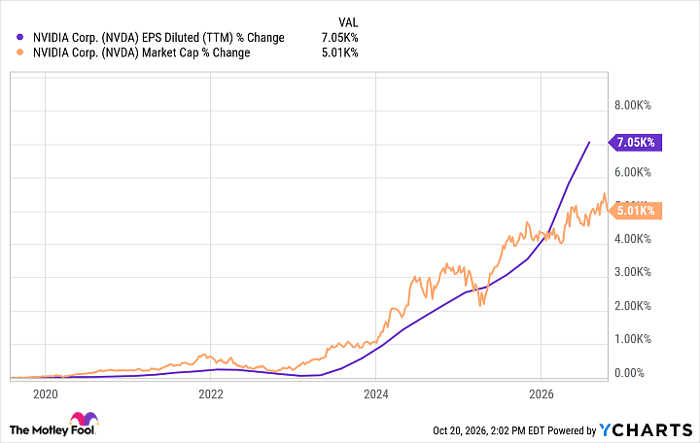
NVDA EPS Diluted (TTM) data by YCharts
Broader AI spending outlooks suggest Nvidia's earnings could continue compounding. Morgan Stanley expects the five largest hyperscalers to spend $1.2 trillion on capital expenditures (capex) in 2027, compared with roughly $800 billion this year. Meanwhile, forecasts from S&P Global Market Intelligence and Goldman Sachs estimate that the hyperscalers will spend over $5 trillion on AI infrastructure by 2030.
Is Nvidia stock a buy right now?
Like any company, Nvidia has experienced its periods of valuation compression. Nevertheless, the company has always emerged with a stronger performance in the long run.
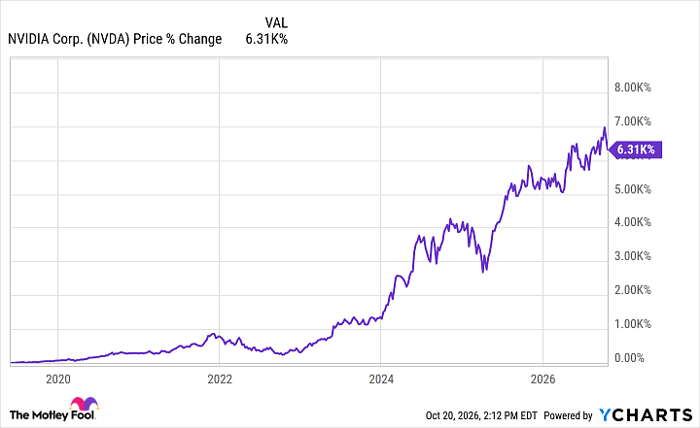
NVDA data by YCharts
The important distinction to make right now is that Nvidia's business is becoming more diversified. The company no longer depends exclusively on selling more GPUs for AI model development. The proliferation of CPUs, networking, software, autonomous vehicles, robotics, and inference deployments provides additional tailwinds to expand revenue and profits.
While Nvidia's $5 trillion market cap might make the stock appear expensive, its earnings-based valuation tells a much different story. With profits accelerating faster than the share price's appreciation, an expanding ecosystem, and trillions of dollars in projected AI infrastructure spending ahead, I see Nvidia stock as a bargain buy-and-hold opportunity right now. For investors with a multiyear horizon, Nvidia's depressed price action could be a generational opportunity rather than a reason to sit on the sidelines.
Should you buy stock in Nvidia right now?
Before you buy stock in Nvidia, consider this:
The Motley Fool Stock Advisor analyst team just identified what they believe are the 10 best stocks for investors to buy now… and Nvidia wasn’t one of them. The 10 stocks that made the cut could produce monster returns in the coming years.
Consider when Netflix made this list on December 17, 2004... if you invested $1,000 at the time of our recommendation, you’d have $370,440!* Or when Nvidia made this list on April 15, 2005... if you invested $1,000 at the time of our recommendation, you’d have $1,330,110!*
Now, it’s worth noting Stock Advisor’s total average return is 924% — a market-crushing outperformance compared to 212% for the S&P 500. Don't miss the latest top 10 list, available with Stock Advisor, and join an investing community built by individual investors for individual investors.
See the 10 stocks »
*Stock Advisor returns as of October 21, 2026.
Adam Spatacco has positions in Alphabet, Amazon, and Nvidia. The Motley Fool has positions in and recommends Alphabet, Amazon, Coherent, Goldman Sachs Group, Lumentum, Marvell Technology, Meta Platforms, and Nvidia. The Motley Fool has a disclosure policy.
Recommended Articles


