


Bank of America Stock Forecast: NII Strength Faces a Wall Street Slowdown Before Q3 Earnings
TradingKey - Bank of America (BAC) moves into this Sunday with its core consumer and lending businesses performing well, but with the momentum in investment banking and trading slowing down from an exceptional second quarter. The last completed U.S. session available for research was October 8, with the stock closing at $53.61, up 0.17%, but still below the $58 to $59 area from mid-September.
The next major catalyst for Bank of America is the release of third quarter results on Wednesday, October 14. The results are scheduled for approximately 6:45 a.m. ET and the accompanying conference call for 8:30 a.m. ET. What is interesting is the rather even balance in the set-up. On the one hand, the traditional franchise is producing strong NII and loan and deposit growth. Management has already commented that Wall Street revenues will not be as strong as in the previous quarter.
Investment Banking Is Set to Fall More Than 10%
On September 14, BofA’s Moynihan said that the bank expected 3Q investment-banking fees to decline at least 10% and come in between $1.6-1.8 billion, down from the $2 billion reported last year. Overall, sales and trading revenues are anticipated to be flat, coming in around $5.4 billion.
Favorable comparisons are being made to 2Q, which was extraordinary. The 33% and 50% increases in the sales and trading and investment-banking divisions, respectively, were driven largely by strong equity markets and investment-banking capital-markets activity.
Moynihan did not describe the deal pipeline as broken. In his September remarks, he said the pipeline is strong. This implies that there are timing and market conditions that may justify some of the slowdown. However, Wednesday’s report will need to provide a clear answer as to whether the slowdown is largely timing related or whether the market conditions are deteriorating to the point where financing is limiting deal activity.
Net Interest Income Is Becoming the Bigger Support
Bank of America’s more traditional banking operations should provide the bigger counterweight. In Q2, net interest income was $16.0 billion, up 9% from the prior year, as higher loan and deposit balances, and positive fixed-rate asset repricing and Global Markets lending, contributed to the increase.
Management expects full-year growth should be toward the top end of the previous 6% to 8% range. This is important as Bank of America is more rate-sensitive than some peers.
Average loans and leases increased 8% to $1.22 trillion in Q2, with all major business segments contributing to the increase. Average deposits increased to $2.02 trillion and increased for the 12th straight quarter.
The strength in loans and deposits, as well as the positive contribution from Global Markets lending, provide a buffer should Bank of America’s investment bank experience a slowdown.
The main challenge for Bank of America, like other banks, is net interest margin. Higher rates can provide support to asset yields, but higher rates can also push up the cost of deposits, thus negatively impacting net interest margin.
For Wednesday’s report, I would highlight NII growth and how much of that benefit is being preserved after funding costs.
Q2 Earnings Set a Strong Fundamental Base
In Q2, Bank of America’s net income was $9.1 billion, up 27% from the year prior, and diluted EPS was $1.21, up 34% from the year prior. Revenues were $31.6 billion, up 15% from the year prior.
Return on average tangible common equity was 17.0%, and the efficiency ratio was 59%, down from 61% last quarter. Operating leverage was 6.6%.
In my view, this is the more relevant information. Double-digit revenue growth and single-digit expense growth is what allowed profitability to increase. This indicates that the investment in the technology, distribution and talent has paid off.
The main challenge is the comparison effect. Elevated trading and investment banking activity in Q2 created a very strong baseline, so Q3 is not expected to meet the absolute levels seen in Q2. The more relevant question is if the steadily compounding consumer, wealth and lending businesses offset underperformance in capital markets.
Consumer Credit Still Looks Manageable
Consumer credit is another area of strength. During the second quarter, provisions for credit losses decreased to $1.4 billion from $1.6 billion in the prior year, and net charge-offs also decreased to $1.4 billion from $1.5 billion in the prior year.
Moynihan stated in September that consumer spending was still strong and credit quality remained healthy. Credit losses and charge-offs have the potential to increase should further inflation lead to a significant slowdown in the economy. Higher rates and inflation will especially impact lower income households and credit card users, but these effects may not be seen immediately.
Bank of America has reported no broad credit issues so far, and because of this, the provision for credit losses and charge-off rates will be important to watch in the third quarter. Continued strength in consumer spending offsets and balances slowed Wall Street trading.
Charge-offs staying low will also support the bank’s retail franchise.
AI Spending Is Becoming a Larger Strategic Priority
Bank of America is also ramping up its in-house AI investment. According to one of the bank’s Co-Presidents, Jim DeMare, the AI budget will roughly double next year. Mr. DeMare cited existing AI tools as aiding productivity. Bank of America’s goal isn’t to build an AI platform like Amazon or Google. Rather, they want to leverage AI for numerous functions within their business such as processes for employees, how operations flow, and helping their staff serve clients better. Bank of America’s investments are focused on using AI within their back office, and in helping its front office better service clients.
While technology investments are not always directly reflected in the bottom line, over the long run, AI expenditures will pay off only if revenues increase faster than expenditures.
The second quarter Efficiency Ratio was improved from the previous year. Operating Leverage is improving but Wednesday’s report will determine if the bank held to its disciplined approach.
Bank of America Technical Analysis: BAC Tests $53.61 Support as Oversold RSI Signals Rebound Potential
Bank of America closed October 8 at $53.61, after declining steeply from the August highs above $64. The stock has lost the rising trendline and broken below both moving averages. It has also formed a series of lower highs and lower lows. Currently, the stock is testing $53.50 to $53.78 zone, where the buyers are trying to find support.
Bank of America is currently very oversold, and RSI is at 25, just below its signal line of 26. This confirms a lot of selling pressure, but increases the probability of a bounce in the near term, especially if the current support level holds.
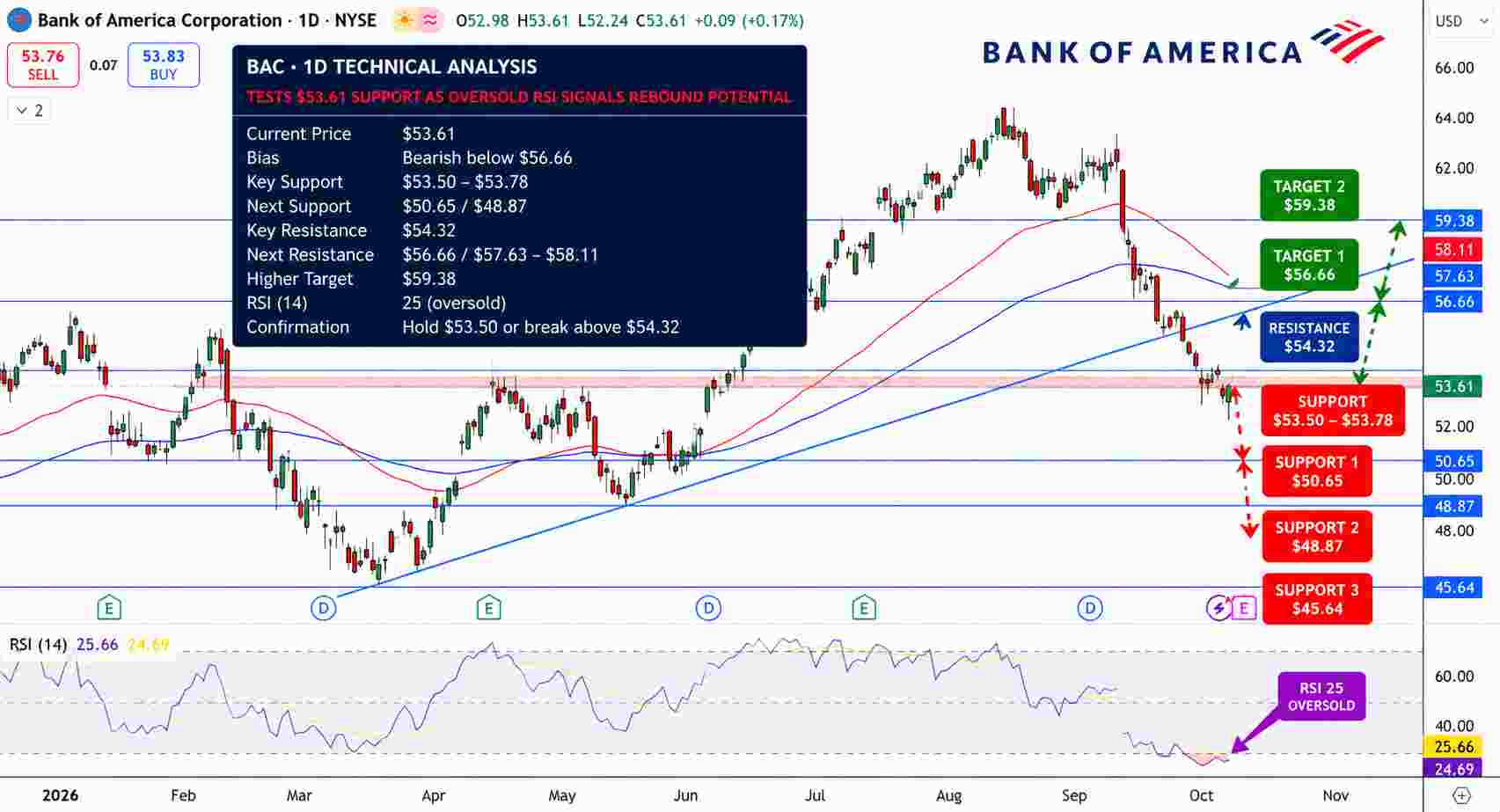
Bank of America Price Chart - Source: Tradingview
The first resistance is at $53.78, and a move above this area makes $54.32 the next target. A daily close above $54.32 will bring $56.66 into focus, where the broken trendline could act as resistance. Beyond $56.66 the $57.63 to $58.11 resistance zone will be in play.
The first real support is at $53.50. Below there, support levels at $50.65 and $48.87 will come into play. Much lower, $45.64, may also be tested.
Until the price trades above $56.66, I will maintain a bearish view. However, the RSI is firmly oversold and a relief bounce is possible.
Why is Bank of America stock in focus this Sunday?
Bank of America reports quarterly earnings this Wednesday, and the street is watching to see if positive trend in NII, loans and deposits will be enough to make up for the clear slow down in their investment banking and trading activities. Management has already warned that Q3 investment-banking fees will be down at least 10% from the previous year.
What level confirms a stronger BAC recovery?
A daily closing price above $56.66 would shift the short-term outlook to more bullish, and increase the probability of an upside move to the $57.63 to $58.11 resistance zone. A close below $53.50 would strengthen the bearish trend, and put $50.65 in focus.
Bottom Line
Bank of America is reporting earnings this Wednesday with a better core business than the recent weakness in the equity price reflects. NII is heading north, loans and deposits are increasing, credit quality remains in check, and the management team is returning capital to shareholders. Wall Street activities, on the other hand, paint a different picture. Management has signaled lower investment banking fees, flat trading, and higher interest rates making the financing environment less attractive. Technically, BAC is still in a downtrend below $56.66, but the RSI is at oversold levels, increasing the potential for a relief bounce. Fundamentally, Wednesday’s report will need to show that strengths in traditional banking will be enough to make up for a less than stellar performance in capital markets.
Recommended Articles


