


CBRS Stock Price Forecast: Pulls Back Over 50% From All-Time High as OpenAI Shift to Nvidia Weakens Strategic Position; Will the Stock Recover?
TradingKey - In the week ended October 9, shares of Cerebras Systems (CBRS) once again approached their all-time low since listing on Nasdaq. The AI chip company went public in May this year with a market capitalization of nearly $95 billion and was viewed by investors as a challenger to Nvidia in the AI chip sector; however, its stock price has remained under pressure since then and has now pulled back more than 50% from its historic high.
The immediate catalyst for the sharp pullback in valuation was OpenAI's decision to choose Nvidia GPUs, rather than Cerebras chips, to provide computing power support when launching its GPT-6.1 Sol "Ultrafast" mode.
For an AI chip company still in its early commercialization stage with market attention closely focused on its customer expansion progress, this news quickly sparked investor concerns regarding its core customer relationships. What the market is truly worried about is not OpenAI selecting Nvidia for a single product launch, but whether OpenAI is handing over more critical inference workloads to Nvidia, thereby undermining Cerebras's strategic position in OpenAI's supply chain.
Why Is Cerebras Stock Price Falling?
Cerebras's core selling point is providing faster processing speeds for specific artificial intelligence workloads through ultra-large specialized chips and AI computing systems. Compared with Nvidia's general-purpose GPUs, Cerebras seeks to build a differentiated advantage in inference speed, system efficiency, and responsiveness in specific scenarios.
Therefore, when OpenAI chose Nvidia GPUs for the "Ultrafast" mode of GPT-6.1 Sol, the market naturally interpreted it as a competitive signal: even if Cerebras can deliver high-speed inference capabilities, OpenAI may still prioritize relying on Nvidia's mature GPU ecosystem and supply capacity.
The reason this concern quickly magnified is related to the massive partnership agreement previously signed between Cerebras and OpenAI. In January this year, the two companies signed a $10 billion agreement under which Cerebras will supply 750 megawatts of computing power to OpenAI over the contract period through 2028. For Cerebras, this agreement not only signifies revenue expectations, but also represents an opportunity to become a key infrastructure supplier for a frontier AI lab.
Precisely because of this, OpenAI's adoption of Nvidia GPUs for a new product was seen by the market as a repricing of Cerebras's future orders and customer stickiness. If OpenAI hands over more inference tasks to Nvidia in the future, Cerebras's order fulfillment, revenue growth, and valuation logic could all be impacted.
However, the hardware selection for a single product cannot be directly equated to a reversal in their partnership. Citi analysts stated last week that they have not lowered their revenue forecasts for Cerebras through 2028. Their rationale is that new models from frontier AI labs may initially launch on internal chips before gradually migrating to run on third-party platforms or the Cerebras cloud; therefore, it may still be premature for the market to judge based on this that Cerebras is being marginalized.
However, Citi also pointed out that gross margin is the key variable determining whether Cerebras's stock price can stabilize. The company's current valuation remains elevated, and investors need to see revenue growth ultimately translate into more stable profits. If gross margins continue to decline, market confidence could be further hit even if the company manages to maintain its revenue expectations.
In other words, Cerebras's recent decline is not simply because "OpenAI used Nvidia," but because this news simultaneously touches upon three sensitive issues: whether core customers will reduce their reliance, whether long-term contracts can be fulfilled, and whether the company can prove sufficient profitability under a high valuation.
Can Cerebras Keep Rising?
Cerebras still has upside potential, but a stock price rebound will require new fundamental evidence rather than relying solely on the AI chip concept and previous customer expectations.
First, the market needs confirmation that the $10 billion agreement with OpenAI can consistently translate into actual orders and compute deployment. If the 750-megawatt supply plan proceeds as contracted, Cerebras's revenue visibility will improve significantly. For a company still scaling its commercial operations, stable anchor customers and long-term contracts can help secure financing, expand capacity, and alleviate market concerns over customer churn.
In addition, Cerebras needs to prove that its relationship with Nvidia is more complementary than a simple substitution. Nvidia GPUs boast a comprehensive software ecosystem and strong supply capabilities, making them suitable for a broad range of training and inference scenarios. Cerebras, on the other hand, may leverage its advantage in certain inference tasks that require high speed and response efficiency. As long as AI workloads continue to grow, frontier labs do not necessarily have to choose only one chip.
However, this complementary logic must be validated through actual revenue and customer deployment. If OpenAI and other major clients shift more of their core inference workloads to Nvidia in the future, Cerebras will need to rely on new customers, new contracts, or new use cases to fill the gap. Otherwise, the market may re-evaluate its customer concentration and room for growth.
Therefore, key catalysts for Cerebras's future stock price may include securing new customer orders, further execution of the OpenAI contract, stabilizing gross margins, and getting more products into actual production environments. Conversely, if order delays occur, customer concentration rises, gross margins decline further, or OpenAI shifts further toward Nvidia, the stock price could remain under pressure.
From a valuation perspective, Cerebras has already been priced by the market with high growth expectations. A rich valuation means the company must not only maintain growth, but also consistently deliver results that exceed expectations. If business progress falls even slightly short of expectations, stock price volatility could be amplified.
Cerebras Technical Analysis
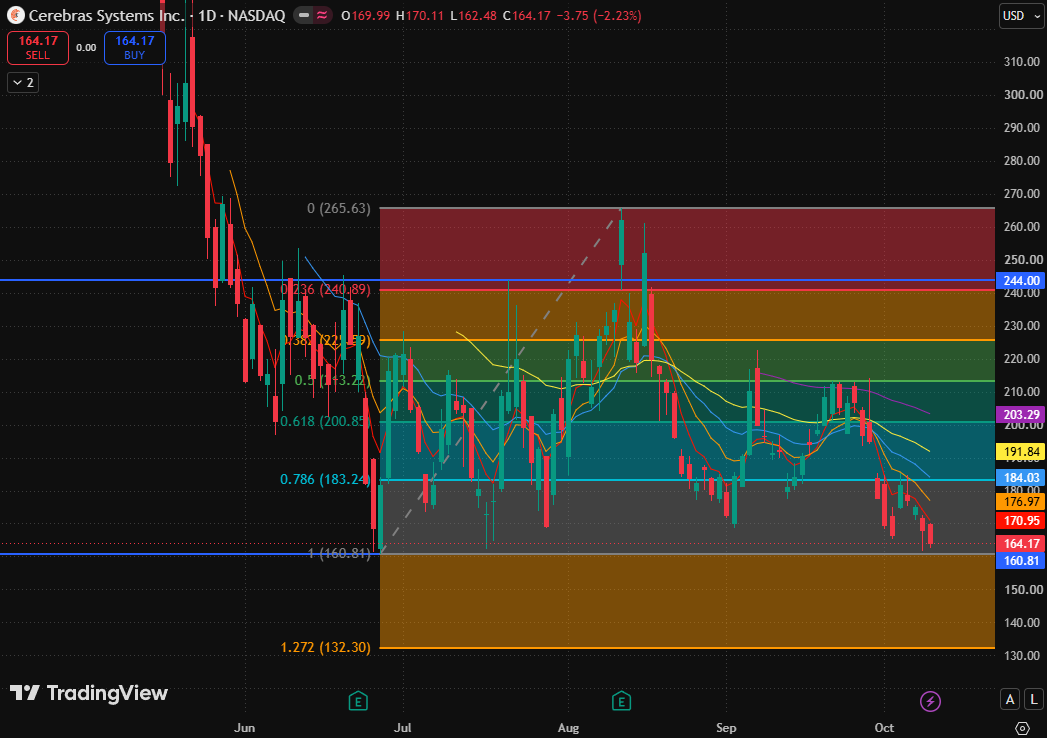
Looking at the stock chart of Cerebras Systems, CBRS has dropped below the 0.786 Fibonacci retracement level ($183.24) and is currently testing support near its previous low of $160.81.
After pulling back from its previous high of $265.63, the stock's rebounds have consistently failed to reclaim the 0.618 Fibonacci retracement level ($200.85) and the 0.786 Fibonacci retracement level ($183.24), and momentum has weakened again recently.
Regarding moving averages, the 5-day moving average is at $170.95, the 10-day at $176.97, the 20-day at $184.03, the 80-day at $191.84, and the 160-day at $203.29. The current price is below all moving averages, which are aligned downward sequentially from short- to long-term in a clear bearish setup, with no daily trend recovery signal appearing yet.
$160.81 is currently the most critical support, located in a price area near historical lows; whether the daily close can hold above this level will determine if a short-term rebound materializes. If the stock convincingly breaks below this price, it indicates that the previous rebound structure has completely failed, and the price may move down to the 1.272 Fibonacci extension level ($132.30) to seek new support.
Overhead resistance is seen first at the 5-day moving average of $170.95, followed by the 10-day moving average of $176.97 and the 0.786 Fibonacci retracement level of $183.24; before reclaiming these positions, any rebound is better viewed as a weak recovery.
Recommended Articles


