


SpaceX Reportedly Wants $40 Billion to Buy Artificial Intelligence (AI) Chips. Here's Why That's Huge News for Nvidia Investors.
Key Points
Artificial intelligence (AI) hyperscalers have been issuing debt to fund infrastructure build-outs.
Bloomberg reports that SpaceX is seeking $40 billion to buy more AI chips.
Elon Musk has publicly made his preference for Nvidia GPUs and CPUs clear.
- 10 stocks we like better than Space Exploration Technologies ›
According to a Bloomberg report, Space Exploration Technologies (NASDAQ: SPCX) is seeking $40 billion in financing to purchase artificial intelligence (AI) chips from Nvidia (NASDAQ: NVDA). Apollo Global Management is rumored to be leading the transaction, which would include $10 billion of bank loans and another $30 billion of investment-grade debt. The deal has not yet been confirmed by SpaceX, Nvidia, or Apollo. Moreover, the transaction wouldn't be expected to close until 2027.
Nevertheless, none of this is difficult to believe. SpaceX is rapidly building an AI infrastructure business that has billions of dollars of contracted revenue. CEO Elon Musk has also made his preference for Nvidia hardware unusually clear. If the debt financing happens, it provides another signal that the AI boom is nowhere close to running out of money.
Missed Nvidia in 2009? This Rare Signal Is Flashing Again. In 2009, a "Double Down" signal flashed for a little-known chipmaker called Nvidia. For the first time in years, that same "Total Conviction" signal is flashing for a company 1/100th the size of Nvidia. Continue »
Image source: Nvidia.
SpaceX is becoming a huge Nvidia customer
SpaceX is quietly building a budding compute-leasing business. Anthropic is paying $1.25 billion per month for access to roughly 325,000 Nvidia GPUs, while Google is contracted for $920 million per month for access to around 110,000 Nvidia GPUs. Reflection AI, a start-up that is backed by Nvidia, is part of an agreement worth $150 million per month for access to Nvidia's GB300 chips inside SpaceX's Colossus 2 data center.
Moreover, during SpaceX's second-quarter earnings call, management disclosed $6.7 billion of additional cloud services revenue during the opening weeks of the third quarter, with capacity ramping up over a six-month period. Subsequently, SpaceX disclosed another unnamed hosting customer expected to generate $1.1 billion of monthly revenue beginning in December.
During SpaceX's Q2 earnings call, Musk said SpaceX has decided to build "exclusively" on Nvidia because he believes the Vera Rubin architecture is the best AI computer. SpaceX expects its cumulative compute capacity to approach 10 gigawatts by the end of 2027. That's an extraordinary amount of infrastructure, and it will cost a lot of money to build under such an aggressive time frame.
$40 billion underscores how expensive the AI race is becoming
SpaceX's biggest challenge to building its AI road map may be paying for all this growth. The company spent $18.4 billion on capital expenditures (capex) during the second quarter alone. In addition, its free cash flow through the first six months of the year was negative $25 billion as SpaceX simultaneously invested in AI data centers, Starlink, and Starship.
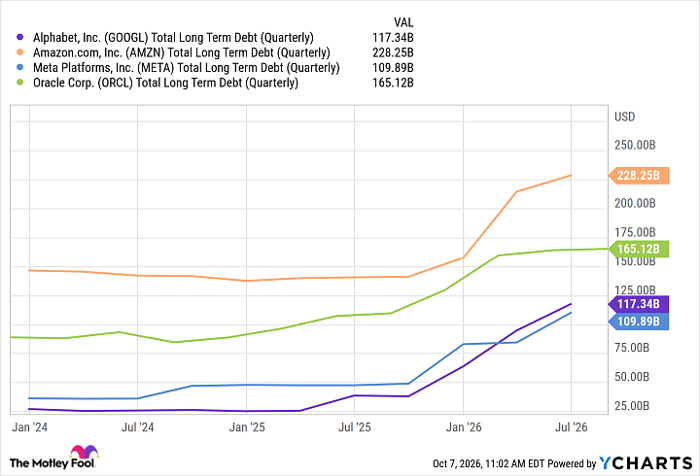
The ongoing cash burn is what makes a massive debt raise easier to understand. AI hyperscalers including Amazon, Alphabet, Meta Platforms, and Oracle collectively issued roughly $194 billion of bonds through early July as these companies increasingly turned toward debt markets to finance AI infrastructure. Lindsay Rosner, who leads Multi-Sector Investing in Goldman Sachs Asset Management, says the hyperscalers could issue another $420 billion of debt in 2027 as infrastructure build-outs remain a priority.
GOOGL Total Long Term Debt (Quarterly) data by YCharts
The pace at which big tech is issuing debt showcases how the AI revolution is increasingly becoming a financing boom. This borrowing does not necessarily mean hyperscalers are struggling, though. They're issuing bonds because the amount of infrastructure they want to build is becoming so enormous that even the companies generating enormous cash flow still need to tap outside capital. SpaceX potentially borrowing additional capital fits directly into this trend.
Nvidia is the biggest winner of the AI infrastructure boom
The interesting way to think about all this is that Nvidia gets paid to supply much of the data center infrastructure for AI hyperscalers. During the second quarter, Nvidia generated $89 billion of data center revenue, up 117% year over year. Importantly, the hyperscalers contributed $48.7 billion of revenue to the data center segment, an increase of 102% year over year.
Investors should not treat SpaceX's reported $40 billion financing as a completed deal just yet. But the idea fits a much larger pattern. AI infrastructure spending is becoming so capital-intensive that the world's largest technology companies are increasingly using debt to supplement their cash flow.
If SpaceX does raise tens of billions of dollars specifically to purchase Nvidia hardware after committing itself to Vera Rubin, it reinforces something that's becoming increasingly difficult to ignore: Nvidia remains one of the biggest toll collectors of the entire AI infrastructure boom.
Should you buy stock in Space Exploration Technologies right now?
Before you buy stock in Space Exploration Technologies, consider this:
The Motley Fool Stock Advisor analyst team just identified what they believe are the 10 best stocks for investors to buy now… and Space Exploration Technologies wasn’t one of them. The 10 stocks that made the cut could produce monster returns in the coming years.
Consider when Netflix made this list on December 17, 2004... if you invested $1,000 at the time of our recommendation, you’d have $370,440!* Or when Nvidia made this list on April 15, 2005... if you invested $1,000 at the time of our recommendation, you’d have $1,470,022!*
Now, it’s worth noting Stock Advisor’s total average return is 955% — a market-crushing outperformance compared to 215% for the S&P 500. Don't miss the latest top 10 list, available with Stock Advisor, and join an investing community built by individual investors for individual investors.
See the 10 stocks »
*Stock Advisor returns as of October 7, 2026.
Adam Spatacco has positions in Alphabet, Amazon, and Nvidia. The Motley Fool has positions in and recommends Alphabet, Amazon, Goldman Sachs Group, Meta Platforms, Nvidia, and Oracle. The Motley Fool has a disclosure policy.
Recommended Articles


