


If I Were in My 40s, I'd Buy This Vanguard ETF Warren Buffett Recommended and Hold It Forever
Key Points
Warren Buffett guided the Berkshire Hathaway investment company to market-beating returns for 60 years.
He often said buying an exchange-traded fund that tracks a diversified index like the S&P 500 is the best investment option for the average person.
In February 2014, he specifically recommended the Vanguard S&P 500 ETF because of its exceptionally low fees, and investors who took his advice continue to do very well.
- 10 stocks we like better than Vanguard S&P 500 ETF ›
Warren Buffett stepped down from his role as the chief executive officer of Berkshire Hathaway (NYSE: BRKA)(NYSE: BRKB) at the end of 2025. During his 60-year tenure, he grew the company into a $1 trillion conglomerate with multiple wholly owned subsidiaries, a $350 billion stock portfolio, and over $350 billion in cash.
Had an investor purchased $500 worth of Berkshire shares when Buffett took the helm in 1965, thatr person would have been sitting on a whopping $24 million by the time Buffett stepped down. However, Buffett was a full-time professional investor, so he always knew the average person would struggle to replicate his results. That's why he regularly advocated for exchange-traded funds (ETF) that track a diversified index like the S&P 500 (SNPINDEX: ^GSPC).
Missed AI’s "Act 1"? Act 2 Could Be 15x Bigger. Most investors think they missed the AI boat because they didn't buy Nvidia in 2005. But according to our analysts, we’re only at the end of "Act 1"—the R&D phase. "Act 2" is the global rollout. Continue »
In his 2013 annual letter to shareholders (published in February 2014), Buffett specifically recommended the Vanguard S&P 500 ETF (NYSEMKT: VOO) because of its exceptionally low fees. While young investors in their 20s and 30s can afford to take more risks, those in their 40s who want to achieve financial security heading into retirement might want to heed Buffett's advice. Here's why I'd buy the Vanguard ETF if I were in that age group.

Image source: Getty Images.
Diversified exposure to America's largest companies
The S&P 500 is made up of 500 American companies from 11 different sectors of the economy. It has a very strict entry criteria, requiring its members to maintain a market capitalization of at least $22.7 billion, and they must also generate positive earnings. But even after meeting those conditions, a special committee still has the final say over which companies make the cut.
The S&P 500 is weighted by market capitalization, so the most valuable companies in the index have a greater influence on its performance than the least valuable. Therefore, even though the S&P is highly diversified, the technology sector alone has a weighting of 37.9% because its five largest members are worth a combined $17 trillion. They are Nvidia, Apple, Microsoft, Broadcom, and Micron Technology.
Here are all 11 sectors in the Vanguard S&P 500 ETF by weight, and their largest member by market cap.
|
S&P 500 Sector |
Sector Weighting |
Largest Company |
|---|---|---|
|
1. Information technology |
37.9% |
Nvidia |
|
2. Financials |
12.3% |
Berkshire Hathaway |
|
3. Communication services |
9.5% |
Alphabet |
|
4. Healthcare |
9.3% |
Eli Lilly |
|
5. Consumer discretionary |
9.1% |
Amazon |
|
6. Industrials |
8.3% |
Caterpillar |
|
7. Consumer staples |
4.5% |
Walmart |
|
8. Energy |
3.5% |
ExxonMobil |
|
9. Utilities |
2% |
NextEra Energy |
|
10. Materials |
1.8% |
Linde PLC |
|
11. Real estate |
1.8% |
Welltower |
Data source: Vanguard. Sector weightings are accurate as of Aug. 31, 2026, and are subject to change.
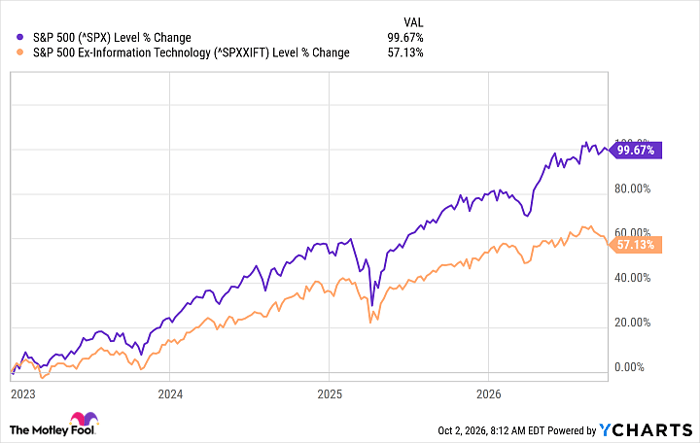
The information technology sector has consistently led the S&P 500 higher over the last couple of decades, thanks to the expanding adoption of smartphones, personal computers, enterprise software, cloud computing, and more. But the sector has made a particularly strong contribution to the index's performance since the start of 2023, which is when the artificial intelligence (AI) boom started gathering momentum.
The S&P 500 has returned 99% since then, but if we exclude information technology stocks, that return shrinks to just 57%.
^SPX data by YCharts
Buffett's advice is yielding exceptional results so far
The S&P 500 has delivered a compound annual return of 10.7% since its inception in 1957. But it has produced an even higher yearly return of 13.9% since Buffett recommended the Vanguard S&P 500 ETF in early 2014, driven primarily by the tech sector.
That means an investor who parked $50,000 in the ETF 12-and-a-half years ago would have around $254,399 today. That doesn't include costs, but with an exceptionally low expense ratio of 0.03%, investors would incur an annual fee of just $15 for every $50,000 they have invested in the fund.
A 45-year-old investor who plans to retire at around age 65 could build a solid nest egg using the Vanguard S&P 500 ETF, although its size will depend on the average yearly return from this point forward.
|
Starting Balance Today |
Compound Annual Return |
Balance After 20 Years |
|---|---|---|
|
$50,000 |
10.7% |
$381,876 |
|
$50,000 |
13.9% |
$675,218 |
Calculations by author.
It might be a good idea to hold onto the ETF even after retirement, because with a large enough balance, the subsequent annual returns could provide a very robust income stream to enhance life after employment.
Should you buy stock in Vanguard S&P 500 ETF right now?
Before you buy stock in Vanguard S&P 500 ETF, consider this:
The Motley Fool Stock Advisor analyst team just identified what they believe are the 10 best stocks for investors to buy now… and Vanguard S&P 500 ETF wasn’t one of them. The 10 stocks that made the cut could produce monster returns in the coming years.
Consider when Netflix made this list on December 17, 2004... if you invested $1,000 at the time of our recommendation, you’d have $361,650!* Or when Nvidia made this list on April 15, 2005... if you invested $1,000 at the time of our recommendation, you’d have $1,437,517!*
Now, it’s worth noting Stock Advisor’s total average return is 936% — a market-crushing outperformance compared to 213% for the S&P 500. Don't miss the latest top 10 list, available with Stock Advisor, and join an investing community built by individual investors for individual investors.
See the 10 stocks »
*Stock Advisor returns as of October 5, 2026.
Anthony Di Pizio has no position in any of the stocks mentioned. The Motley Fool has positions in and recommends Alphabet, Amazon, Apple, Berkshire Hathaway, Broadcom, Caterpillar, Eli Lilly, Micron Technology, Microsoft, NextEra Energy, Nvidia, Vanguard S&P 500 ETF, and Walmart. The Motley Fool recommends Linde. The Motley Fool has a disclosure policy.
Recommended Articles


