


JPMorgan Chase Earned More in 2025 Than Bank of America and Wells Fargo Combined. Can the Stock Keep Outrunning Them?
Key Points
Not all banks’ profit centers are similarly proportional.
Rising interest rates aren't as beneficial in a lethargic economic environment as they are in a strong economy.
This backdrop works against some banks more than others, although the big differentiator here is the near-term future of capital markets.
- 10 stocks we like better than JPMorgan Chase ›
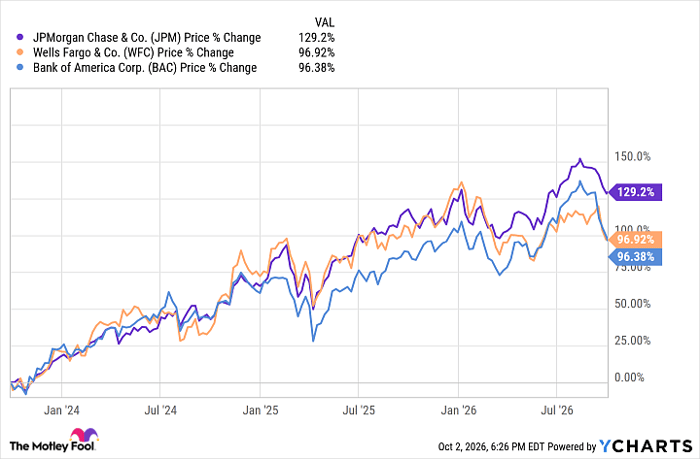
They may all be categorized as banking stocks. But they're certainly not all performing the same. Over the past three years, shares of JPMorgan Chase (NYSE: JPM) have measurably outperformed those of Bank of America (NYSE: BAC) and Wells Fargo (NYSE: WFC). JPM stock is up nearly 130% since early October 2023, in fact, while WFC and BAC have recently dialed back their performances for this time frame to less than 100%. By slower-moving bank stock standards, that's a significant difference.
Missed Nvidia in 2009? This Rare Signal Is Flashing Again. In 2009, a "Double Down" signal flashed for a little-known chipmaker called Nvidia. For the first time in years, that same "Total Conviction" signal is flashing for a company 1/100th the size of Nvidia. Continue »
JPM data by YCharts
What gives?
A deeper dive into these organizations' profit profiles explains what's at work here. Moreover, how these mixes differ sets up JPMorgan shares for continued outperformance.
One of these things is not like the other
At first blush, they're all similar enough. Digging into the details of their full-year reporting, however, reveals some stark differences between these three names. Not only is JPMorgan Chase bigger than the other two banks in terms of total revenue and net income, but it is also bigger specifically because it does so much more corporate and investment banking than BofA or Wells Fargo.
Last year, well over half of JPMorgan's bottom line came from investment banking and corporate-oriented services, topping Wells Fargo's corporate and investment banking proportion of its earnings and trouncing Bank of America's 45.1%. Conversely, JPMorgan (through Chase) does relatively less consumer banking business than BofA or Wells Fargo.
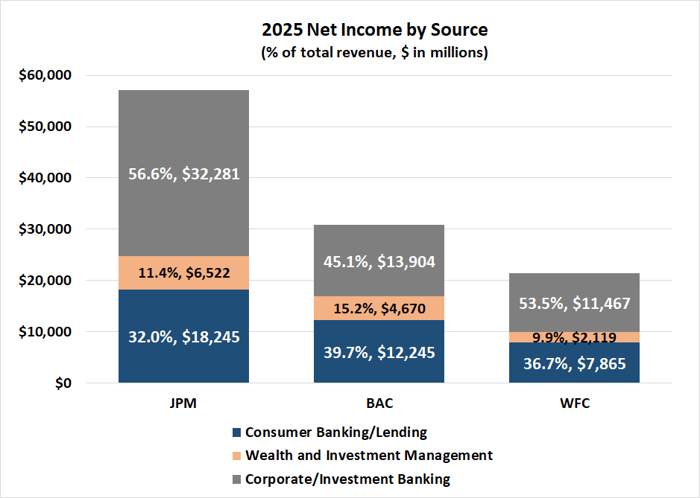
Data sources: JPMorgan Chase, Wells Fargo, and Bank of America 2025 investor reports. Chart by author.
And this matters now and for the foreseeable future.
Although higher interest rates are generally positive for banks' lending businesses -- since it widens the profit margins on loans -- the recent uptick in interest rates may not be the boon it typically is. The economy is sluggish due to lingering inflation, crimping demand for loans. Indeed, the Mortgage Bankers Association reports applications for mortgage loans were down roughly 24% year over year last week, extending a trend that now has the MBA's purchase applications index at a new 52-week low.
You can't make money on loans you're not even being asked to extend, posing a bigger problem for Wells Fargo and JPMorgan, and an even bigger problem for Bank of America, which does more consumer-facing business.

Image source: Getty Images.
The differences between these three banks' business mixes will likely become even more apparent, however, as demand for corporate fundraising swells. See, mega-IPOs like Anthropic's and OpenAI's remain on the horizon following Space Exploration Technologies' record-breaking capital raise in June of this year. Although these two (and other) companies are holding off on their planned IPOs for now to make their pitch to a more confident market, they won't wait forever. They can't. The next hint of economic strengthening that suggests support for strong public offering prices could prompt these and other outfits to take the plunge. Although Wells Fargo and BofA are both in the business, capital markets is JPMorgan's bread and butter.
To this end, the graphic above may somewhat understate JPMorgan Chase's place in the capital markets/fundraising arena. Investment banking fees and principal transactions alone accounted for over 40% of the big bank's non-interest revenue in 2025, while only 12% of Bank of America's non-interest revenue came from investment banking. Separately but similarly, JPMorgan is consistently the world's biggest investment bank in terms of total volume. It's got the inside track to most of whatever public offerings and fundraisers are in the pipeline.
Now, but not necessarily forever
Continued economic headwinds will work against every aspect of the money business, posing a threat to JPMorgan just like it does to any other bank. Its stock could still lose ground from here if the backdrop worsens rather than improves.
On a comparative basis, though, JPM remains the more promising ticker just because JPMorgan's business mix is different than BofA's or Fargo's in a way that favors it at this time. If and when interest rates level off and consumers are willing and able to borrow again -- but corporations aren't really looking for new capital to the same degree -- this argument will likely be reversed.
It's just something to bear in mind for right now, but perhaps more than that, something to remember in the future once the economic backdrop shifts again. They're all banks, but they're not all built the same.
Should you buy stock in JPMorgan Chase right now?
Before you buy stock in JPMorgan Chase, consider this:
The Motley Fool Stock Advisor analyst team just identified what they believe are the 10 best stocks for investors to buy now… and JPMorgan Chase wasn’t one of them. The 10 stocks that made the cut could produce monster returns in the coming years.
Consider when Netflix made this list on December 17, 2004... if you invested $1,000 at the time of our recommendation, you’d have $361,650!* Or when Nvidia made this list on April 15, 2005... if you invested $1,000 at the time of our recommendation, you’d have $1,437,517!*
Now, it’s worth noting Stock Advisor’s total average return is 936% — a market-crushing outperformance compared to 213% for the S&P 500. Don't miss the latest top 10 list, available with Stock Advisor, and join an investing community built by individual investors for individual investors.
See the 10 stocks »
*Stock Advisor returns as of October 5, 2026.
Wells Fargo is an advertising partner of Motley Fool Money. Bank of America is an advertising partner of Motley Fool Money. JPMorgan Chase is an advertising partner of Motley Fool Money. James Brumley has no position in any of the stocks mentioned. The Motley Fool has positions in and recommends JPMorgan Chase. The Motley Fool has a disclosure policy.
Recommended Articles


