


Warren Buffett's Farewell Letter Contains the Only 4 Words Investors Need to Build a $10 Million Portfolio
Key Points
Time is the most powerful force in investing.
The combination of time and dollar-cost averaging can help build a million-dollar portfolio.
- These 10 stocks could mint the next wave of millionaires ›
Over his career, Warren Buffett established himself as one of the world's best investors. However, after 60 years at Berkshire Hathaway, he finally stepped away for good. After relinquishing the CEO title at the start of the year, he also stepped down as Chairman last month.
In a farewell letter to shareholders on Sept. 18, Buffett said his goodbyes. In it were the only four words that investors need to be successful: "Father Time always wins." While Buffett was talking about his age and retirement, these words also hold true for investing and can help investors build a $10 million portfolio.
Missed Nvidia in 2009? This Rare Signal Is Flashing Again. In 2009, a "Double Down" signal flashed for a little-known chipmaker called Nvidia. For the first time in years, that same "Total Conviction" signal is flashing for a company 1/100th the size of Nvidia. Continue »
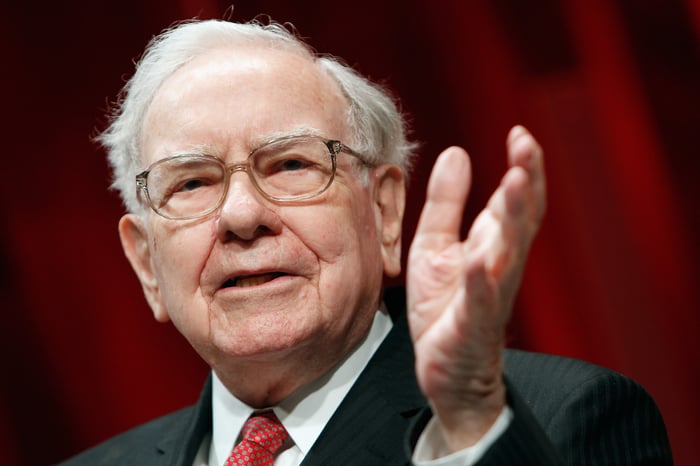
Image source: Getty Images.
The power of time
The most powerful force in investing is time. It's not necessarily about picking the best stocks or timing the market correctly; it's about time in the market. Over time, the stock market, as represented by the S&P 500 (SNPINDEX: ^GSPC), has always gone up in the long term.
The longer you are in the market, the greater your wealth will grow. This is due to compounding, where in later years your gains start generating gains of their own. While early growth may seem slow, it's the late-stage growth that will eventually turn even a small investment into millions of dollars.
Over the past 40 years, the S&P 500 index has averaged an 11.5% annual return. If you invested $20,000 and got that same return, your investment would be around $59,400 after 10 years. However, after 30 years, it would be $524,000, and after 40 years, it would be over $1.5 million. That's time and compounding working in your favor.
However, an even better way to build long-term wealth is through dollar-cost averaging. This is simply investing a set amount each month, regardless of how the stock market is performing. By adding another $1,000 a month to your initial $20,000 investment, your portfolio balance would suddenly be $275,600 at 10 years, nearly $3.3 million at 30 years, and around $10 million after 40 years. Meanwhile, at 30 years, 88% of that balance would be from investment gains, while at 40 years, that rises to 95%.
Notably, when you add dollar-cost averaging to the mix, your starting amount actually matters less. An initial $1,000 investment and $1,000 a month subsequent investment will give you an ending portfolio value of $2.8 million at the end of 30 years and $8.5 million at the end of 40 years. Don't worry if you don't have that much to invest. You can still get to a $1 million balance after 40 years by starting with a $125 investment and adding an additional $125 each month.
That is your money working for you. It's sort of like rolling a snowball down a hill. It starts small but grows bigger and bigger as every rotation picks up exponentially more snow than the last, until it becomes massive.
The best investment option
With dollar-cost averaging, I think the best option is to go with a Buffett favorite in an S&P 500 index fund. The reason is that these funds give investors an instant, diversified portfolio that few large-cap active funds can beat. Meanwhile, the S&P 500 has outperformed 86% of actively managed large-cap funds over the past 10 years. Buffett also famously won a bet that his investment in an S&P 500 fund would outperform a portfolio of hedge funds over a 10-year period. In fact, it wasn't even close -- he won easily.
While there are several S&P 500 investment options to choose from, my favorite is the Vanguard S&P 500 ETF (NYSEMKT: VOO). It's the world's largest exchange-traded fund (ETF), does a great job mimicking the index's returns, and comes with a minuscule expense ratio of just 0.03%.
Investing can be complicated, but it doesn't have to be. The combination of time and the Vanguard S&P 500 ETF is a great way to build long-term wealth.
Where to invest $1,000 right now
When our analyst team has a stock tip, it can pay to listen. After all, Stock Advisor’s total average return is 936%* — a market-crushing outperformance compared to 211% for the S&P 500.
They just revealed what they believe are the 10 best stocks for investors to buy right now, available when you join Stock Advisor.
See the stocks »
*Stock Advisor returns as of October 4, 2026.
Geoffrey Seiler has positions in Vanguard S&P 500 ETF. The Motley Fool has positions in and recommends Berkshire Hathaway and Vanguard S&P 500 ETF. The Motley Fool has a disclosure policy.
Recommended Articles


