


Which Is the Better Dividend ETF for Income Investors: JEPQ or SCHD?
Key Points
The JPMorgan Nasdaq Equity Premium Income ETF offers exceptional current income.
The Schwab U.S. Dividend Equity ETF offers greater income growth and lower fees.
Both funds are worthy of spots in income investors' portfolios.
- 10 stocks we like better than JPMorgan Nasdaq Equity Premium Income ETF ›
$153 billion. That's the amount of assets managed by two of the most popular income-focused exchange-traded funds (ETFs) -- the JPMorgan Nasdaq Equity Premium Income ETF (NASDAQ:JEPQ) and the Schwab U.S. Dividend Equity ETF (NYSEMKT:SCHD).
Which of these two is the better dividend ETF for income investors? Perhaps the best answer to that question is to ask another question: What's your specific income goal?
Missed Nvidia in 2009? This Rare Signal Is Flashing Again. In 2009, a "Double Down" signal flashed for a little-known chipmaker called Nvidia. For the first time in years, that same "Total Conviction" signal is flashing for a company 1/100th the size of Nvidia. Continue »

Image source: Getty Images.
When maximizing current income is paramount.
If you want to maximize your current income, it's an easy decision between these two funds. The JPMorgan Nasdaq Equity Premium Income ETF offers a 30-day SEC yield of 12.9%, compared with 3.3% for the Schwab U.S. Dividend Equity ETF. This significant difference in yields is due to how the two ETFs are designed.
The JPMorgan Nasdaq Equity Premium Income ETF owns growth stocks in the Nasdaq-100 Index, with its top holdings including Nvidia (NASDAQ:NVDA), Apple (NASDAQ:AAPL), Microsoft (NASDAQ:MSFT), Micron Technology (NASDAQ:MU), and Google parent Alphabet (NASDAQ:GOOG) (NASDAQ:GOOGL). Many of these stocks either don't pay dividends or, if they do, pay relatively modest dividends.
So how does the fund generate income? It sells out-of-the-money Nasdaq-100 Index call options. Investors receive monthly income that can be especially attractive when volatility is high, since call options command higher premiums in such environments.
Meanwhile, the Schwab U.S. Dividend Equity ETF foin the Dow Jones U.S. Dividend 100 Index, which tracks high-yield U.S. dividend stocks with solid dividend records solid records of paying dividends and strong fundamentals. This fund's largest holdings include Qualcomm (NASDAQ:QCOM), Texas Instruments (NASDAQ:TXN), Procter & Gamble (NYSE:PG), Coca-Cola (NYSE:KO), and Merck (NYSE:MRK).
These stocks pay their dividends quarterly. Unsurprisingly, the Schwab U.S. Dividend Equity ETF also pays its distributions quarterly. However, the covered call strategy of the JPMorgan Nasdaq Equity Premium Income ETF allows it to pay distributions monthly, which is attractive to many income investors.
When stability matters more
Not every income investor prioritizes current income, though. Stability matters more for some investors. And that's where the Schwab U.S. Dividend Equity ETF gets the clear nod.
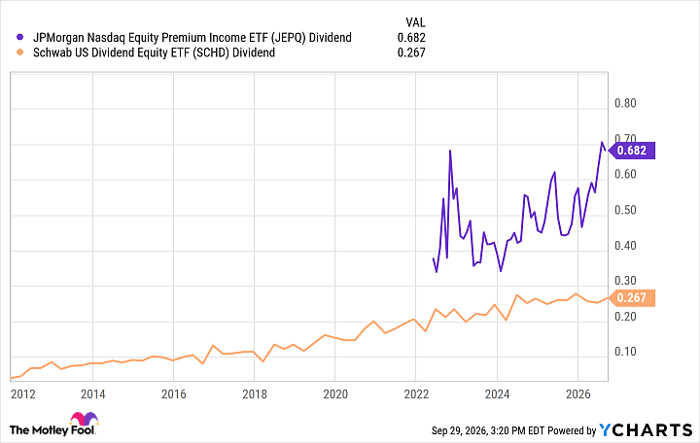
The income received from the JPMorgan Nasdaq Equity Premium Income ETF can vary tremendously, depending on how much volatility drives option premiums. But the Schwab ETF is a dependable income grower. The following chart tells the tale.
JEPQ Dividend data by YCharts
Savvy investors know that the buying power of their income can be eroded over time by inflation. The Schwab U.S. Dividend Equity ETF's dividends are more likely to grow at a faster pace than inflation than the JPMorgan Nasdaq Equity Premium Income ETF's dividends are.
Granted, the JPMorgan Nasdaq Equity Premium Income ETF has delivered a higher total return over the last three years -- 19.3% compared to 16.2% for the Schwab U.S. Dividend Equity ETF. However, this outperformance is largely due to the strong returns from artificial intelligence (AI) stocks. If the AI boom fizzles, the Schwab ETF's total returns could easily outpace those of the JPMorgan fund.
Cost is another key differentiator. The JPMorgan Nasdaq Equity Premium Income ETF's annual expense ratio is 0.35%. While that's not ridiculously high, it's still well above the annual expense ratio of 0.06% for the Schwab U.S. Dividend Equity ETF.
Two tools for two different jobs
Let's return to our original question: Which of these dividend ETFs is the better choice for income investors? Hopefully, you have seen enough to know that the answer depends on what you prioritize the most.
The bottom line is that the JPMorgan Nasdaq Equity Premium Income ETF and the Schwab U.S. Dividend Equity ETF represent two tools for two different jobs. One offers exceptionally high income, while the other offers increased income stability and protection against inflation. Both of these funds could deserve a spot in income investors' portfolios.
Should you buy stock in JPMorgan Nasdaq Equity Premium Income ETF right now?
Before you buy stock in JPMorgan Nasdaq Equity Premium Income ETF, consider this:
The Motley Fool Stock Advisor analyst team just identified what they believe are the 10 best stocks for investors to buy now… and JPMorgan Nasdaq Equity Premium Income ETF wasn’t one of them. The 10 stocks that made the cut could produce monster returns in the coming years.
Consider when Netflix made this list on December 17, 2004... if you invested $1,000 at the time of our recommendation, you’d have $365,910!* Or when Nvidia made this list on April 15, 2005... if you invested $1,000 at the time of our recommendation, you’d have $1,418,530!*
Now, it’s worth noting Stock Advisor’s total average return is 930% — a market-crushing outperformance compared to 211% for the S&P 500. Don't miss the latest top 10 list, available with Stock Advisor, and join an investing community built by individual investors for individual investors.
See the 10 stocks »
*Stock Advisor returns as of October 3, 2026.
Keith Speights has positions in Alphabet, Apple, JPMorgan Nasdaq Equity Premium Income ETF, and Microsoft. The Motley Fool has positions in and recommends Alphabet, Apple, Micron Technology, Microsoft, and Nvidia. The Motley Fool has a disclosure policy.
Recommended Articles


