


Bloom Energy Stock Price Forecast: AI Data Center Power Shortages Boost Fuel Cell Demand, Stock Could Rise to $309
TradingKey - Bloom Energy (BE) stock price hit a recent high of $292.72 on September 25. Just two months earlier, on July 29, the fuel cell manufacturer's stock was at only $157, representing an astonishing gain of 86% over the period.
Not only did it significantly outperform the Nasdaq Composite Index and the Philadelphia Semiconductor Index over the same period, but it also outpaced popular memory stocks—SanDisk (SNDK) rose about 62%, and Micron (MU) gained roughly 32%.
So what allowed this company to significantly outperform the market during the AI investment boom? AI data centers are currently facing a practical problem: chips can be bought, but electricity may not be easily connected. Slow grid expansion and long delivery backlogs for power generation equipment make 'powering up as quickly as possible' a key consideration in power procurement. As a result, the fuel cell industry in which Bloom Energy operates is gaining new growth opportunities.
Captive Power Accelerates Expansion
According to projections by Goldman Sachs, global data center electricity demand will grow by 170% by 2030 compared to 2025, with more than 60% of the incremental growth coming from the United States.
However, grid construction is lagging significantly behind. The average annual mileage of newly built high-voltage transmission lines in the U.S. fell from 1,700 miles in 2010–2014 to 350 miles in 2020–2023. For grid-connection projects listed in the report, the median wait time from application to commercial operation is close to five years.
Waiting means expensive computing infrastructure cannot be put into use. Consequently, data centers are beginning to deploy power generation equipment on-site or nearby, known as "behind-the-meter generation." Goldman Sachs raised its 2030 forecast for global data center behind-the-meter generation capacity from 40 GW to 67 GW, estimating that it could meet about 25% of global data center power demand by then. Some operators have even signed power supply contracts for up to 15 years, making on-site generation a long-term arrangement.
Bloom Energy’s Competitiveness Lies in Delivery Speed
Bloom Energy is a solid oxide fuel cell manufacturer. According to comparisons by Goldman Sachs, fuel cells do not hold a cost advantage: in a model estimating a 500-megawatt data center, their lifecycle levelized cost of electricity is approximately $117/MWh, higher than $80 for reciprocating engines and $81 for combined-cycle gas turbines. Even assuming a 30% investment tax credit under Goldman Sachs' assumptions, the cost of fuel cells only falls to about $90.
A key reason customers are still willing to consider them is delivery speed. Reportedly, solid oxide fuel cell manufacturers quote about 6 to 12 months from order placement to power supply, whereas reciprocating engines require 1.5 to 2.5 years, and heavy-duty gas turbines require 5 to 7 years.
For AI projects eager to go online, earlier power supply means delivering computing power sooner and generating revenue earlier. In Goldman Sachs' overall scoring, time-to-commissioning accounts for 20% and availability accounts for 15%; fuel cells consequently received the highest score.
Widespread Power Equipment Shortage Brings Expansion Opportunities for BE
The opportunity for fuel cells also stems from supply bottlenecks in other power generation equipment.
According to reference data, GE Vernova's combined backlog and reserved capacity reach 116 gigawatts, with capacity sold out through 2030. Reciprocating engines are also facing long wait times: Cummins' orders are booked through 2028, while INNIO's backlog and reserved capacity exceed 15 gigawatts. Consequently, data center operators need to evaluate multiple power supply options simultaneously.
On the other hand, Goldman Sachs believes that small modular nuclear reactors have long-term potential for on-site power generation, but constrained by construction timelines, large-scale deployment is unlikely before 2030. Prior to that, gas turbines, reciprocating engines, and fuel cells will continue to jointly satisfy incremental demand. The opportunity for BE thus becomes clear: slow grid interconnection and delayed delivery of traditional equipment elevate the commercial value of rapid power deployment.
Looking at the Bloom Energy stock price chart, the current stock price has pulled back sharply and lost the 0.618 Fibonacci retracement level ($277.16), touching an intraday low of $259.46, and is currently testing its 20-day moving average ($260.22).
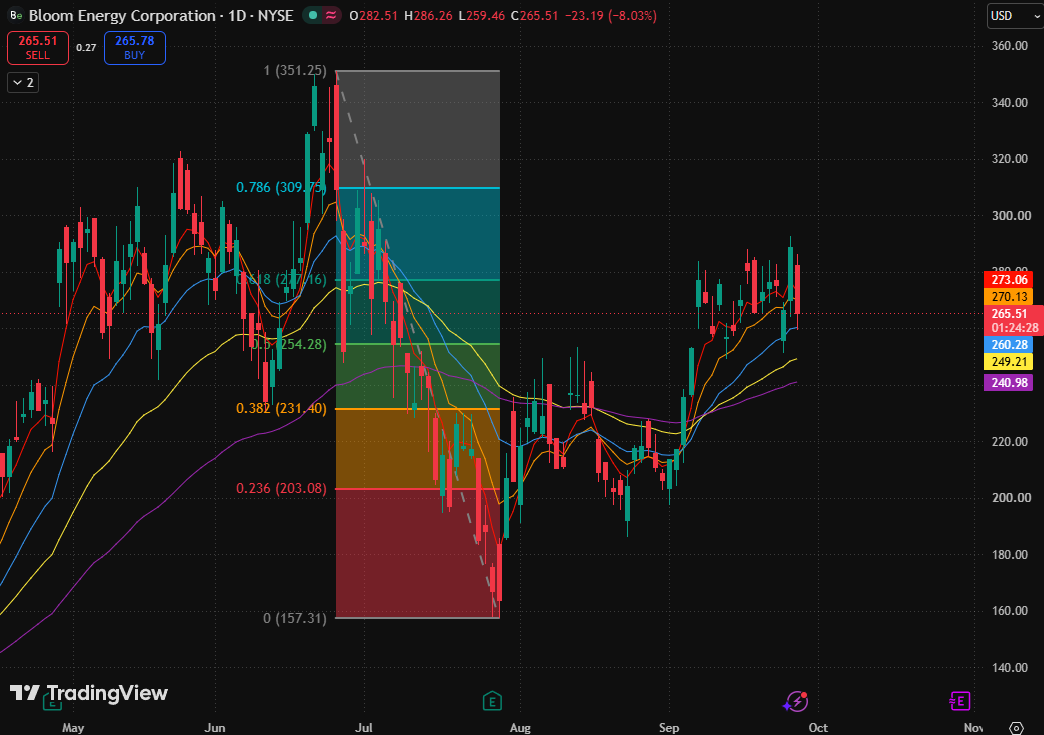
Bloom Energy daily chart, Source: TradingView
The current pullback is a sharp correction within an uptrend, with no trend reversal confirmed yet; the 0.5 Fibonacci retracement level ($254.28) serves as the core pivot determining strength or weakness in the next phase.
Although the current stock price has broken below the 5-day moving average ($272.84) and 10-day moving average ($270.01), indicating an interruption in the short-term uptrend, the 20-day moving average remains above the 80-day moving average ($249.18) and 160-day moving average ($240.96), suggesting that the medium-term structure has not yet turned bearish. The intraday low approached the 20-day moving average, showing some buying support here.
On the upside, if the stock price reclaims the 0.618 Fibonacci retracement level ($277.16), the rebound structure is expected to be repaired. The next price target would be further raised to the 0.786 Fibonacci retracement level ($309.75).
The biggest risk is that losses expand further and the 0.5 Fibonacci retracement level ($254.28) is decisively broken. Once this pivot is lost, the price may continue to test $249.18, further pointing to the support zone between $240.96 and $231.40.
Recommended Articles


