


Chipotle Is Down 14% Compared to McDonald's 24%. But There's an Even Better Restaurant Stock to Buy in October.
Key Points
Texas Roadhouse is still growing sales, adding restaurants, and attracting customers despite the recent stock pullback.
The company has strong customer loyalty and steady traffic give the business some cushion if the economy gets tougher.
With a growing dividend, new locations, and share buybacks, Texas Roadhouse offers several ways to reward investors beyond stock price gains.
- 10 stocks we like better than Texas Roadhouse ›
Chipotle (NYSE: CMG) and McDonald's (NYSE: MCD) are both in a slump this year. Chipotle's stock is down about 14% year to date as of Sept. 29. McDonald's has fallen even more, with a drop of roughly 24% over the same period.
These dips warrant some attention. Both companies still have strong brands, steady traffic, and global scale. For long‑term investors, buying great businesses after a sell‑off is often a smart instinct. Here, though, I'd look one step further down the restaurant aisle. There's a chain whose ticker has been beaten down, but its story is tied less to marketing campaigns than to the operations that keep humming even when markets wobble.
Missed Nvidia in 2009? This Rare Signal Is Flashing Again. In 2009, a "Double Down" signal flashed for a little-known chipmaker called Nvidia. For the first time in years, that same "Total Conviction" signal is flashing for a company 1/100th the size of Nvidia. Continue »
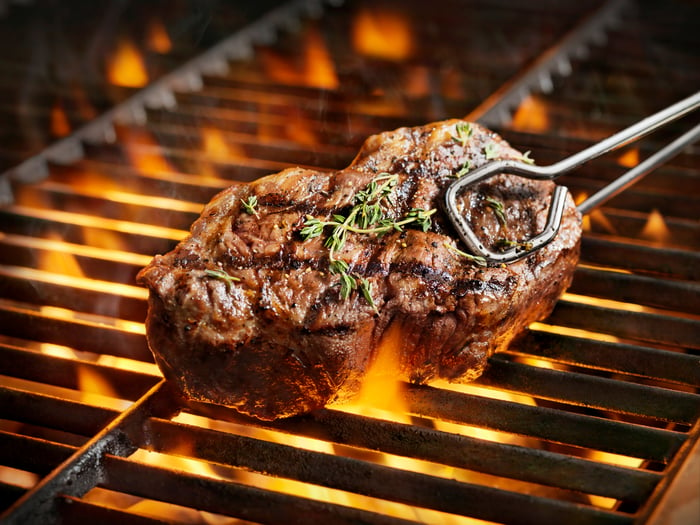
Image source: Getty Images.
Texas Roadhouse keeps growing even as the stock drops
Texas Roadhouse (NASDAQ: TXRH) is a casual‑dining steakhouse chain built around simple things: consistent food (the rolls are to die for), strong service, and a community/loyalty model. Its stock has been hit hard in the last month, dropping around 15% and leaving shares down roughly 4% for the year. That's a much uglier chart than the underlying business, which is still growing sales, opening new restaurants, and paying regular dividends. None of this aligns with the recent price damage.
According to Restaurant Business Online, the company has become the largest casual‑dining chain in the U.S. by leaning on operations rather than national TV ads. This suggests customer loyalty flows from the in‑store experience and returning customers, not just the latest promotion. Personally, I live near a Texas Roadhouse and regularly see lines out the door at both lunch and dinner. To me, that's a sign of a strong, loyal fanbase that keeps coming back even when the economy gets tougher. That kind of customer loyalty is important to consider when evaluating the stock.
The numbers in its recent second‑quarter release back that up. Comparable restaurant sales rose 6.2%, and store weeks grew 5%. Average weekly sales climbed to $177,252, with to‑go sales up from a year earlier, which shows both dining‑room traffic and off‑premise orders are working at the same time. When a restaurant concept can grow both in‑person and takeout business, it has more ways to handle changing consumer habits.
Texas Roadhouse is also opening new doors. In the quarter, it added nine company restaurants and one franchise restaurant. Outside its filings, you can already see that pipeline in local news, with new locations planned in places like Waxahachie and Georgetown. Expansion by itself does not guarantee success, but a chain that grows units while maintaining high sales per store is often building real value.
Cash returns and discipline
Investors also get a steady cash stream. The board approved a quarterly dividend of $0.75 per share, which has now been paid in March and June and is scheduled again for late September. That kind of regular, meaningful dividend is not something Chipotle offers today. McDonald's pays a dividend, but Texas Roadhouse is pairing its payouts with visible unit growth rather than mature‑market saturation.
The company says it expects positive comparable sales for 2026, 5%-6% store-week growth, and capital spending of about $400 million, focused on expansion and upgrades. It has also bought back its own stock alongside funding new builds and those dividends. That signals a management team that is thinking about shareholder returns, not just headline sales.
Why Texas Roadhouse looks better in October
Chipotle and McDonald's will likely recover over time. They are strong global brands with deep resources. But in October, if I had to choose one restaurant stock where the business story and the shareholder story line up more tightly, I'd pick Texas Roadhouse. You get rising sales per store, new units, and a management team that has grown into the top spot in U.S. casual dining without heavy advertising. You also get a meaningful dividend and a clear plan for continued expansion.
Should you buy stock in Texas Roadhouse right now?
Before you buy stock in Texas Roadhouse, consider this:
The Motley Fool Stock Advisor analyst team just identified what they believe are the 10 best stocks for investors to buy now… and Texas Roadhouse wasn’t one of them. The 10 stocks that made the cut could produce monster returns in the coming years.
Consider when Netflix made this list on December 17, 2004... if you invested $1,000 at the time of our recommendation, you’d have $375,240!* Or when Nvidia made this list on April 15, 2005... if you invested $1,000 at the time of our recommendation, you’d have $1,403,292!*
Now, it’s worth noting Stock Advisor’s total average return is 932% — a market-crushing outperformance compared to 211% for the S&P 500. Don't miss the latest top 10 list, available with Stock Advisor, and join an investing community built by individual investors for individual investors.
See the 10 stocks »
*Stock Advisor returns as of October 2, 2026.
Micah Zimmerman has no position in any of the stocks mentioned. The Motley Fool has positions in and recommends Chipotle Mexican Grill and Texas Roadhouse. The Motley Fool recommends the following options: long January 2028 $320 calls on McDonald's, short January 2028 $340 calls on McDonald's, and short September 2026 $35 calls on Chipotle Mexican Grill. The Motley Fool has a disclosure policy.
Recommended Articles


