


3 Key Reasons to Buy This Huge Turnaround Story That's Gaining Traction
Key Points
Developing new global partnerships, where former leadership preferred an insular approach, is a great shift.
Stellantis has already taken steps to distance itself from the financial abomination that was 2025.
Unnoticed by many investors was Stellantis' engineer hiring spree.
- 10 stocks we like better than Stellantis ›
After a brutal 2025, Stellantis (NYSE: STLA) Chief Executive Officer Antonio Filosa quickly unveiled a major $70 billion global turnaround plan referred to as "FaSTLAne 2030." The broad strategy was mostly well received, but Wall Street is giving the automaker little credit, as Stellantis stock has dropped nearly 40% since the strategy was announced.
In my opinion, there is very little of Stellantis' turnaround upside priced into the stock, giving investors an opportunity to buy in low, give the company time to execute, and in theory, reap the rewards during the next five years. There's obviously risk in putting faith in the plan, but here are three developments that suggest its recovery is starting to work.
Missed Nvidia in 2009? This Rare Signal Is Flashing Again. In 2009, a "Double Down" signal flashed for a little-known chipmaker called Nvidia. For the first time in years, that same "Total Conviction" signal is flashing for a company 1/100th the size of Nvidia. Continue »
1. If you can't beat 'em...
One way Filosa is changing things at Stellantis is by reversing the automaker's insular approach to both engineering and manufacturing. The automaker's new strategy is to add external partnerships to the core of its manufacturing. These partnerships, such as Stellantis' 51% controlling stake in Leapmotor International, a joint venture formed by the Chinese electric vehicle (EV) maker and Stellantis, will help drive down research and development costs, reduce capital expenditures, and even optimize its factory utilization globally.
What's more, Stellantis can utilize these partnerships differently. For instance, Stellantis' partnership with Tata Jaguar Land Rover will enable the latter to assemble vehicles in the U.S. using Stellantis' production lines, which will lower fixed manufacturing costs for both of them. Stellantis can also utilize its Chinese automaker partnerships to learn China's impressive development speed (cutting the historical time of vehicle development roughly in half), vertical integration, and cost-saving measures.
2. Financials are improving
When looking at Stellantis' financials for the first half of 2026, there's a clear improvement from a rough 2025. First-half 2026 revenue climbed 10% from the prior year, as it reversed a first-half 2025 decline.
Investors should now watch the second half of 2026 to see if Stellantis can improve and exceed its full-year projections for net revenue and adjusted operating income, while improving its cash burn rate.
Another important piece of data came from the second quarter, when Stellantis' North America shipments jumped 38% from a year earlier. North America will continue to be the automaker's profit engine, and as it embarks on launching a long list of new vehicles, profitability and regional market share should rise.
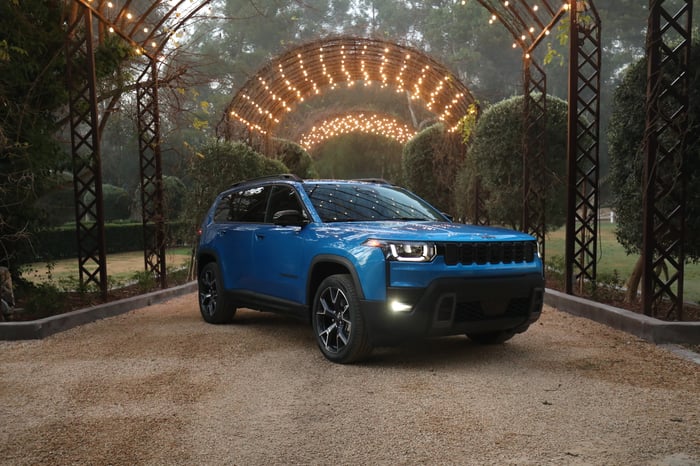
Jeep, as well as Ram, will play big roles in improving Stellantis' sales mix and gross margin. Image source: Stellantis.
3. Talent influx
Stellantis' broader recovery plan hits a number of critical aspects the company needs to improve, but one that's often overlooked is that the company hired more than 2,000 engineers in 2025 alone. This talent will drive design, development, and quality improvement with the goal of increasing demand from consumers, especially in North America.
Investors have seen companies deal with a talent exodus when morale is low or the company faces a dire outlook, as electric vehicle (EV) maker Lucid has demonstrated during the past year. Perhaps just as important as developing vehicles and improving quality is that these hires will also support Stellantis' "Value Creation Program," which is targeting $7 billion in cost savings by 2028.
What it all means
There's no question that there is risk buying into a potential Stellantis turnaround, and the company has had a few bumpy years. However, the company's plan on paper looks solid, and early evidence of a makeover can be seen in its first-half 2026 financials.
Further, Stellantis has identified its four core brands (Jeep, Ram, Fiat, Peugeot) with scalability and higher margins to focus its capital investment on giving it more brand identity than it's had in many years. In five years, Stellantis won't be the best automaker compared with historical rivals Ford Motor Company and General Motors, but its stock price might have the most upside as Wall Street eventually recognizes the progress Stellantis is making.
Should you buy stock in Stellantis right now?
Before you buy stock in Stellantis, consider this:
The Motley Fool Stock Advisor analyst team just identified what they believe are the 10 best stocks for investors to buy now… and Stellantis wasn’t one of them. The 10 stocks that made the cut could produce monster returns in the coming years.
Consider when Netflix made this list on December 17, 2004... if you invested $1,000 at the time of our recommendation, you’d have $379,123!* Or when Nvidia made this list on April 15, 2005... if you invested $1,000 at the time of our recommendation, you’d have $1,396,103!*
Now, it’s worth noting Stock Advisor’s total average return is 933% — a market-crushing outperformance compared to 212% for the S&P 500. Don't miss the latest top 10 list, available with Stock Advisor, and join an investing community built by individual investors for individual investors.
See the 10 stocks »
*Stock Advisor returns as of October 1, 2026.
Daniel Miller has positions in Ford Motor Company and General Motors. The Motley Fool recommends General Motors and Stellantis. The Motley Fool has a disclosure policy.
Recommended Articles


