


If I Had $10,000 to Invest Today, Here's the Growth Stock I'd Buy Instead of SpaceX
Key Points
Elon Musk's Space Exploration Technologies (SpaceX) went public in June, and it has already lost 34% of its peak value.
SpaceX's space transportation, satellite connectivity, and artificial intelligence businesses are packed with potential, but its stock appears to be heavily overvalued.
Netflix might be a much better long-term investment based on its robust business, attractive valuation, and substantial addressable market.
- 10 stocks we like better than Netflix ›
Elon Musk's Space Exploration Technologies (NASDAQ: SPCX) went public in June. Investors were initially very optimistic about the company's space transportation, satellite internet connectivity, and artificial intelligence businesses, so they piled into its stock, which sent it soaring to a peak of $225. However, it has since plummeted by 34% and closed at $148.68 last Friday, Sept. 25.
But SpaceX is still expensive. Based on the company's hefty market capitalization of $2.02 trillion and its trailing-12-month revenue of $23 billion, its stock is trading at a price-to-sales (P/S) ratio of 87, making it 13 times as expensive as the technology-heavy Nasdaq-100 index.
Missed AI’s "Act 1"? Act 2 Could Be 15x Bigger. Most investors think they missed the AI boat because they didn't buy Nvidia in 2005. But according to our analysts, we’re only at the end of "Act 1"—the R&D phase. "Act 2" is the global rollout. Continue »
As a result, more downside might be ahead for SpaceX stock, so if I had $10,000 to invest today, I'd probably look elsewhere. I think Netflix (NASDAQ: NFLX) could perform better over the long term thanks to its robust streaming business and attractive valuation. Read on.
Image source: The Motley Fool.
Netflix is on track to double its advertising revenue this year
Netflix operates the world's largest streaming platform for movies and television shows. It has over 325 million paying subscribers, so it's towering over its nearest rivals, Amazon Prime and Warner Bros. Discovery (the owner of HBO Max and Discovery+), which have 200 million and 140 million members, respectively.
Netflix typically outspends the competition each year when it comes to creating and licensing content, which helps attract new subscribers. But it also offers different membership tiers that appeal to people of different income levels, and this has been a core part of its success. For example, the company introduced an affordable subscription option in 2022 for just $8.99 per month, much lower than its Standard and Premium tiers, which cost $19.99 and $26.99 per month, respectively.
However, in exchange for the lower price, subscribers to the $8.99 tier will occasionally see ads during programming. It seems to be an acceptable trade-off for consumers, because this tier consistently accounts for over half of all new signups in countries where it's available. It's also a win for Netflix, because it can charge businesses more money for ad slots as the membership base grows larger, so each subscriber becomes more valuable over time.
Netflix has also started showing ads to members in every tier during live events, giving businesses an opportunity to showcase their products to the company's entire subscriber base. This is partly why the streaming giant is investing heavily in sports content in boxing, Major League Baseball, the National Football League, and more. Not only can it charge more money for ad slots because of the larger potential audience, but also because live events tend to attract premium prices overall.
According to management's most recent guidance, Netflix is on track to generate around $51.2 billion in total revenue in 2026, which would be a 13% increase from last year. But revenue from selling advertising slots, specifically, is expected to double to $3 billion. The advertising business is still in its infancy, but it could soon be a meaningful part of Netflix's overall business if it continues growing at this pace.
Netflix stock is a bargain compared to SpaceX stock
As I highlighted earlier, SpaceX's P/S ratio of 87 makes it substantially more expensive than the broader market. Netflix stock, on the other hand, has a P/S ratio of just 6.2, so not only is it much cheaper than SpaceX, but it's also slightly cheaper than the Nasdaq-100, which has a P/S ratio of 6.4.
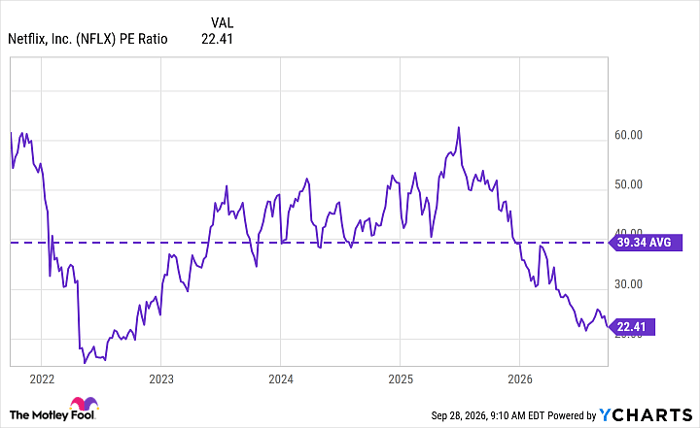
Moreover, Netflix is extremely profitable whereas SpaceX isn't, so we can also value it using the more traditional price-to-earnings (P/E) ratio. The company generated earnings of $3.18 per share over the last four quarters, placing its stock at a P/E ratio of just 22.4.
That's a significant discount to its five-year average of 39.3, but it also means Netflix is much cheaper than the S&P 500 and the Nasdaq-100, which have P/E ratios of 23.5 and 35.2, respectively.
NFLX PE Ratio data by YCharts
Netflix says it has captured only around 7% of its $670 billion global addressable market across streaming subscriptions, advertising, gaming, and more, so it still has a very long runway for potential growth. Therefore, I think its stock could be a very rewarding investment over the next few years.
Should you buy stock in Netflix right now?
Before you buy stock in Netflix, consider this:
The Motley Fool Stock Advisor analyst team just identified what they believe are the 10 best stocks for investors to buy now… and Netflix wasn’t one of them. The 10 stocks that made the cut could produce monster returns in the coming years.
Consider when Netflix made this list on December 17, 2004... if you invested $1,000 at the time of our recommendation, you’d have $379,123!* Or when Nvidia made this list on April 15, 2005... if you invested $1,000 at the time of our recommendation, you’d have $1,396,103!*
Now, it’s worth noting Stock Advisor’s total average return is 933% — a market-crushing outperformance compared to 212% for the S&P 500. Don't miss the latest top 10 list, available with Stock Advisor, and join an investing community built by individual investors for individual investors.
See the 10 stocks »
*Stock Advisor returns as of October 1, 2026.
Anthony Di Pizio has no position in any of the stocks mentioned. The Motley Fool has positions in and recommends Amazon, Netflix, and Warner Bros. Discovery. The Motley Fool has a disclosure policy.
Recommended Articles


