


Michael Burry Buys Put Options on Nvidia, Micron, and Palantir as "The Big Short" Investor Predicts a 1987-Style Market Crash
Key Points
Michael Burry thinks AI stocks are overvalued and at risk of fueling a widespread market crash.
While some of Burry's arguments are valid, he has a clear incentive to publish his trades.
Investors should do their own diligence instead of blindly following someone else's playbook.
- 10 stocks we like better than Micron Technology ›
Michael Burry is back in the headlines as he challenges the bull narrative around artificial intelligence (AI) stocks. Recently, the famous investor covered his short positions in Nvidia (NASDAQ: NVDA), Micron Technology (NASDAQ: MU), and Palantir Technologies (NASDAQ: PLTR) and bought put options in each of these stocks.
If you only know of Burry from The Big Short, that makes sense. He is the doctor-turned-investor who noticed something peculiar in the subprime mortgage market years before Wall Street caught on. His claim to fame is buying credit default swaps that paid off when the housing market collapsed between 2008 and 2009.
Missed AI’s "Act 1"? Act 2 Could Be 15x Bigger. Most investors think they missed the AI boat because they didn't buy Nvidia in 2005. But according to our analysts, we’re only at the end of "Act 1"—the R&D phase. "Act 2" is the global rollout. Continue »
That single trade still does most of the talking for Burry, but in reality his track record has been messier since 2008. He has been early, loud, and often wrong on timing as markets climbed while he warned about another crash. While Burry's ability to read filing is impressive, one famous call from 18 years ago is not a guarantee on the direction of artificial intelligence (AI) stocks today.
Is AI a bubble?
As hyperscalers continue to pour capital into chips and data centers at a pace not seen since the dot-com bubble, Burry is becoming increasingly concerned that AI euphoria could fuel a 1987-style crash. Moreover, growth investors are assuming unsustainable levels of leverage and momentum funds are piling into a crowded AI trade, pushing the S&P 500 to record levels. These factors are what has Burry arguing that an AI bubble might burst "sooner than later."
While I understand his point of view, I think seeing the AI revolution as the next dot-com bubble event is an apples-to-oranges comparison. Cisco was a very real business back in 2000. The stock only got crushed once customers decelerated the pace they were buying networking gear. This is a big reason why Burry harps on depreciation schedules and chip cycles. If Nvidia GPUs and the servers around them age faster than the books imply, then earnings will look prettier now relative to cash realities later.

Image source: Getty Images.
Micron is the other half of the chip supply chain. The stock has nearly tripled this year thanks to insatiable demand for high-bandwidth memory (HBM) and DRAM. Tight supply in the memory market has allowed Micron to command lucrative pricing power, resulting in juicy gross margins and record profits for the company.
Burry's thesis is that the old boom-bust cycle of memory markets is changing, but AI is not "nearly different enough" to completely change the way memory makers should be priced. As Chinese supply ramps and new manufacturing facilities from Samsung, SK Hynix, and Micron itself come online, Burry suggests supply will catch up with demand, which could lead to a predictable down cycle and a harsh sell-off.
Meanwhile, Burry is parroting an old bear narrative around Palantir, suggesting the company is not a true software services business and is really just a consulting firm.
All of these talking points and risk factors are only half-clean. Back in the late 1990s, many of the internet "darlings" had little revenue and no real path to sustained profitability. By contrast, Nvidia, Micron, and Palantir are leaders in selling hardware and software into real, recurring demand from big tech. Meanwhile, AI's biggest spenders -- Alphabet, Microsoft, Amazon, Meta Platforms, and Oracle -- are collectively profitable; hence, they can continue funding their infrastructure buildouts.
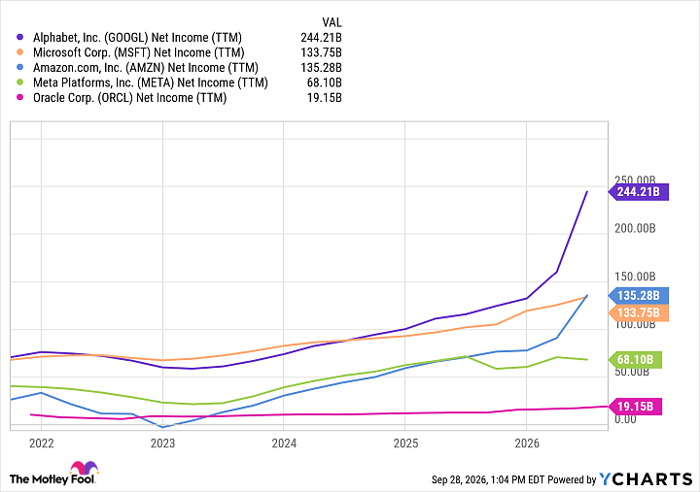
GOOGL Net Income (TTM) data by YCharts
Burry has a potential conflict of interest
In my eyes, there is an awkward incentive with Burry publishing his trades on social media. The investor writes a paid Substack newsletter under the name Cassandra Unchained. I'm not suggesting that his process of pouring over 10-Ks and footnotes doesn't have merit. But a very public bearish megaphone with a subscription fee attached is beneficial when everyday investors line up to hit the refresh button in anticipation of your next warning. Investors can respect Burry's homework while still noticing the business model at play here.
I think investors are best off taking forecasts from any prominent personality with a grain of salt. Burry and many others have been "the boy who cried wolf" often enough that copying their trades is not a viable strategy in the long-run. The more prudent move is the boring one: do your own due diligence by reading financial reports and listening to earnings calls. From there, investors can supplement external opinions they may hear or read about with their own personal sentiment before buying or selling a stock.
Should you buy stock in Micron Technology right now?
Before you buy stock in Micron Technology, consider this:
The Motley Fool Stock Advisor analyst team just identified what they believe are the 10 best stocks for investors to buy now… and Micron Technology wasn’t one of them. The 10 stocks that made the cut could produce monster returns in the coming years.
Consider when Netflix made this list on December 17, 2004... if you invested $1,000 at the time of our recommendation, you’d have $379,123!* Or when Nvidia made this list on April 15, 2005... if you invested $1,000 at the time of our recommendation, you’d have $1,396,103!*
Now, it’s worth noting Stock Advisor’s total average return is 933% — a market-crushing outperformance compared to 212% for the S&P 500. Don't miss the latest top 10 list, available with Stock Advisor, and join an investing community built by individual investors for individual investors.
See the 10 stocks »
*Stock Advisor returns as of September 30, 2026.
Adam Spatacco has positions in Alphabet, Amazon, Microsoft, Nvidia, and Palantir Technologies. The Motley Fool has positions in and recommends Alphabet, Amazon, Cisco Systems, Meta Platforms, Micron Technology, Microsoft, Nvidia, Oracle, and Palantir Technologies. The Motley Fool has a disclosure policy.
Recommended Articles


