


What a $10,000 Investment Split Between Micron and Sandisk Could Be Worth by the End of 2027
Key Points
The AI-driven demand wave for memory chips will last for several more years.
An investment in these two has the potential to triple your money by next year.
- 10 stocks we like better than Sandisk ›
Micron (NASDAQ: MU) and Sandisk (NASDAQ: SNDK) have been two of the best-performing stocks in the entire market during 2026. Sandisk is the top-performing stock in the S&P 500 (SNPINDEX: ^GSPC), up over 600% so far this year. Micron is now the fourth-best-performing stock, up by around 270%.
Normally, when investors see returns like that in the immediate past, they get a bit concerned about what the future holds, since it's rare for stocks to sustain that level of growth. However, with the massive demand these two are seeing for their technology, I think now is still the perfect time to invest in them.
Missed AI’s "Act 1"? Act 2 Could Be 15x Bigger. Most investors think they missed the AI boat because they didn't buy Nvidia in 2005. But according to our analysts, we’re only at the end of "Act 1"—the R&D phase. "Act 2" is the global rollout. Continue »
The reality is that the market is not pricing Micron and Sandisk as if it expects them to keep growing beyond this year. I think that could be a mistake, because several well-connected businesses project otherwise.

Image source: Getty Images.
Sandisk and Micron play a key role in data centers
Sandisk and Micron make memory chips. Both of them make NAND memory, which is often used for longer-term data storage. Solid-state drives (SSDs) use NAND memory, and are one of the go-to data storage choices for data centers. Micron also makes DRAM memory, while Sandisk does not. DRAM memory is used inside computing units for rapid information access and is also in high demand. And in particular, Micron make high-bandwidth memory (HBM) -- a type of DRAM widely used in data centers, and embedded on AI accelerator chips and graphics processing units (GPUs).
There are only a handful of memory-chip foundry companies, and as a group, their combined capacity is far from enough to keep up with the biggest wave of computing demand ever experienced -- though all are now building more chip production facilities in a bid to meet more of that demand. However, Micron told investors last quarter that it doesn't see the "tightness" in the memory chip market easing until sometime after 2027. The market has taken that guidance, assuming that this will be when memory chip makers see a major decline in demand, and the historically cyclical nature of that chip market will reassert itself.
However, I don't think that's the right way of looking at it.
Right now, both Sandisk and Micron have elevated margin profiles -- since demand for memory chips far exceeds the world's production capacity for them, they are able to charge pretty much whatever they want. While new production capacity is being built, its arrival will not signal the end of the boom times for these two. The reality is that the artificial intelligence build-out will last for several years more, and that Micron and Sandisk's production capacities will be used at high levels throughout, allowing these companies to maximize profit margins just like they would during any previous demand spike.
This will result in several years of strong profits for these two companies, and I think investing in them now will deliver solid returns.
Both stocks could triple over the next year
Sandisk's fiscal year ends in June, while Micron's wraps up in August. So, next year's earnings projections provide a good basis for calculating where the stocks could be by the end of 2027.
Right now, Sandisk and Micron each trade at a respectable 24 times earnings.
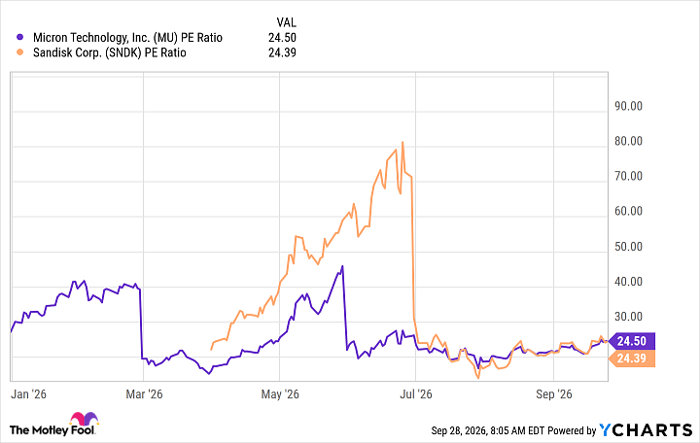
MU PE Ratio data by YCharts.
That's neither a high nor a low valuation, and would be just right for many stocks.
However, relative to next year's earnings projections, these stocks look dirt cheap.
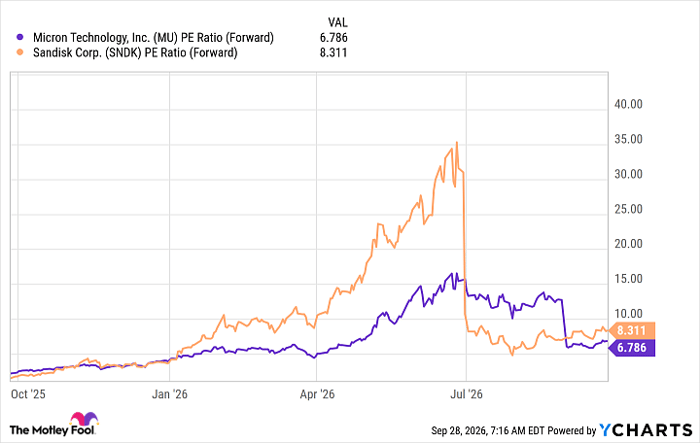
MU PE Ratio (Forward) data by YCharts.
If each of them continues to trade at 24 times trailing earnings as their bottom lines grow toward their projected levels, by the end of their respective fiscal years
Sandisk would have to grow by 189%. For Micron to have a P/E of 24 after the earnings it anticipates will require 253% growth over the next year.
So, if you evenly split a $10,000 investment between these two right now and the projections above pan out, those positions will be worth over $32,000, with $14,457 coming from Sandisk and $17,647 coming from Micron.
Those are simply incredible returns, and the key reason that you can look forward to them is that right now, the market is pessimistic about these two companies' future. However, based on the premise that AI infrastructure demand will remain elevated for multiple years longer, I think that the market has nothing to fear here, and that investors should buy Sandisk and Micron stock hand over fist.
Should you buy stock in Sandisk right now?
Before you buy stock in Sandisk, consider this:
The Motley Fool Stock Advisor analyst team just identified what they believe are the 10 best stocks for investors to buy now… and Sandisk wasn’t one of them. The 10 stocks that made the cut could produce monster returns in the coming years.
Consider when Netflix made this list on December 17, 2004... if you invested $1,000 at the time of our recommendation, you’d have $373,352!* Or when Nvidia made this list on April 15, 2005... if you invested $1,000 at the time of our recommendation, you’d have $1,406,241!*
Now, it’s worth noting Stock Advisor’s total average return is 933% — a market-crushing outperformance compared to 212% for the S&P 500. Don't miss the latest top 10 list, available with Stock Advisor, and join an investing community built by individual investors for individual investors.
See the 10 stocks »
*Stock Advisor returns as of September 30, 2026.
Keithen Drury has no position in any of the stocks mentioned. The Motley Fool has positions in and recommends Micron Technology. The Motley Fool has a disclosure policy.
Recommended Articles


