

5 Secrets of 401(k) Millionaires

Source The Motley Fool

Key Points

  • Most 401(k) millionaires have contributed to their accounts for about 25 years, letting compounding grow their balances.

  • Even if they start small, 401(k) millionaires steadily increase their contribution percentages over time.

  • 401(k) millionaires remain invested through market declines.

  • The $23,760 Social Security bonus most retirees completely overlook ›

According to Fidelity Investments, the number of 401(k) millionaires the firm manages surged to 769,000 in the second quarter of 2026, up 19% from the first quarter. And that's just Fidelity. Across firms like Vanguard, BlackRock, State Street, JPMorgan Chase, Goldman Sachs, and others, the number of 401(k) millionaires is in the millions.

While some people become wealthy through inheritance or by hitting it big with a company IPO, the average millionaire followed the long, disciplined road to riches. Here's what it took for everyday people to build such impressive portfolios.

Missed AI’s "Act 1"? Act 2 Could Be 15x Bigger. Most investors think they missed the AI boat because they didn't buy Nvidia in 2005. But according to our analysts, we’re only at the end of "Act 1"—the R&D phase. "Act 2" is the global rollout. Continue »
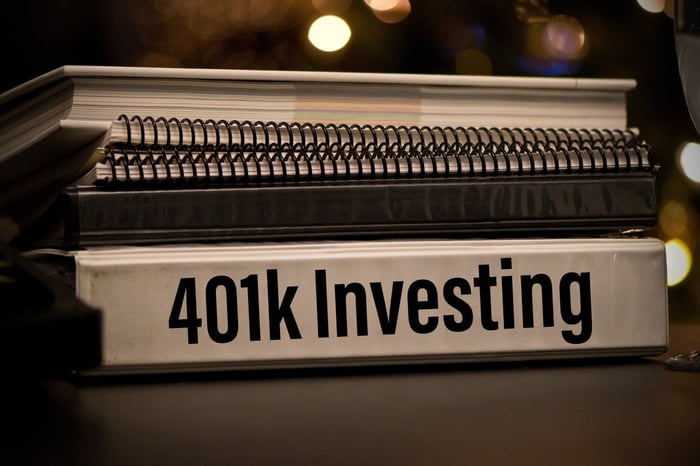
Stack of notebooks, with "401k Investing" printed on the spine of the bottom notebook.

Image source: Getty Images.

1. They build regular investing into their everyday lives

The average 401(k) millionaire is 59 years old and has been investing for roughly 26 years. In other words, nothing happened overnight. Those who couldn't afford to contribute much when they were younger steadily increased their contributions over time -- often by just 1 percentage point per year. That way, raises and bonuses translate into higher savings.

2. They pay themselves first

A person will always have a reason to believe they can't afford to invest, plus about 100 other things they feel compelled to spend the money on. However, 401(k) millionaires have learned to prioritize retirement savings by paying themselves first. While learning this skill might have been tricky, it removes monthly willpower from the equation and keeps contributions flowing. One of the easiest ways to pay yourself first is through automated contributions that you can set and forget.

3. They never leave money on the table

A "secret" central to the success of 401(k) millionaires has been making sure they contribute enough to take advantage of employer matching. For example, if an employer matches 5%, investors should contribute at least 5% of their paychecks each month to capture the full match.

4. They remain invested

What these millionaires have in common is a dedication to investing, no matter what's happening in the market. They make the same contributions month in and month out, regardless of market swings. While the desire to flee the market amid downturns may be a natural human response, these savers stay invested, knowing that doing so lets them buy high-quality assets at a bargain price. Just as importantly, staying invested allows their portfolios to grow dramatically as the market recovers.

That's because roughly 36% of the market's best days occurred in the first two months of a bull market, before it was even clear that a bull market had begun. If they'd left the market when things got rough, they would have missed out on low-priced assets and amplified gains as the market recovered.

5. They deliberately choose boring investments

401(k) millionaires tend to keep their investments simple. For many, low-cost index funds or target-date funds that stay broadly diversified across stocks, bonds, and sectors are enough.

The secret to becoming a 401(k) millionaire isn't complex: Start early, increase contributions as your income grows, capture employer matches, automate savings, and stay in the market as others flee.

The $23,760 Social Security bonus most retirees completely overlook

If you're like most Americans, you're a few years (or more) behind on your retirement savings. But a handful of little-known "Social Security secrets" could help ensure a boost in your retirement income.

One easy trick could pay you as much as $23,760 more... each year! Once you learn how to maximize your Social Security benefits, we think you could retire confidently with the peace of mind we're all after. Join Stock Advisor to learn more about these strategies.

View the "Social Security secrets" »

JPMorgan Chase is an advertising partner of Motley Fool Money. Dana George has no position in any of the stocks mentioned. The Motley Fool has positions in and recommends BlackRock, Goldman Sachs Group, and JPMorgan Chase. The Motley Fool has a disclosure policy.

Disclaimer: For information purposes only. Past performance is not indicative of future results.
placeholder
October hike odds climb toward 60% as Goldman and BofA both flip — what Warsh's "dose of accommodation" really changedRate futures now price roughly 55% to 62% for a 25bp hike at the October 27-28 FOMC, up from about 30% before Chair Warsh's post-meeting framing that the Fed is merely "removing some accommodation." Goldman Sachs has added an October hike to its forecast and Bank of America now sees moves in both October and December. Here is the repricing, the language behind it, and the two data points that decide it.
Author  Irene Q.
Sep 23, Wed
Rate futures now price roughly 55% to 62% for a 25bp hike at the October 27-28 FOMC, up from about 30% before Chair Warsh's post-meeting framing that the Fed is merely "removing some accommodation." Goldman Sachs has added an October hike to its forecast and Bank of America now sees moves in both October and December. Here is the repricing, the language behind it, and the two data points that decide it.
placeholder
Four jobs reports in five days: what JOLTS, ADP, claims and the September payrolls mean for the October Fed decisionThe US labour market faces its densest data week of the month. JOLTS job openings land Tuesday (7.2 million expected), ADP on Wednesday (70,000 expected), initial claims on Thursday and the September non-farm payrolls on Friday (100,000 expected, down from 162,000). Markets price a 64%-70% chance of another quarter-point Fed hike on October 28. The dollar index sits at 100.77 and the S&P 500 at 7,729.8.
Author  Mitrade
Sep 28, Mon
The US labour market faces its densest data week of the month. JOLTS job openings land Tuesday (7.2 million expected), ADP on Wednesday (70,000 expected), initial claims on Thursday and the September non-farm payrolls on Friday (100,000 expected, down from 162,000). Markets price a 64%-70% chance of another quarter-point Fed hike on October 28. The dollar index sits at 100.77 and the S&P 500 at 7,729.8.
placeholder
Nvidia's $150 billion buyback landed — and the AI sector fell anyway. That's the signal worth tradingNvidia closed up 1.68% at $228.86 on 28 September after announcing a $150 billion share repurchase authorisation, the largest single corporate buyback on record, while the rest of the AI complex sold off: AMD -3.6%, Micron -2.6%, Meta -4.8% and the Philadelphia Semiconductor Index -1.61%. The divergence is not noise. Capital is rotating toward cash-flow certainty, not abandoning the AI theme. With Micron reporting after the close on 30 September, here is what the split means.
Author  Irene Q.
Yesterday 06: 31
Nvidia closed up 1.68% at $228.86 on 28 September after announcing a $150 billion share repurchase authorisation, the largest single corporate buyback on record, while the rest of the AI complex sold off: AMD -3.6%, Micron -2.6%, Meta -4.8% and the Philadelphia Semiconductor Index -1.61%. The divergence is not noise. Capital is rotating toward cash-flow certainty, not abandoning the AI theme. With Micron reporting after the close on 30 September, here is what the split means.
placeholder
The 30-year Treasury just hit a 22-year high — and the bond market is not pricing the Fed, it is pricing the deficitThe 30-year Treasury yield closed at 5.56% on 28 September, the highest since June 2004, while the 10-year reached 5.24% and the 20-year 5.60%. The curve has steepened roughly 30bp in eight sessions even as October hike odds sit at 70.3%. That gap is the story: the long end is repricing fiscal and inflation risk, not policy. With PCE on Wednesday and payrolls on Friday, here is what the long end is really saying.
Author  Irene Q.
Yesterday 07: 08
The 30-year Treasury yield closed at 5.56% on 28 September, the highest since June 2004, while the 10-year reached 5.24% and the 20-year 5.60%. The curve has steepened roughly 30bp in eight sessions even as October hike odds sit at 70.3%. That gap is the story: the long end is repricing fiscal and inflation risk, not policy. With PCE on Wednesday and payrolls on Friday, here is what the long end is really saying.
placeholder
【Daily Brief】30-year Treasury tops 5.59%, S&P 500 slips to 7,670 and gold holds $4,180 — PCE lands tonightThe 30-year Treasury yield closed at 5.59%, its highest since June 2002, and the Dow fell 131.59 points to 51,349.92. US consumer confidence dropped to 81.9, a 12-year low, and JOLTS job openings fell to 7.1 million. August PCE and Q3 GDP both land at 8:30am ET tonight.
Author  Suzie
6 hours ago
The 30-year Treasury yield closed at 5.59%, its highest since June 2002, and the Dow fell 131.59 points to 51,349.92. US consumer confidence dropped to 81.9, a 12-year low, and JOLTS job openings fell to 7.1 million. August PCE and Q3 GDP both land at 8:30am ET tonight.
goTop
quote