


Stellantis' Turnaround Continues to Gain Traction -- Here's 1 Overlooked Reason to Buy the Hype
Key Points
Stellantis is attempting to turn around its operations with a huge $70 billion global strategy.
Before the plan was unveiled, Stellantis was already making moves to hire more than 2,000 engineers last year.
Getting the product right, especially in North America, is the most important aspect for Stellantis' turnaround to gain traction.
- 10 stocks we like better than Stellantis ›
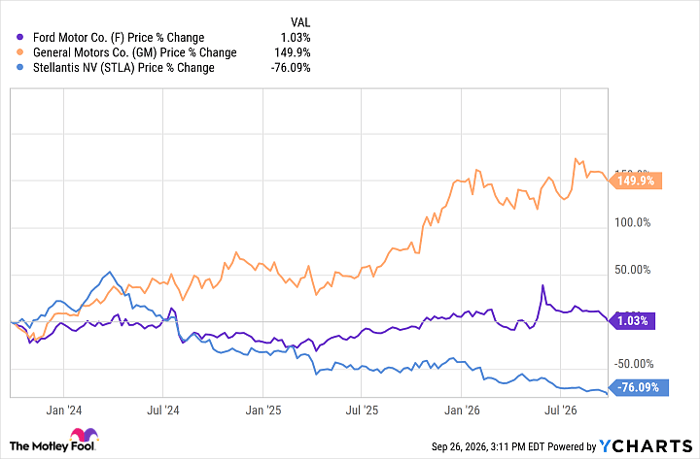
There's usually value to be found within the automotive industry. When comparing arguably the three closest rivals out of all legacy automakers, Ford Motor Company (NYSE: F), General Motors (NYSE: GM), and Stellantis (NYSE: STLA), you will quickly notice which one Wall Street is applauding, which one it's ignoring, and which one it doesn't want to touch.
Missed Nvidia in 2009? This Rare Signal Is Flashing Again. In 2009, a "Double Down" signal flashed for a little-known chipmaker called Nvidia. For the first time in years, that same "Total Conviction" signal is flashing for a company 1/100th the size of Nvidia. Continue »
F data by YCharts.
During the next five years, Stellantis, which is embarking on a huge $70-billion-dollar global turnaround plan, won't become the best automaker or business of the three. However, because it's been so heavily sold off, it has immense near-term upside for investors willing to risk that the company can execute and gain traction with its revamp. When it begins to prove that progress is real, expect the stock to bounce higher.
Let's take a closer look at one development investors seem to overlook, and one thing to keep an eye on as Stellantis approaches the end of the third quarter and its next earnings call.
Overlooked talent inflow
When Stellantis Chief Executive Officer Antonio Filosa took over the struggling global automaker, it was clear that it needed a sweeping overhaul and an influx of talent. Stellantis then hired more than 2,000 engineers in 2025 alone, with many of them focused on quality improvements. In a statement, Stellantis also noted that some of the hiring surge was to support its Value Creation Program, which aims to deliver $7 billion in cost savings by 2028.
It's a great sign that Stellantis is bringing on engineering talent as it invests tens of billions into new platforms, vehicle launches, and quality improvements. It's also interesting to note that the company has now frozen hiring of white-collar workers for its North America headquarters. That suggests that it's moving on to its next phase to keep advancing its makeover.
"After a first half marked by unprecedented hiring to support both the Value Creation Program and the FaSTLAne 2030 strategic plan, we are entering the next phase of our talent strategy, focused on integrating new employees, accelerating internal career opportunities and continuing to build the capabilities of our workforce," Stellantis said in a statement.
Why new talent is important
On paper, Stellantis' plan checks all the boxes. It's investing immense capital into its profit engine, North America, which will launch a long list of new vehicles to regain lost market share and attack the pent-up demand for more affordable vehicles. It's doing this by introducing seven vehicles priced under $40,000 and two priced for less than $30,000. This will certainly raise the company's sales volume and revenue, but just as importantly, it will improve profitability by adding production to its underutilized factories.
Essentially, while Stellantis is putting its money where its mouth is and has developed a strong global turnaround plan, what will make or break the entire strategy is developing higher-quality vehicles that generate strong demand, especially in its North America profit engine. Bringing on thousands of engineers and incorporating them into the broader turnaround plan, driven by developing a strong product pipeline and more efficient platforms, will be key for success.
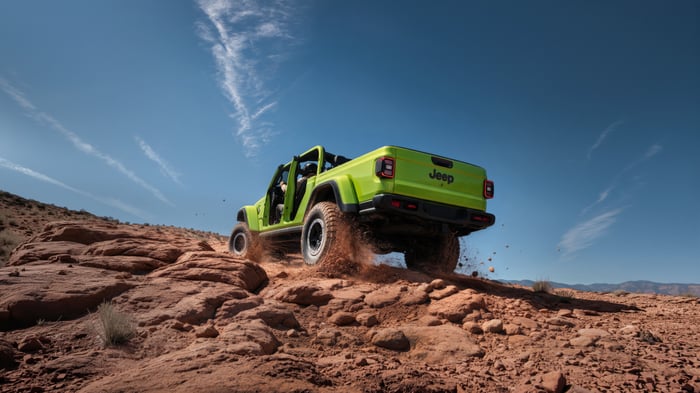
Notice the unique Jeep vehicle. Image source: Stellantis.
One last thing to watch
It was easy for investors to get excited about Stellantis' North America shipment volume during the second quarter, which saw regional vehicle shipments jump 38% compared to a year earlier. However, while part of that was indeed driven by strong retail performances from vehicles such as the refreshed Jeep Grand Wagoneer (43% sales increase during Q2), another chunk of that shipment increase was loading up inventory before its planned summer factory shutdown.
What we will want to keep an eye on when third-quarter data is released is how North America's shipment volume moves. Will it show a rise, suggesting stronger demand for its newer products? Or will it tumble, suggesting that more of the 38% Q2 gain in North America was purely loading inventory?
Ultimately, Stellantis' core engineering talent inflow was overlooked, but it's a critical component of its global refresh that will see more than 60 new vehicle launches. The hiring freeze now signals that the next stage is underway, which should have investors feeling optimistic about the company's turnaround prospects during the next three to five years.
Should you buy stock in Stellantis right now?
Before you buy stock in Stellantis, consider this:
The Motley Fool Stock Advisor analyst team just identified what they believe are the 10 best stocks for investors to buy now… and Stellantis wasn’t one of them. The 10 stocks that made the cut could produce monster returns in the coming years.
Consider when Netflix made this list on December 17, 2004... if you invested $1,000 at the time of our recommendation, you’d have $373,352!* Or when Nvidia made this list on April 15, 2005... if you invested $1,000 at the time of our recommendation, you’d have $1,406,241!*
Now, it’s worth noting Stock Advisor’s total average return is 933% — a market-crushing outperformance compared to 212% for the S&P 500. Don't miss the latest top 10 list, available with Stock Advisor, and join an investing community built by individual investors for individual investors.
See the 10 stocks »
*Stock Advisor returns as of September 30, 2026.
Daniel Miller has positions in Ford Motor Company and General Motors. The Motley Fool recommends General Motors and Stellantis. The Motley Fool has a disclosure policy.
Recommended Articles


