


If an AI Bubble Crashes the Stock Market, Warren Buffett Says This Is the First Move Investors Should Make
Key Points
The AI boom has been lucrative for the market, but it's tough to say how long it might last.
If a downturn is coming, now is the ideal time to prepare.
Warren Buffett has both a warning and crucial advice for investors.
- 10 stocks we like better than S&P 500 Index ›
Artificial intelligence (AI) stocks have fueled much of the stock market's growth over the past few years. The S&P 500 (SNPINDEX: ^GSPC) has surged by more than 88% over the past three years alone, while the tech-heavy Nasdaq Composite (NASDAQINDEX: ^IXIC) is up 111% over that period.
However, increased AI-related spending has some investors worried that revenue won't be able to keep up. According to recent research from Goldman Sachs strategist Ryan Hammond, AI users will have to spend at least $1 trillion per year for hyperscalers to generate enough returns on their investments to justify this spending.
Missed Nvidia in 2009? This Rare Signal Is Flashing Again. In 2009, a "Double Down" signal flashed for a little-known chipmaker called Nvidia. For the first time in years, that same "Total Conviction" signal is flashing for a company 1/100th the size of Nvidia. Continue »
To be clear, this doesn't necessarily mean that a market crash is coming or even that we're in a bubble. But it does mean investors should keep realistic expectations and be careful about where they buy. And if an AI-driven bear market is on the table, this one investing move will be critical, according to Buffett.
Image source: The Motley Fool.
How to prepare for a potential bubble
Rewind to 1999. The internet was a brand-new technology with loads of potential, and many people were excited about all the ways it could transform society. Investors were also pouring money into tech stocks, leading to record-breaking IPOs and a massive surge in valuations.
Late that year, in an essay for Fortune, Buffett issued a warning to investors. He emphasized that all of the growth experienced over the previous few years was likely unsustainable, urging investors to ensure they're investing in tech stocks for the right reasons.
Buffett noted that a technology can change the world, but that doesn't necessarily make it a smart investment. He used airplanes as an example, explaining that while air travel had fundamentally transformed society, 129 airline companies had filed for bankruptcy in the last 20 years.
"The key to investing," Buffett explained in his 1999 essay, "is not assessing how much an industry is going to affect society, or how much it will grow, but rather determining the competitive advantage of any given company and, above all, the durability of that advantage."
History says this is the smartest move investors can make
Whether or not we're in an AI bubble right now, we could be facing a similar situation in the stock market. Not all AI-related companies are smart investments, as there's no shortage of hype in the tech sector right now. If the sector does eventually face a pullback, weak companies lacking a competitive advantage will be hit the hardest.
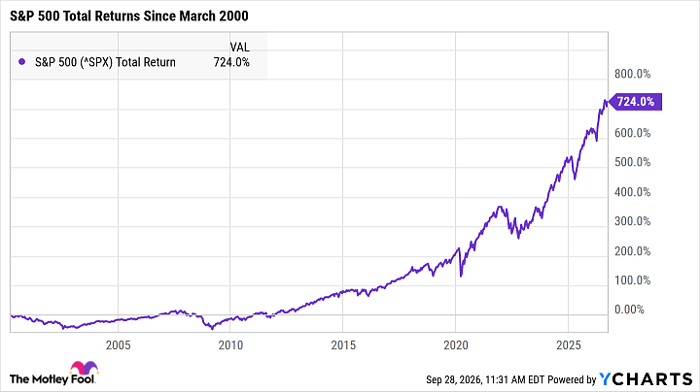
The good news is that healthy companies are far more likely to survive even extreme volatility. Since March 2000 -- the beginning of the dot-com bear market -- the S&P 500 has earned total returns of more than 700%.
^SPX data by YCharts
During his tenure as CEO of Berkshire Hathaway, Buffett was known for sitting on large cash piles and occasionally selling more stocks than he bought. But the company still purchased consistently every quarter, suggesting that even when the market is expensive or potentially on the verge of a downturn, there are still stocks worth buying.
Over time, it's all but certain the broader market will survive even extreme volatility. Analysis from Crestmont Research found that since 1919, every single one of the S&P 500's 20-year periods has ended in positive total returns. This means that by investing in an S&P 500 ETF and holding it for 20 years, you'd have made money -- even if the market faced a brutal recession in that period.
The silver lining of a downturn is that it provides investors with an opportunity to load up on quality stocks at a fraction of the price. If there's just one move to make right now, it's to seek out healthy stocks with robust competitive advantages and prepare to hold them for the long term.
In the wise words of Buffett, "Keep buying it through thick and thin, and especially through thin."
Should you buy stock in S&P 500 Index right now?
Before you buy stock in S&P 500 Index, consider this:
The Motley Fool Stock Advisor analyst team just identified what they believe are the 10 best stocks for investors to buy now… and S&P 500 Index wasn’t one of them. The 10 stocks that made the cut could produce monster returns in the coming years.
Consider when Netflix made this list on December 17, 2004... if you invested $1,000 at the time of our recommendation, you’d have $373,352!* Or when Nvidia made this list on April 15, 2005... if you invested $1,000 at the time of our recommendation, you’d have $1,406,241!*
Now, it’s worth noting Stock Advisor’s total average return is 933% — a market-crushing outperformance compared to 212% for the S&P 500. Don't miss the latest top 10 list, available with Stock Advisor, and join an investing community built by individual investors for individual investors.
See the 10 stocks »
*Stock Advisor returns as of September 30, 2026.
Katie Brockman has no position in any of the stocks mentioned. The Motley Fool has positions in and recommends Berkshire Hathaway. The Motley Fool has a disclosure policy.
Recommended Articles


