


I've Covered Palantir for 5 Years. Here's How to Know if the Artificial Intelligence (AI) Stock Is Overvalued.
Key Points
Wall Street and retail investors have been debating Palantir's valuation since the company went public.
Palantir is often benchmarked against other SaaS businesses, but I think this analysis is short-sighted.
Palantir sells a much more unique piece of software relative to other data tools, making its valuation harder to judge.
- 10 stocks we like better than Palantir Technologies ›
I first bumped into Palantir Technologies (NASDAQ: PLTR) about 10 years ago. At the time, I was working as an investment analyst at a business development company (BDC). While riding the Metro home after work one day, I noticed a person sitting across from me was wearing a Palantir beanie.
Given most of the deals I worked on were focused on technology start-ups, I had heard Palantir's name in passing, but I didn't really know the business. When I got home, I Googled "what does Palantir do" and instantly became curious -- tracking the company's funding rounds, investor roster, and waited anxiously for its public debut.
Missed Nvidia in 2009? This Rare Signal Is Flashing Again. In 2009, a "Double Down" signal flashed for a little-known chipmaker called Nvidia. For the first time in years, that same "Total Conviction" signal is flashing for a company 1/100th the size of Nvidia. Continue »
Over the last five years, I've covered the data analytics darling through its meme-stock phase, the artificial intelligence (AI) boom, and the never-ending debate over whether Palantir stock is a bubble or a once-in-a-generation opportunity. The honest answer starts with a simple point: the usual scorecards are a misleading way to judge this company. Let me explain why.

Image source: Getty Images.
Traditional valuation methods don't fully capture Palantir
If you benchmark Palantir against or a basket of software-as-a-service (Saas) using the price-to-sales (P/S) ratio, it will look expensive every single time. Using price-to-earnings (P/E) multiples are even more useless, as many of the SaaS "peers" below are not yet generating consistent profitability.
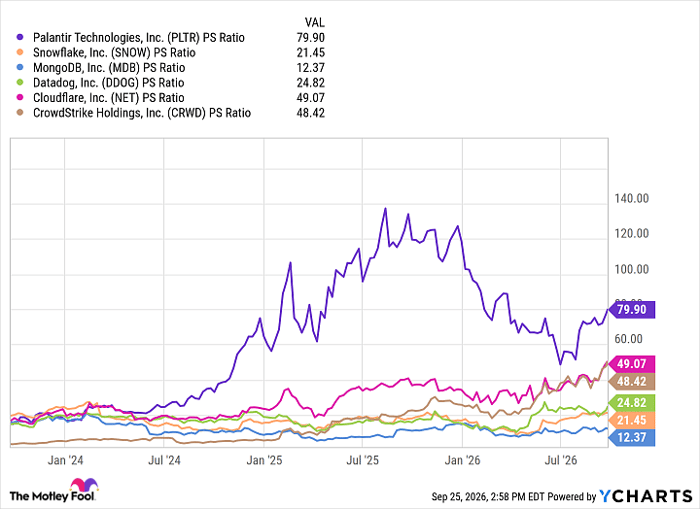
PLTR PS Ratio data by YCharts
Since Palantir's market cap looks enormous relative to its current revenue, Wall Street loves to treat that disparity as the end of the conversation. This comparison is flawed, though. While the companies shown above are good businesses, all of them sell relatively well-understood products: CRMs, data warehouses, observability, and cybersecurity. The products in this stack are quickly becoming commoditized, meaning customers can switch vendors, stitch different solutions together, or wait for a cheaper alternative. Palantir does not compete in that type of market.
Palantir's core product is called an ontology. Think of this as a living map of how an organization actually works: the customer details, vendor relationships, and product decisions that sit inside of spreadsheets. Once that map exists, Palantir's software suites -- Gotham and Foundry -- form the basis of its Artificial Intelligence Platform (AIP), turning messy operational data into real-time actionable intelligence. A chatbot bolted onto a data warehouse cannot replicate this at scale.
Palantir spent two decades building this intimate data layer for intelligence and defense agencies who cannot afford to be drowned in sloppy data. Software developers simply can't recreate 20 years of models, workflow logic, and classified deployments by shipping a nicer dashboard. That is what gives Palantir a first-mover advantage when selling AI-driven solutions to the U.S. government, its allies, and an increasing number of Fortune 500 companies.
What Palantir's earnings actually show
Palantir's financial trajectory is finally starting to look like one of a platform business, not a consulting shop. During the second quarter of 2026, revenue rose 93% year over year to $1.94 billion. U.S. commercial revenue jumped 149% to $764 million, while U.S. government revenue increased 90% to $809 million. Meanwhile, operating income was $912 million and adjusted free cash flow was $1.2 billion, or a 63% margin. The company ended the quarter with $9.4 billion in cash and Treasuries and no meaningful debt.
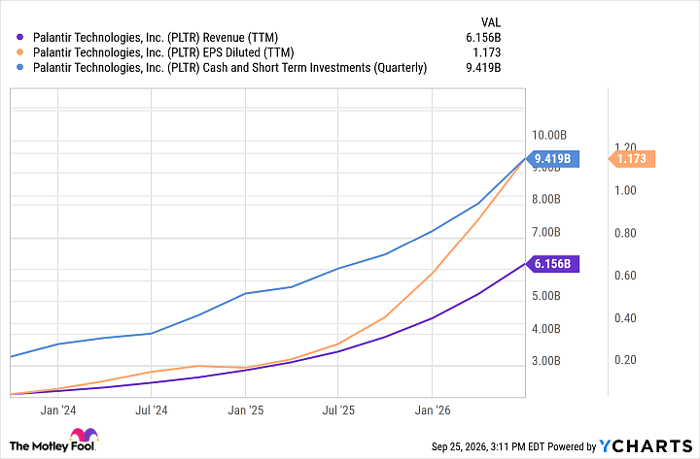
PLTR Revenue (TTM) data by YCharts
One of the lesser-tracked, albeit critical, metrics with Palantir is net dollar retention (NRR). This measures how much sales the company retains net of churn. At the end of the second quarter, NRR hit 157% -- underscoring that not only are customers renewing, but they are expanding their original contracts for higher amounts. In other words, Palantir is far outselling any churn it experiences.
In addition, U.S. commercial remaining deal value (RDV) climbed to $6.24 billion -- up 124% year over year. Given this level of growth, it's not surprising that management raised full-year 2026 revenue guidance to about $8.2 billion, implying 82% growth. This is the opposite of a one-off AI success story.
Palantir's long-term tailwinds are specific. Sovereign AI is quickly becoming a real budget line for governments and enterprises that do not want their operational data training a frontier model developed by an outside lab. The company is also partnering its ontology platform with Nvidia's open models, as well as being deployed in cloud environments hosted by Amazon Web Services (AWS) and Microsoft Azure. Inside the Pentagon, Palantir is embedded through Gotham, the Maven Smart System (MSS), as well as the Army's TITAN program. NATO has even deployed Maven as an alliancewide decision layer. Those are sticky platform deals, not one-year software licenses or pilot programs.
Is Palantir stock overvalued?
By conventional standards, Palantir stock is not cheap. A growth stock this richly valued will get punished if growth even resembles a hiccup. But saying Palantir is overvalued relative to its SaaS peers is not entirely accurate, as the company is so differentiated it doesn't really have an apples-to-apples competitor.
With Palantir, you aren't buying another CRM. Enterprises are buying an operating system that bridges raw data and real-world decisions in critical environments. Five years of covering Palantir has made understanding the business and its mission much more clear.
As the ontology keeps compounding and customers keep expanding, Palantir should become less of a crowded momentum trade and more of a generational buy hiding behind what will first appear to be an uncomfortable valuation screen. In my eyes, Palantir is a great buy for investors with a long-term time horizon and for those looking to complement their core AI stocks.
Should you buy stock in Palantir Technologies right now?
Before you buy stock in Palantir Technologies, consider this:
The Motley Fool Stock Advisor analyst team just identified what they believe are the 10 best stocks for investors to buy now… and Palantir Technologies wasn’t one of them. The 10 stocks that made the cut could produce monster returns in the coming years.
Consider when Netflix made this list on December 17, 2004... if you invested $1,000 at the time of our recommendation, you’d have $373,352!* Or when Nvidia made this list on April 15, 2005... if you invested $1,000 at the time of our recommendation, you’d have $1,406,241!*
Now, it’s worth noting Stock Advisor’s total average return is 933% — a market-crushing outperformance compared to 212% for the S&P 500. Don't miss the latest top 10 list, available with Stock Advisor, and join an investing community built by individual investors for individual investors.
See the 10 stocks »
*Stock Advisor returns as of September 29, 2026.
Adam Spatacco has positions in Amazon, Microsoft, Nvidia, and Palantir Technologies. The Motley Fool has positions in and recommends Amazon, Cloudflare, CrowdStrike, Datadog, Microsoft, MongoDB, Nvidia, Palantir Technologies, and Snowflake. The Motley Fool has a disclosure policy.
Recommended Articles


