

Bloom Energy Surges Over 13%, Tops $300 Level as Jefferies Says Orders Support Growth Expectations

Source Tradingkey

TradingKey - On September 29 Eastern Time, Bloom Energy (BE) surged over 13% in early trading, recovering all of yesterday's losses and hitting a new recent high.

Morgan Stanley maintained its "Overweight" rating and $310 price target on the stock, believing that signed projects, multi-gigawatt partnerships, and strong 2026 guidance are expected to cushion the impact of delays in individual project rollouts on near-term earnings.

Market expectations for data center power demand are an important backdrop to this rally. As AI data centers require continuous and stable power supply, Bloom Energy's solid oxide fuel cells have attracted attention. Such equipment can be deployed relatively quickly, providing on-site power, off-grid, or microgrid solutions for large cloud service providers and data centers.

However, institutions remain divided on the certainty of growth delivery. Jefferies raised its price target for Bloom Energy to $264, which is still about 10% away from the current price, while maintaining its "Hold" rating without an upgrade.

The firm believes that the logic of tapping into AI data center power demand through "behind-the-meter" power generation remains unchanged, with recent large orders and capacity expansion supporting growth prospects. However, several key projects still face uncertainties regarding air, water, natural gas supplies, and local approvals.

The firm noted that a significant portion of Bloom Energy's current revenue growth relies on a few large projects, making its financial performance more sensitive to the execution pace of individual projects. The Jupiter project is a prime example. The project was originally planned to use Bloom Energy fuel cells to power a large AI data center, but natural gas pipeline construction and local permitting issues have increased the risk of project delays. Projects like Vineland also face varying degrees of permitting and infrastructure constraints.

Jefferies therefore believes that Bloom Energy's current biggest risk is no longer whether it can secure customers, but whether these large-scale projects can complete permitting, construction, and revenue recognition according to the original timeline.
8-ff034f7aac0f4271bdf797334ef07c24

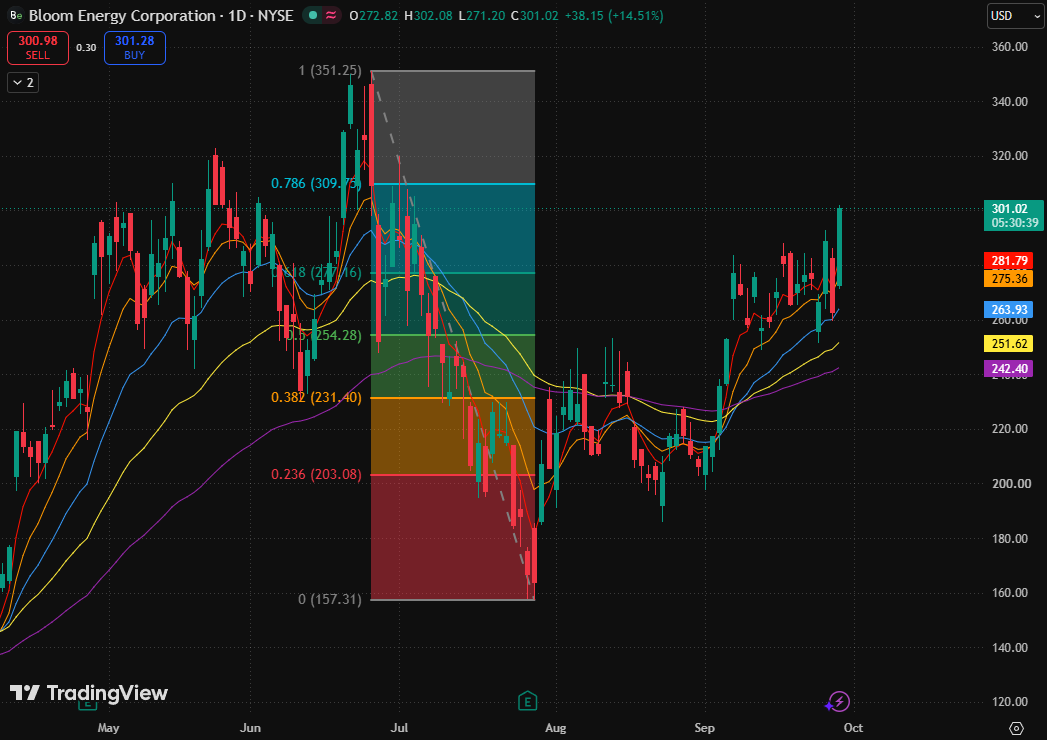
BE daily chart. Source: TradingView

Bloom Energy's stock price rebounded sharply from the steep drop in the previous trading session, climbing back above its 5-day moving average ($280.40), 10-day moving average ($274.60), 20-day moving average ($263.54), 80-day moving average ($251.41), and 160-day moving average ($242.30), while recovering the 0.618 Fibonacci retracement level ($277.16).

The current structure has shifted from a steep pullback near support back to a strong rebound, but it remains between the 0.618 and 0.786 Fibonacci retracement levels, having not yet broken through the 0.786 Fibonacci retracement level ($309.79).

On the upside, if the stock price continues to rise and breaks above the 0.786 Fibonacci retracement level ($309.79), the rally is expected to extend toward the historical high of $309.79.

If the breakout lacks momentum, the stock price could still return to the 0.618 Fibonacci retracement level ($277.16) to seek support. In a weaker scenario, it may further retest the support zone near the 20-day moving average ($263.54) and the 0.5 Fibonacci retracement level ($254.28).

Disclaimer: For information purposes only. Past performance is not indicative of future results.
placeholder
October hike odds climb toward 60% as Goldman and BofA both flip — what Warsh's "dose of accommodation" really changedRate futures now price roughly 55% to 62% for a 25bp hike at the October 27-28 FOMC, up from about 30% before Chair Warsh's post-meeting framing that the Fed is merely "removing some accommodation." Goldman Sachs has added an October hike to its forecast and Bank of America now sees moves in both October and December. Here is the repricing, the language behind it, and the two data points that decide it.
Author  Irene Q.
Sep 23, Wed
Rate futures now price roughly 55% to 62% for a 25bp hike at the October 27-28 FOMC, up from about 30% before Chair Warsh's post-meeting framing that the Fed is merely "removing some accommodation." Goldman Sachs has added an October hike to its forecast and Bank of America now sees moves in both October and December. Here is the repricing, the language behind it, and the two data points that decide it.
placeholder
Four jobs reports in five days: what JOLTS, ADP, claims and the September payrolls mean for the October Fed decisionThe US labour market faces its densest data week of the month. JOLTS job openings land Tuesday (7.2 million expected), ADP on Wednesday (70,000 expected), initial claims on Thursday and the September non-farm payrolls on Friday (100,000 expected, down from 162,000). Markets price a 64%-70% chance of another quarter-point Fed hike on October 28. The dollar index sits at 100.77 and the S&P 500 at 7,729.8.
Author  Mitrade
Sep 28, Mon
The US labour market faces its densest data week of the month. JOLTS job openings land Tuesday (7.2 million expected), ADP on Wednesday (70,000 expected), initial claims on Thursday and the September non-farm payrolls on Friday (100,000 expected, down from 162,000). Markets price a 64%-70% chance of another quarter-point Fed hike on October 28. The dollar index sits at 100.77 and the S&P 500 at 7,729.8.
placeholder
Nvidia's $150 billion buyback landed — and the AI sector fell anyway. That's the signal worth tradingNvidia closed up 1.68% at $228.86 on 28 September after announcing a $150 billion share repurchase authorisation, the largest single corporate buyback on record, while the rest of the AI complex sold off: AMD -3.6%, Micron -2.6%, Meta -4.8% and the Philadelphia Semiconductor Index -1.61%. The divergence is not noise. Capital is rotating toward cash-flow certainty, not abandoning the AI theme. With Micron reporting after the close on 30 September, here is what the split means.
Author  Irene Q.
Sep 29, Tue
Nvidia closed up 1.68% at $228.86 on 28 September after announcing a $150 billion share repurchase authorisation, the largest single corporate buyback on record, while the rest of the AI complex sold off: AMD -3.6%, Micron -2.6%, Meta -4.8% and the Philadelphia Semiconductor Index -1.61%. The divergence is not noise. Capital is rotating toward cash-flow certainty, not abandoning the AI theme. With Micron reporting after the close on 30 September, here is what the split means.
placeholder
【Daily Brief】The dollar ground higher for six days — and the AUD fell 2% in the very week the RBA hiked to a 15-year highThe dollar index held above 101 while the Australian dollar slid to a two-month low of 0.6976, a 2.02% six-session loss, even though the RBA raised rates to 4.60% and Australian CPI printed 4.0%. The yen is the only major currency gaining, ahead of Japan's monthly intervention tally at 7pm JST.
Author  Irene Q.
18 hours ago
The dollar index held above 101 while the Australian dollar slid to a two-month low of 0.6976, a 2.02% six-session loss, even though the RBA raised rates to 4.60% and Australian CPI printed 4.0%. The yen is the only major currency gaining, ahead of Japan's monthly intervention tally at 7pm JST.
placeholder
【Daily Brief】30-year Treasury tops 5.59%, S&P 500 slips to 7,670 and gold holds $4,180 — PCE lands tonightThe 30-year Treasury yield closed at 5.59%, its highest since June 2002, and the Dow fell 131.59 points to 51,349.92. US consumer confidence dropped to 81.9, a 12-year low, and JOLTS job openings fell to 7.1 million. August PCE and Q3 GDP both land at 8:30am ET tonight.
Author  Suzie
18 hours ago
The 30-year Treasury yield closed at 5.59%, its highest since June 2002, and the Dow fell 131.59 points to 51,349.92. US consumer confidence dropped to 81.9, a 12-year low, and JOLTS job openings fell to 7.1 million. August PCE and Q3 GDP both land at 8:30am ET tonight.
goTop
quote