


Dutch Bros Stock Is Down 49% From Its High Despite Revenue Rising 32%. Should You Buy Now or Stay Away?
Key Points
Second-quarter revenue rose 32% year over year, driven by a 5.8% increase in comparable sales.
Rising costs and softer comps guidance are weighing on the stock.
The stock is trading at an attractive valuation that could set the stage for strong long-term returns.
- 10 stocks we like better than Dutch Bros ›
Dutch Bros (NYSE: BROS) stock looks like a buy after its recent pullback. The coffee chain posted strong second-quarter results on Aug. 5, with revenue up 32% year over year and healthy margins, but as of Sept. 25, the stock is down 49% from its 52-week high after management's near-term outlook came in softer than investors wanted.
Here's why the market's focus on the third quarter is creating an attractive entry point in this company's long-term growth story.
Missed Nvidia in 2009? This Rare Signal Is Flashing Again. In 2009, a "Double Down" signal flashed for a little-known chipmaker called Nvidia. For the first time in years, that same "Total Conviction" signal is flashing for a company 1/100th the size of Nvidia. Continue »
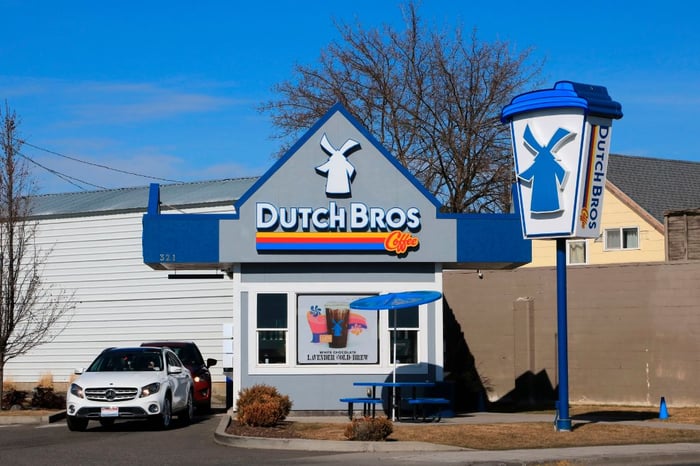
Image source: Getty Images.
Stock sold off on slower comparable sales growth
In the second quarter, Dutch Bros' revenue growth was driven both by 48 new shop openings and 5.8% year-over-year growth in systemwide same-shop sales (a metric that excludes locations opened within the last 15 months). This was the company's 13th straight quarter of same-store sales growth.
Profitability is also improving as the chain scales. On a trailing-12-month basis, net margin reached 7%. In the quarter, net income rose to $51.6 million from $38.4 million a year earlier.
So why did the stock sell off? Four factors stand out:
- Third-quarter guidance implied slower momentum. Management expects same-shop sales growth of 4% to 5%. That deceleration in growth reflects that the company faces tougher year-over-year comparisons after last year's food program rollout.
- Near-term cost pressures. Higher coffee and food costs, along with a shift toward built-to-suit leases, are expected to raise the cost of goods sold and weigh on the company's gross margin.
- Higher capital spending. The company raised its capex guidance to a range of $350 million to $370 million -- up from its prior range of $270 million to $290 million -- as it aims to stay on pace to hit its goal of operating 2,029 shops by 2029.
- A deal that didn't happen. On Aug. 5, Dutch Bros said it planned to buy 65 former Salad and Go locations, but later walked away after a competing bid exceeded its maximum price.
Wall Street prefers a clean, predictable growth path. When anything clouds a company's near-term outlook -- even if its long-term narrative is intact -- the market often punishes the stock.
But the opportunity hasn't changed. At its March 2025 investor day, management pegged its long-term U.S. expansion potential at over 7,000 shops. With 1,225 locations open as of June 30, 2026, Dutch Bros still has a long runway for growth ahead.
Dutch Bros is trading at 2.6 times sales
The rising profit margin and the discipline to avoid overpaying for Salad and Go suggest management is prioritizing profitable growth and long-term shareholder returns. The stock's near-term volatility has created an opening for long-term investors to buy in at a lower valuation.
Dutch Bros trades at about 2.6 times sales. Restaurant chains like Starbucks and Chipotle often commanded price-to-sales multiples in the 3 to 4 range during their early-stage, high-growth years, so 2.6 is a clear discount. For investors who can hold the stock for at least five years, Dutch Bros looks like a buy on this pullback.
Should you buy stock in Dutch Bros right now?
Before you buy stock in Dutch Bros, consider this:
The Motley Fool Stock Advisor analyst team just identified what they believe are the 10 best stocks for investors to buy now… and Dutch Bros wasn’t one of them. The 10 stocks that made the cut could produce monster returns in the coming years.
Consider when Netflix made this list on December 17, 2004... if you invested $1,000 at the time of our recommendation, you’d have $383,680!* Or when Nvidia made this list on April 15, 2005... if you invested $1,000 at the time of our recommendation, you’d have $1,382,954!*
Now, it’s worth noting Stock Advisor’s total average return is 937% — a market-crushing outperformance compared to 214% for the S&P 500. Don't miss the latest top 10 list, available with Stock Advisor, and join an investing community built by individual investors for individual investors.
See the 10 stocks »
*Stock Advisor returns as of September 29, 2026.
John Ballard has no position in any of the stocks mentioned. The Motley Fool has positions in and recommends Chipotle Mexican Grill, Dutch Bros, and Starbucks. The Motley Fool recommends the following options: short September 2026 $35 calls on Chipotle Mexican Grill. The Motley Fool has a disclosure policy.
Recommended Articles


