


Anthropic Releases Claude Sonnet 5.5: Speed Increased by Over 30%, Single-Task Costs Cut by Up to 30%
TradingKey - Anthropic announced the launch of its new model, Claude Sonnet 5.5. The model is the second product in the Claude 5.5 series. Compared to the previous-generation Sonnet 5, its output speed is increased by over 30%, fewer tokens are required to complete the same task, and per-task costs can be reduced by up to 30%.
Sonnet 5.5 is positioned for routine programming, software debugging, as well as document, presentation, and spreadsheet creation, serving as a low-cost complement to the higher-tier Opus 5.5. Anthropic stated that Opus 5.5 is better suited for open-ended tasks requiring continuous judgment and complex reasoning, while Sonnet 5.5 emphasizes speed, efficiency, and rapid iteration.
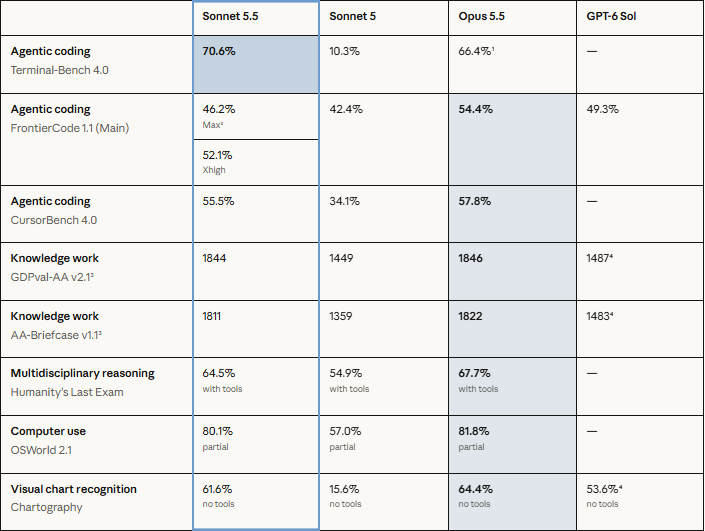
In terms of performance, Sonnet 5.5 significantly surpasses Sonnet 5 across multiple evaluations. In the agentic programming benchmark Terminal-Bench 4.0, Sonnet 5.5 scored 70.6%, higher than Sonnet 5's 10.3%. In the GDPval-AA evaluation, which tests 44 occupations across 9 major industries, Sonnet 5.5 scored 1844, close to Opus 5.5's 1846 and noticeably higher than Sonnet 5's 1449.
Source: Anthropic
Regarding pricing, Sonnet 5.5 remains consistent with Sonnet 5: $2 per million input tokens, $10 per million output tokens, $0.20 per million tokens for cache reads, and $2.50 per million tokens for cache writes. In comparison, Opus 5.5's input and output prices are $4 and $20 per million tokens, respectively. Anthropic stated that Sonnet 5.5 reduces actual usage costs by decreasing the number of tokens needed to complete tasks, rather than simply lowering list prices.
From a commercial perspective, this change indicates that competition among AI models is further shifting from simple token pricing to per-task cost and processing throughput. For enterprise customers, whether a model can complete software development, analysis, and content creation tasks with fewer calls and in less time may affect budgets and return on investment more directly than nominal API unit prices.
In terms of safety, Anthropic stated that Sonnet 5.5 performed better than or equal to Sonnet 5 on most metrics across automated behavioral audits in about 1,850 scenarios. Because its cybersecurity capabilities approach those of Opus 5.5, Sonnet 5.5 is equipped for the first time with cybersecurity protection mechanisms similar to higher-tier models; for higher-risk cybersecurity tasks, the system will fall back to Sonnet 5. The model also includes safety classifiers to prevent large-scale extraction of reasoning capabilities.
Recommended Articles


