


Intel Stock Surged Over 40% in September. History Shows What's Next.
Key Points
Intel's stock skyrocketed on almost no news.
Intel's valuation is far higher than industry leaders'.
- 10 stocks we like better than Intel ›
Intel (NASDAQ: INTC) has been one of the top stocks to own during the month of September, rising over 40% so far. That's an impressive run over a short time frame, and what's even more impressive is that it did it on top of an already spectacular 2026. Intel is up around 250% in 2026, making it the fifth-best-performing stock in the S&P 500 (SNPINDEX: ^GSPC).
That's a great run for Intel and its investors, but I think history has something to say about what's next. Investors need to heed this warning sign, as it could limit future returns.
Missed AI’s "Act 1"? Act 2 Could Be 15x Bigger. Most investors think they missed the AI boat because they didn't buy Nvidia in 2005. But according to our analysts, we’re only at the end of "Act 1"—the R&D phase. "Act 2" is the global rollout. Continue »

Image source: Getty Images.
Did Intel deserve this monster gain?
When a stock rises, it can be for multiple reasons. However, not all stock rallies are created equal.
Intel really hasn't had much come out in recent weeks about its plans or the success of its foundry business, which needs to be turned around to justify its current valuation. Thanks to the rapid rally in September, Intel's stock is incredibly expensive. It trades for 84 times this year's earnings estimates and 62 times 2027's estimates.
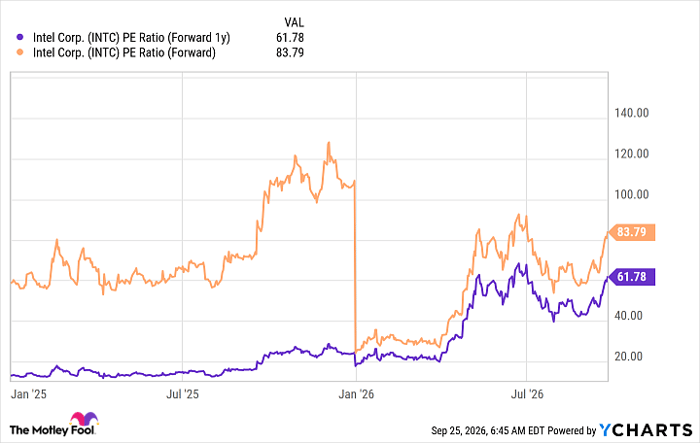
INTC PE Ratio (Forward 1y) data by YCharts. PE = price-to-earnings.
Those are far outside the normal valuation range for a company in Intel's industry, and history tells us that doesn't bode well for the stocks involved.
Intel's business is best split into two divisions: Computing hardware and foundry. The foundry business is best compared to Taiwan Semiconductor (NYSE: TSM), which has traded for an average of about 23 times earnings over the past decade. That means Intel must nearly triple its earnings after 2027 if it hopes to trade at the same price-to-earnings multiple as the industry leader.
Finding a comparison for its computing product divisions is pretty straightforward, as AMD (NASDAQ: AMD) offers many of the same products. However, AMD has had an average valuation of its own over the past decade, due to problems achieving peak profitability. Instead, I'll compare Intel to Nvidia (NASDAQ: NVDA), which trades for just 28 times earnings now.
These are far more reasonable prices for Intel's stock, and with Intel trading at over 60 times next year's earnings, it's a very expensive price tag. History tells us time and time again that these valuations don't last. Either the companies must grow enough to justify them, or investors must suffer a significant price drop as the market rerates their valuations.
I think Intel could see that happen over the next few years, and investors should look elsewhere for more reasonably priced chip stocks (like Taiwan Semiconductor or Nvidia).
Should you buy stock in Intel right now?
Before you buy stock in Intel, consider this:
The Motley Fool Stock Advisor analyst team just identified what they believe are the 10 best stocks for investors to buy now… and Intel wasn’t one of them. The 10 stocks that made the cut could produce monster returns in the coming years.
Consider when Netflix made this list on December 17, 2004... if you invested $1,000 at the time of our recommendation, you’d have $383,680!* Or when Nvidia made this list on April 15, 2005... if you invested $1,000 at the time of our recommendation, you’d have $1,382,954!*
Now, it’s worth noting Stock Advisor’s total average return is 937% — a market-crushing outperformance compared to 214% for the S&P 500. Don't miss the latest top 10 list, available with Stock Advisor, and join an investing community built by individual investors for individual investors.
See the 10 stocks »
*Stock Advisor returns as of September 27, 2026.
Keithen Drury has positions in Nvidia and Taiwan Semiconductor Manufacturing. The Motley Fool has positions in and recommends Advanced Micro Devices, Intel, Nvidia, and Taiwan Semiconductor Manufacturing. The Motley Fool has a disclosure policy.
Recommended Articles


