


Gold finds a pulse as WTI slump takes the edge off US Dollar
- Gold rebounds from $4,254 as Oil drops over 3%.
- Softer Dollar offers relief despite 10-year yield above 5%.
- Fed hike bets remain elevated as inflation expectations climb.
Gold (XAU/USD) price holds firm on Friday after two days of losses, as US bond yields remain high and inflationary concerns mount, increasing the likelihood of further tightening by the Federal Reserve (Fed) and other major central banks. The XAU/USD pair trades at $4,280 after reaching a low of $4,254.
XAU/USD stabilizes as easing crude offsets stubbornly high Treasury yields
The yellow metal recovered some ground as Oil prices edged lower amid progress in US-Iran negotiations, with CBS reporting that conversations moved to a detailed technical phase and sources in Tehran describing the atmosphere as positive. However, a Senior Iranian official confirmed that the Strait of Hormuz will remain closed and that conditions for nuclear talks between both parties have not been met.
Despite this, West Texas Intermediate (WTI) is down over 3% to $91.00 per barrel. At the same time, the US Dollar Index (DXY), which tracks the buck’s performance against a basket of six currencies, is down 0.22% at 101.02.
The US 10-year Treasury yield edged down nearly 2 basis points to 5.192% on Friday, even though traders increased bets that the Federal Reserve will continue to tighten monetary policy.
Data-wise, the US economic schedule featured core Durable Goods Orders rising above estimates in August, while July data was upwardly revised, indicating robust business spending.
Recently, the University of Michigan Consumer Sentiment Index for September fell to a four-month low of 48.1 in September, down from August’s 51.7. Rising inflationary concerns continued to erode households' purchasing power. Consequently, Americans revised inflation expectations for one year upward to 4.6% from 4%, and for a five to ten-year period, ticked up from 3.3% to 3.4%.
This week, Fed speak provided a leg lower for Gold and elevated the probability of a rate hike at the October meeting. Prime Terminal shows 64% odds, and for the December meeting, the rate is nearly 93%.
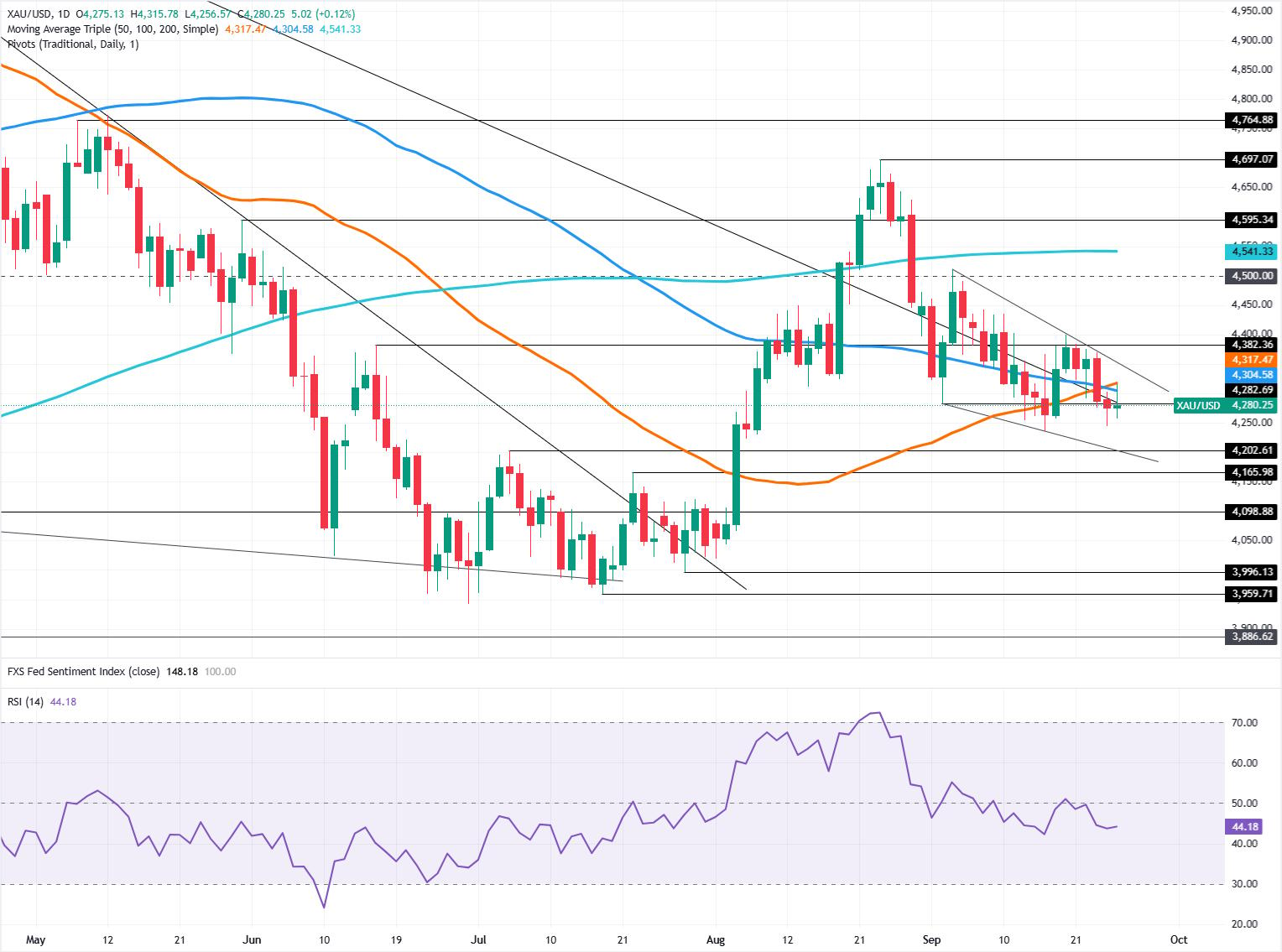
XAU/USD technical analysis: Gold recovers, but stays below $4,300
Price action indicates that Gold bias remains tilted to the downside, despite showing signs of life. XAU/USD trades subdued within a ‘bullish wedge’ pattern, and a failure to decisively clear the 100- and 50-day SMAs, roughly $4,304-$4,312, caps the yellow metal's recovery above $4,300.
Momentum shows that Gold's bearish outlook persists, with the Relative Strength Index (RSI) remaining below the 50 neutral mark. Thus, the most likely direction is downward.
For a bearish continuation, XAU/USD needs to break below the ‘bullish wedge' bottom, around $4,200-$4,210. Doing so would invalidate the pattern and open the path to test the August 3 low of $4,019, with the $4,000 mark in sight.
On the upside, initial resistance for Gold is at $4,300, near the SMAs convergence area, followed by $4,350. The next key level is $4,400.
Gold FAQs
Gold has played a key role in human’s history as it has been widely used as a store of value and medium of exchange. Currently, apart from its shine and usage for jewelry, the precious metal is widely seen as a safe-haven asset, meaning that it is considered a good investment during turbulent times. Gold is also widely seen as a hedge against inflation and against depreciating currencies as it doesn’t rely on any specific issuer or government.
Central banks are the biggest Gold holders. In their aim to support their currencies in turbulent times, central banks tend to diversify their reserves and buy Gold to improve the perceived strength of the economy and the currency. High Gold reserves can be a source of trust for a country’s solvency. Central banks added 1,136 tonnes of Gold worth around $70 billion to their reserves in 2022, according to data from the World Gold Council. This is the highest yearly purchase since records began. Central banks from emerging economies such as China, India and Turkey are quickly increasing their Gold reserves.
Gold has an inverse correlation with the US Dollar and US Treasuries, which are both major reserve and safe-haven assets. When the Dollar depreciates, Gold tends to rise, enabling investors and central banks to diversify their assets in turbulent times. Gold is also inversely correlated with risk assets. A rally in the stock market tends to weaken Gold price, while sell-offs in riskier markets tend to favor the precious metal.
The price can move due to a wide range of factors. Geopolitical instability or fears of a deep recession can quickly make Gold price escalate due to its safe-haven status. As a yield-less asset, Gold tends to rise with lower interest rates, while higher cost of money usually weighs down on the yellow metal. Still, most moves depend on how the US Dollar (USD) behaves as the asset is priced in dollars (XAU/USD). A strong Dollar tends to keep the price of Gold controlled, whereas a weaker Dollar is likely to push Gold prices up.
Recommended Articles


