

Cheaper AI models gain ground as corporate America cuts costs

Source Cryptopolitan

US enterprises are selecting the least expensive AI solution that can perform the job efficiently, rather than automatically opting for the most advanced AI solution available.

This trend has created certain pressure on high prices because the new AI models are eliminating the gap in capabilities while the costs for the tokens are consistently decreasing, according to the Financial Times.

Buying the cheapest model that gets the job done

The essence of the notion is that costly frontier models are required to perform only when necessary and the regular job can be done by inexpensive models, which do the task sufficiently well.

That pattern showed up in Ramp’s September 9 AI Index. Based on August 2026 spending data, 43.8% of US businesses in Ramp’s sample purchased Anthropic products, compared with 39.8% for OpenAI. Ramp also pointed to growing use of cheaper models as a threat to AI companies that rely on businesses steadily spending more on frontier systems.

The trend is also consistent with findings from the OECD’s agentic AI report published in September 2026. Interviews with 25 organizations indicated that cost savings were a common reason for using agentic systems, along with their contribution to higher productivity and addressing labor shortages.

A price war measured in fractions of a penny

The price of models is quickly declining, just as new systems are being introduced.

According to earlier coverage by Cryptopolitan, OpenAI released the GPT-6 Sol and GPT-6 Luna on September 22 with prices at least 50% less than the previous models, GPT-5.6. The GPT-6 Sol costs $2 for every million input tokens and $10 for every million output tokens.

In the same week, Anthropic launched Opus 5.5 while xAI presented Grok 4.7 into a market increasingly driven by price-performance criteria. According to Axios, cheap but still efficient models represent the new competitive race in the industry.

The long-term downward trend is even more astonishing. According to Epoch AI, the price of achieving a constant AI performance level dropped by around 47% on a quarterly basis since 2023, or approximately 13 times yearly.

Cost per finished task matters more

Because of that growing price-based pressure, the metrics by which companies measure success are changing. The importance of benchmark leadership has not diminished, but there is more focus on how much clients need to pay for efficient performance.

The AutomationBench by Zapier tests agents with respect to end-to-end workflows in 47 business tools. As of September 28, Claude Opus 5.5 led the table with 42.47% efficiency with a price of $1.44 per task, while GPT-6 Sol was at 33.2% at XHigh for only $0.27 a task.

The same tradeoff appears in Artificial Analysis. GPT-6 Sol at maximum effort scores 48 on its Intelligence Index at an estimated $1.06 per task. Xiaomi’s open-weight MiMo-V2.6-Pro scores 46 while costing just $0.13 per task.
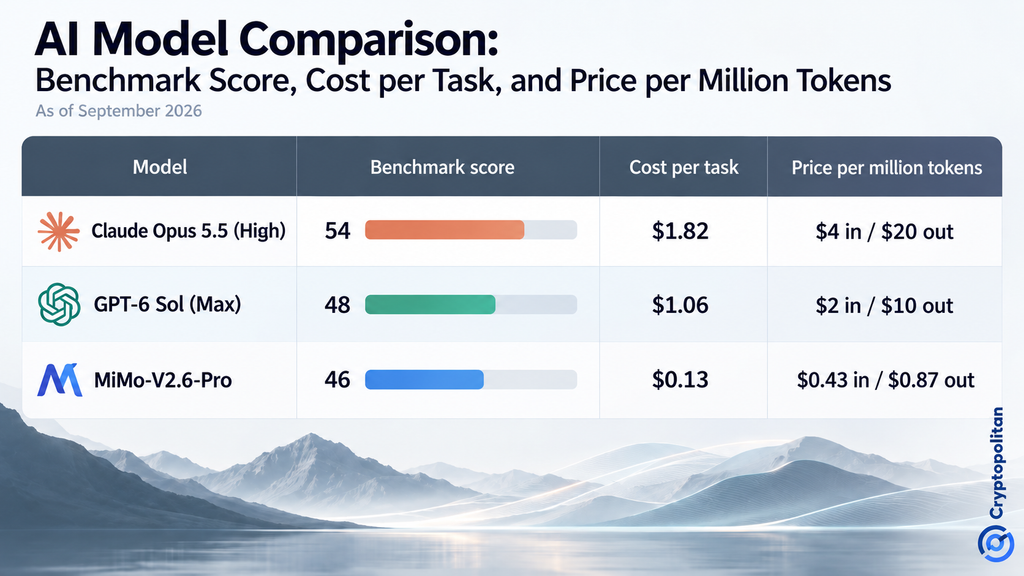
AI Model Cost Comparison: GPT-6 Sol vs Claude Opus 5.5 vs MiMo-V2.6-Pro

That gap is so small that multi-model routing becomes viable. Instead of having to use a single vendor for all workloads, companies have the opportunity to use the right model based on the relative importance and complexity of a task.

Cheaper tokens can still mean bigger bills

Lower prices do not necessarily mean lower AI spending.

According to Axios, the Jevons paradox indicates that more affordable resources lead to their greater consumption. Gartner made a statement similar to the Jevons paradox in its forecast on August 17, where it estimated a more than five-fold rise in the inference cost of agentic workflows by 2028.

Less expensive models can also increase accessibility in other parts of the world as well. According to the Global AI Diffusion Report published by Microsoft, affordable and open models can provide accessibility as well, however, infrastructure, connectivity, and skills will play a vital role in determining those who can take advantage of this.

The demand is growing stronger for corporate buyers: the best AI might not be the smartest AI, but is the kind of AI that does its job efficiently at the lowest cost.

The smartest crypto minds already read our newsletter. Want in? Join them.

Disclaimer: For information purposes only. Past performance is not indicative of future results.
placeholder
October hike odds climb toward 60% as Goldman and BofA both flip — what Warsh's "dose of accommodation" really changedRate futures now price roughly 55% to 62% for a 25bp hike at the October 27-28 FOMC, up from about 30% before Chair Warsh's post-meeting framing that the Fed is merely "removing some accommodation." Goldman Sachs has added an October hike to its forecast and Bank of America now sees moves in both October and December. Here is the repricing, the language behind it, and the two data points that decide it.
Author  Irene Q.
Sep 23, Wed
Rate futures now price roughly 55% to 62% for a 25bp hike at the October 27-28 FOMC, up from about 30% before Chair Warsh's post-meeting framing that the Fed is merely "removing some accommodation." Goldman Sachs has added an October hike to its forecast and Bank of America now sees moves in both October and December. Here is the repricing, the language behind it, and the two data points that decide it.
placeholder
Memory chips surge, Nasdaq notches a second straight record close — why the Dow fell 185 points anywayMicron gained 5%, SanDisk 6.8%, Seagate 4% and Western Digital 3% as the memory complex led the Nasdaq Composite to a second consecutive record close of 27,244.28. But the Dow fell 185 points as JPMorgan, Wells Fargo and Schwab slid more than 3% each — a split tape that says more about positioning than about the economy.
Author  Irene Q.
Sep 23, Wed
Micron gained 5%, SanDisk 6.8%, Seagate 4% and Western Digital 3% as the memory complex led the Nasdaq Composite to a second consecutive record close of 27,244.28. But the Dow fell 185 points as JPMorgan, Wells Fargo and Schwab slid more than 3% each — a split tape that says more about positioning than about the economy.
placeholder
US input costs rose at the fastest pace in four years — the September flash PMI beat is an inflation story, not a growth storyUS September flash PMIs came in far above expectations, with the composite at 58.4, a five-year high. But the detail that moved markets was input cost inflation at its fastest since October 2022, driven by fuel, transport and supply shortages. Brent is back above $100 and the 10-year Treasury yield has hit its highest since 2007.
Author  Suzie
Sep 24, Thu
US September flash PMIs came in far above expectations, with the composite at 58.4, a five-year high. But the detail that moved markets was input cost inflation at its fastest since October 2022, driven by fuel, transport and supply shortages. Brent is back above $100 and the 10-year Treasury yield has hit its highest since 2007.
placeholder
WTI (USOIL) Is down 2.03% on Sep 25: Here Is WhyWTI (USOIL) is down 2.03% at Sep 24 22:20(UTC+0), now at $92.517, with a 7-day down of 3.63%.What is driving WTI (USOIL)’s stock price down today?The drop in WTI crude oil prices was primarily driven by
Author  TradingKey
Sep 25, Fri
WTI (USOIL) is down 2.03% at Sep 24 22:20(UTC+0), now at $92.517, with a 7-day down of 3.63%.What is driving WTI (USOIL)’s stock price down today?The drop in WTI crude oil prices was primarily driven by
placeholder
Four jobs reports in five days: what JOLTS, ADP, claims and the September payrolls mean for the October Fed decisionThe US labour market faces its densest data week of the month. JOLTS job openings land Tuesday (7.2 million expected), ADP on Wednesday (70,000 expected), initial claims on Thursday and the September non-farm payrolls on Friday (100,000 expected, down from 162,000). Markets price a 64%-70% chance of another quarter-point Fed hike on October 28. The dollar index sits at 100.77 and the S&P 500 at 7,729.8.
Author  Mitrade
8 hours ago
The US labour market faces its densest data week of the month. JOLTS job openings land Tuesday (7.2 million expected), ADP on Wednesday (70,000 expected), initial claims on Thursday and the September non-farm payrolls on Friday (100,000 expected, down from 162,000). Markets price a 64%-70% chance of another quarter-point Fed hike on October 28. The dollar index sits at 100.77 and the S&P 500 at 7,729.8.
goTop
quote